Page 1 of 3
Wind tunnels - dumb aero question
Posted: 12 Feb 2014, 12:15
by Mikey_s
Something has been niggling away at me for several years now regarding simulation issues in wind tunnels....
In the tunnel the car is static (although I believe they do spin the wheels) and the 'wind' (air) moves, whereas in real life the air speed is more or less static (relative to the vehicle speed) and it is the car that moves. For the flow above the car I could imagine that this is not so much of an issue, but for simulation of the flow beneath the car I am struggling, from an intellectual perspective, to visualise the flow patterns between the underside of the car and the track surface.
After a long discussion several years back about diffuser models this issue has been going around in my head and I can't get to the bottom of how this could be replicated in the tunnel, even with a belt underneath the car travelling at the same speed as the air stream.
I'm not sure if I'm able to articulate what I'm trying to say here, but the air molecules at the track surface are effectively stationary until the car travels over that piece of asphalt, this seems to me to be a quite different situation to a rapidly moving airstream being 'interfered with' by a static car in the tunnel. If I try to visualise what is happening at a given static spot of the circuit as the vehicle travels over it I have difficulty in translating that to the discussions about Bernoulli and air being accelerated beneath the car to generate low pressure. For a given air molecule that is sitting somewhere above the track surface as the vehicle travels past what happens to that molecule (and the molecules around it) to generate the low pressure? It is evident from the wake turbulence of the cars that there is quite some disturbance and that the air is disturbed by the transit of the car, but I can't translate that to a 'static' molecule (or cluster) suddenly going from stationary to high speed flow as the car passes. That the vehicles generate downforce from the undertray is not at question here.... what I'm struggling with is whether the flow under the vehicle in the wind tunnel is the same as what is occurring on the track.
Can any clever aero chaps enlighten me as to whether I am missing a point here?
Re: Wind tunnels - dumb aero question
Posted: 12 Feb 2014, 13:35
by rscsr
I don't understand what you are trying to tell. Way to long for my taste. Buy I try to explain what I think you don't understand.
It's all a matter of point of view. You just have to get the relative speed of all the surfaces to the air right. The absolute speed is completely irrelevant in such low speeds we are driving at. Otherwise it would make a difference if you are going north or east.
Re: Wind tunnels - dumb aero question
Posted: 12 Feb 2014, 13:42
by rjsa
Re: Wind tunnels - dumb aero question
Posted: 12 Feb 2014, 14:57
by bcoxa
Isn't this a question of, is the car moving or is the world around it moving?
Re: Wind tunnels - dumb aero question
Posted: 12 Feb 2014, 15:00
by Del Boy
The rolling road is travelling the same speed as the air. Therefore it's exactly the same as the car moving just in reverse. The car stationary everything else moving - in reality the car moves everything else is stationary.
It's an interesting subject however as F1 teams use 60% wind tunnels and air doesn't scale. Hence when you make model aircraft you use model profiles for aero surfaces not direct to scale replicas. I believe that's why they use CFD increasingly.
Re: Wind tunnels - dumb aero question
Posted: 12 Feb 2014, 15:06
by tim|away
Aerodynamic theory discusses the motion of air. It doesn't matter whether the air moves relative to a stationary aerodynamic surface, or whether the surface itself moves relative to the air - the interaction between air and surface is the same in both cases.
Re: Wind tunnels - dumb aero question
Posted: 12 Feb 2014, 15:07
by Holm86
I think what he is talking about is that in a windtunnel the air blown at the car has a laminar flow. When a car is driving through the air in the real world its not driving through laminar air. The air is moving in several different directions. Its turbulent, has different temperatures and pressures etc. In a windtunnel the flow hits the car at a perfect angle.
Re: Wind tunnels - dumb aero question
Posted: 12 Feb 2014, 15:25
by CBeck113
what I'm struggling with is whether the flow under the vehicle in the wind tunnel is the same as what is occurring on the track.
Since most if not all teams use rolling roads (nice link, rjsa!), they have pretty accurate conditions similar to the track. In the old-style (static

) chamber, they needed to compensate for the differences in the flow between the car and the surface. For instance, the air moving over the floor in the static chamber creates a boundry layer; this "pressure difference" has to be calculated into the results.
The rolling road also simulates the turbulences caused by the rotating tires, which is even more important.
Re: Wind tunnels - dumb aero question
Posted: 12 Feb 2014, 15:26
by el-Magico
bcoxa wrote:Isn't this a question of, is the car moving or is the world around it moving?
Everything is moving.. not just the world around it

Re: Wind tunnels - dumb aero question
Posted: 12 Feb 2014, 15:43
by Mikey_s
Thanks for the comments so far... and the link, it makes sense to move the substrate.
Having thought a little more about it I just wanted to add a little...
For aero purposes I understand that we should consider the air to be an incompressible fluid. Whilst I (demonstrably!) don't know much about aero, I have done a considerable amount of rheology in the past and I guess what I'm getting at is that the air on the track surface could be considered to be static relative to the road surface. The air passing under the car body is moving at high speed relative to the car itself. In a fluid model this would be analogous to a shear stress being applied to the fluid, where one part of the system is stationary and the other is moving, creating a shear stress across the gap.
I don't know if the air (our fluid in this analogy) is shear sensitive, or behaves as a Newtonian fluid and what the flow condition is from static at the road surface, to fast moving air at the vehicle surface (which it should be if it is generating d/f via the Bernoulli principle.)... or is it static at both the track surface and the car boundary, but moving in between?
Re: Wind tunnels - dumb aero question
Posted: 12 Feb 2014, 16:14
by rjsa
Mikey_s wrote:Thanks for the comments so far... and the link, it makes sense to move the substrate.
Having thought a little more about it I just wanted to add a little...
For aero purposes I understand that we should consider the air to be an incompressible fluid. Whilst I (demonstrably!) don't know much about aero, I have done a considerable amount of rheology in the past and I guess what I'm getting at is that the air on the track surface could be considered to be static relative to the road surface. The air passing under the car body is moving at high speed relative to the car itself. In a fluid model this would be analogous to a shear stress being applied to the fluid, where one part of the system is stationary and the other is moving, creating a shear stress across the gap.
I don't know if the air (our fluid in this analogy) is shear sensitive, or behaves as a Newtonian fluid and what the flow condition is from static at the road surface, to fast moving air at the vehicle surface (which it should be if it is generating d/f via the Bernoulli principle.)... or is it static at both the track surface and the car boundary, but moving in between?
While considering air incompressible (that if memory serves me is good up to mach 0.3, which is the upper limit of a F1 operarting envelope) all the laws and equations rulling the flow are the same as liquids. So yes, there is shear involved and trasition form laminar to turbulent will reflect reynolds number aswell.
Re: Wind tunnels - dumb aero question
Posted: 12 Feb 2014, 19:47
by flyboy2160
rjsa wrote:Rolling Road:...
Note the perforated plate just ahead of the rolling road. It's almost certainly to bleed off the boundary layer that has built up on the non-rolling part of the tunnel floor ahead of the rolling road.
Re: Wind tunnels - dumb aero question
Posted: 17 Feb 2014, 13:31
by FW17
The rules are clear that only 60% models can be used for aero testing
but
can a full scale thermal tunnel be used with engines fired up to validate the engine and cooling package?
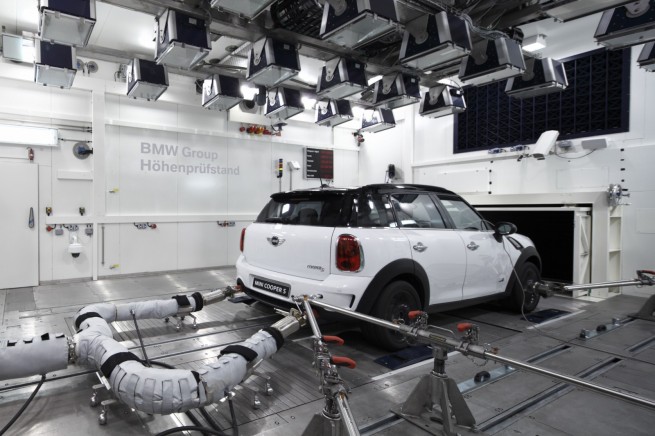
Mahle has one such facility wonder if F14T used it
Re: Wind tunnels - dumb aero question
Posted: 17 Feb 2014, 16:12
by Tik
Thermal tunnel? Well, you learn something new everyday

Re: Wind tunnels - dumb aero question
Posted: 18 Feb 2014, 01:50
by Manoah2u
Holm86 wrote:I think what he is talking about is that in a windtunnel the air blown at the car has a laminar flow. When a car is driving through the air in the real world its not driving through laminar air. The air is moving in several different directions. Its turbulent, has different temperatures and pressures etc. In a windtunnel the flow hits the car at a perfect angle.
i was thinking the same, offcourse a windtunnel brings a close representation of reality, however, the fact remains that
there is an enforced stream of air powered to the car, whilst in fact in real life, there is no wind 'aimed' at the car, the car
breaks the wind, and indeed, wind can come from several directions.
a windtunnel does provide a good representation of how it 'cuts' through air, which is offcourse important [otherwise there would not be so much invested].
the fact that windtunnel testing is very tricky is that ferrari last year made various parts that in the windtunnel performed like they were hoping, but in real life didn't provide the same results.