Page 1 of 4
The Chrysler Turbine History
Posted: 23 Feb 2014, 13:19
by Sombrero
Re: The Chrysler Turbine History
Posted: 23 Feb 2014, 16:54
by flynfrog
One of my favorites
http://www.allpar.com/mopar/turbine.html
http://www.allpar.com/mopar/turbine-photos.html
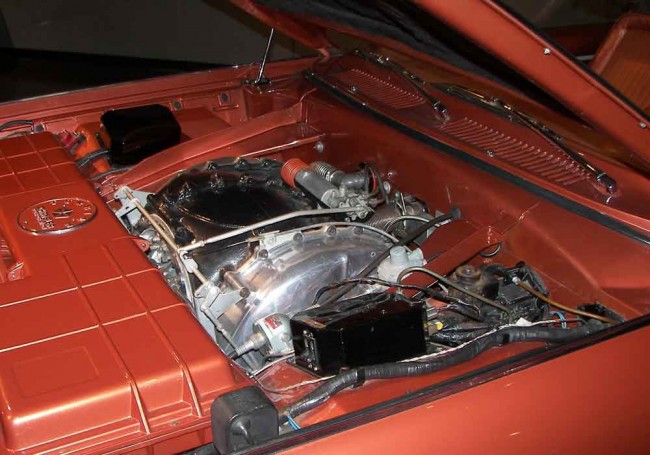
I have some pictures of the one present in the Henry Ford Museum but as high as the nose is it looks like the engine has been pulled.
Re: The Chrysler Turbine History
Posted: 23 Feb 2014, 23:25
by WhiteBlue
Turbines are for aircraft and not for land vehicle. The technical history of the 20th century has proven that over and over. The only thing that turbines do well is the power to weight ratio. In every other category they are being outdone by turbocharged piston engines. This is particularly true for the most important discipline of fuel efficiency. Turbo diesels have been beating turbines in all thinkable land transport applications from passenger car over truck to havy tanks. Turbines aren't frugal and robust enough to compete. Full stop.
Re: The Chrysler Turbine History
Posted: 24 Feb 2014, 00:07
by zonk
The Jaguar C-X75, the concept that debuted at the 2010 Paris Motor Show, is an electric hybrid that uses two small gas-powered turbines to generate electricity when the battery is low. Looking at the stats, it’s an impressive ride: an estimated fuel economy of 41.1 mpg, 778 horsepower, 0 to 62mph in 3.4 seconds, and a top speed of 205 mph.
Link to a page with Rover tubine powered cars:
http://www.rover.org.nz/pages/jet/jet5.htm
Re: The Chrysler Turbine History
Posted: 24 Feb 2014, 01:17
by Richard
WhiteBlue wrote:Turbines are for aircraft and not for land vehicle. .... Full stop.
I agree that's been true date for mechanical connection to the wheels, but as zonk points out there are other methods that could be effective for converting combustion to propulsion.
Re: The Chrysler Turbine History
Posted: 24 Feb 2014, 04:28
by flynfrog
Re: The Chrysler Turbine History
Posted: 24 Feb 2014, 04:32
by flynfrog
How about some race cars
The granatelli turbine car. Should have won indy had a bearing in the driveline fail with a few laps to go.
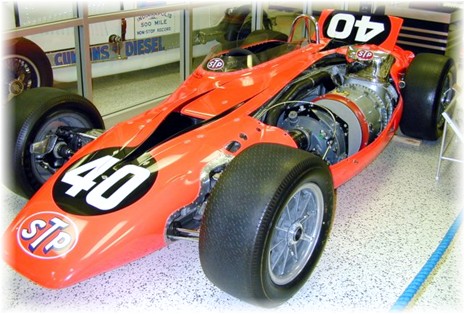
Lotus Turbine

Re: The Chrysler Turbine History
Posted: 24 Feb 2014, 04:45
by flynfrog
Re: The Chrysler Turbine History
Posted: 24 Feb 2014, 15:01
by WhiteBlue
Using a turbine as extender is not a novel application in my view. And we have to ask ourselves why it only works in a concept car and not in an application like the BMW i8.
http://www.bmw.de/de/neufahrzeuge/bmw-i ... trieb.html
Re: The Chrysler Turbine History
Posted: 24 Feb 2014, 18:29
by autogyro
They cannot get the small turbine generators to work efficiently and safely within a sensible budget.
Re: The Chrysler Turbine History
Posted: 24 Feb 2014, 18:47
by Sombrero
Re: The Chrysler Turbine History
Posted: 24 Feb 2014, 19:32
by WhiteBlue
autogyro wrote:
They cannot get the small turbine generators to work efficiently and safely within a sensible budget.
That is one theory which I do not discard. But to me it seems to be pretty fundamental that you do not get sufficient fuel efficiency in a wheeled or tracked vehicle from a turbine. If you have an application like a race car where you can use the power to weight ratio to some advantage you may get away with that in an appropriate formula. For general road use I think you don't stand a chance. You will not get a road going turbine to 45% BTE but you can achieve that with turbo charged piston engines. The fact that the engine is a bit lighter is compensated by the higher fuel load you have to carry for the same reach. So in the end the manufacturers will pretty much always select the more fuel efficient and cheaper to produce propulsion unit.
Re: The Chrysler Turbine History
Posted: 24 Feb 2014, 20:12
by Richard
How much of this is down to the decades of R&D for turbo-piston engines compared to the much more immature turbine?
The emergence of electric propulsion creates a market where turbine range extenders might be viable because we'd be looking for engines for optimal electricity generation not mechanical propulsion.
Re: The Chrysler Turbine History
Posted: 24 Feb 2014, 20:41
by WhiteBlue
richard_leeds wrote:How much of this is down to the decades of R&D for turbo-piston engines compared to the much more immature turbine?
I don't think you can make that claim with good justification. The aero industry has sunk billions into making turbines more efficient.
Re: The Chrysler Turbine History
Posted: 24 Feb 2014, 20:57
by Richard
A range extending turbine is on a different scale with different operating criteria compared to a jet engine on a plane. If we're going for comparisons like that, one could say it is telling that turbines are used for generating electricity in power stations, not piston engines. Anyway, I'm not sure that is particularly helpful.
The idea is to decouple the engine from mechanical propulsion so it is merely mobile electricity generator. That's a configuration that's not been developed so it could well lead to engine configurations that we've not seen before, or previously dismissed.