Page 1 of 1
Kart steering geometry - why is toe in mm?
Posted: 23 May 2014, 11:09
by SidSidney
Hi
I am playing around with toe and camber setting on my shifter and realised that the whole 1-2mm toe-in/out measure is a bit indistinct.
A degree / angular measure is more precise as it doesn't rely on a relative distance from one part of the tyre or rim.
So I wonder why the mm unit is used so often in karting, and if there is a de facto measurement point like the rim, to say 1mm toe in here = 1 mm toe in there?
Also toe is measured as the delta between the distance between the two points at front and rear of the wheel - so is 1mm toe just one side of the wheel or the combined delta between the two measurements, or combined across the whole front wheelbase or something else? So indistinct....
I would be much happier with degrees!
Sid
Re: Kart steering geometry - why is toe in mm?
Posted: 23 May 2014, 13:21
by Jersey Tom
It's just a preference, I've seen it done both ways (angle or length). If it's your kart you can write your setup sheet however you want!
While keeping your notebook as toe in degrees is perhaps less ambiguous it's not necessarily more precise. Ultimately, seeing a car up with a string and tape measure.. you're going to be using length measurements to set the toe. Recording toe as a length measurement saves a step of converting back and forth to degrees.
"Standard" process would probably be total difference front to rear of the rim. But again, if it's your kart or car or whatever - you can pick whatever method you want.
Re: Kart steering geometry - why is toe in mm?
Posted: 23 May 2014, 16:36
by SidSidney
Jersey Tom wrote:It's just a preference, I've seen it done both ways (angle or length). If it's your kart you can write your setup sheet however you want!
While keeping your notebook as toe in degrees is perhaps less ambiguous it's not necessarily more precise. Ultimately, seeing a car up with a string and tape measure.. you're going to be using length measurements to set the toe. Recording toe as a length measurement saves a step of converting back and forth to degrees.
"Standard" process would probably be total difference front to rear of the rim. But again, if it's your kart or car or whatever - you can pick whatever method you want.
You are quite right, it's probably more precise in terms of absolute measurement, as 1mm is equal to about an 8th of a degree at my tyre rim. I just wonder when people say "you need about 1-2mm of toe" where do you measure that from and to? Front of rim? Front of tyre? Front minus rear of either/both?
In the end you need what works in terms of setup, but if transfering information from one person/kart to another it's potentially a problem unless the measurement point is also defined I guess?
Re: Kart steering geometry - why is toe in mm?
Posted: 24 May 2014, 00:47
by Jersey Tom
SidSidney wrote:I just wonder when people say "you need about 1-2mm of toe" where do you measure that from and to? Front of rim? Front of tyre? Front minus rear of either/both?
Ask yourself this - what's going to be the most simple and practical way to be measuring and setting toe when working on a car? That's how most guys are going to be doing it. I'd give it 90% chance if someone says "2 mm of toe" it's difference front of rim to rear of rim. Simple as that - because that's the only consistent thing you can measure to.
Re: Kart steering geometry - why is toe in mm?
Posted: 24 May 2014, 03:17
by Ciro Pabón
... not to mention that to measure 1/8 of a degree you need a precision tool. On the other hand you can measure 1 mm with very simple tools. It's much harder to measure angles than distances. Yeah, I know you can convert from one to the other, as Tom points out (hi, Tom!), but that's not your question. Believe me, I'm old enough to have used theodolites...
Using nonius (vernier) you can measure up to 1 minute of arc (that's around 10% error for 1 mm of toe, from the top of my head) with this thing
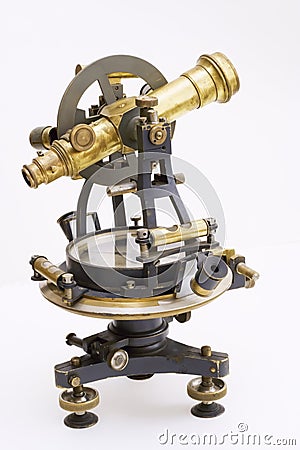 Sorry for the vernier gif... I couldn't resist: this is one of the smartest things I know

Besides, when you measure an angle using a plane that touches the bottom and the top of rim (which, given the shape of rims it's the only way you can do it) you're introducing errors that come from the entire shape of the wheel, while when you measure only the distance from the rim to a fixed point in the chassis you can average in an easier way the irregularities the rim could (will) have simply by turning the wheel around its axle.
Finally, to measure angles you need a
vertical reference. That's not always easily done and introduces another source of errors, because
on this Earth the vertical is never vertical. It's much more repeatable to measure a distance to a point in the chassis than to measure an angle to vertical.
The Earth is round... or not

Repeatability is very important: after all, you're not interested in getting 0.125 degrees of toe because that some kind of tolerance you have to follow (as when you're building an engine, for example): you're interested in dialing
the same toe you had in your last race, when you won.
So, 1 mm it is.
Re: Kart steering geometry - why is toe in mm?
Posted: 24 May 2014, 10:31
by autogyro
Try it with three drivers of different weights I dare you

Tracking gauges with mirrors for cars are notoriously inaccurate.
I always used front and rear rim to rim measure.
If you measure to a chassis fixed point you halve the size of the measurement and have less accuracy.
For rapid checks (rallying in the field or to check crash damage) I kept a piece of two by one batten to place against the rear rim so as to check the toe on the front rim. (needs blocks with bulging tyres)
Toe is good adjustment for set up missed by many.
Re: Kart steering geometry - why is toe in mm?
Posted: 24 May 2014, 20:50
by simieski
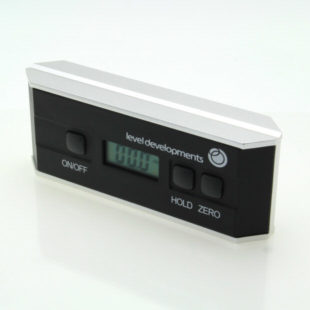
We typically use one of these for angular measurements when rigging aircraft flying controls. Very fast, simple and accurate as long as you have a repeatable datum for zeroing it. Could this be of any use?
Re: Kart steering geometry - why is toe in mm?
Posted: 25 May 2014, 04:00
by Jersey Tom
simieski wrote:http://www.leveldevelopments.com/wp/wp- ... 10x310.jpg
We typically use one of these for angular measurements when rigging aircraft flying controls. Very fast, simple and accurate as long as you have a repeatable datum for zeroing it. Could this be of any use?
I'm guessing that doesn't work for angles in yaw (for lack of a better term), e.g. steering the tires, and is instead designed for angles relative to ground.