Page 1 of 2

Contolling Dive...

Posted: 22 Jun 2006, 08:31
by karkai6
F1 cars have an anti roll bar to control roll... but is there an anti dive bar to control dive durin accl. and brakin? nobody talks abt it much...

Posted: 22 Jun 2006, 10:23
by kilcoo316
They have anti-dive geometry built into the front suspension [and anti-squat for the rear too].

The geometry will use the enourmous horizontal forces from braking against the tendancy of the car to nose-down. [and opposite for squat]


(I think :oops: :lol: )

Posted: 22 Jun 2006, 10:29
by manchild
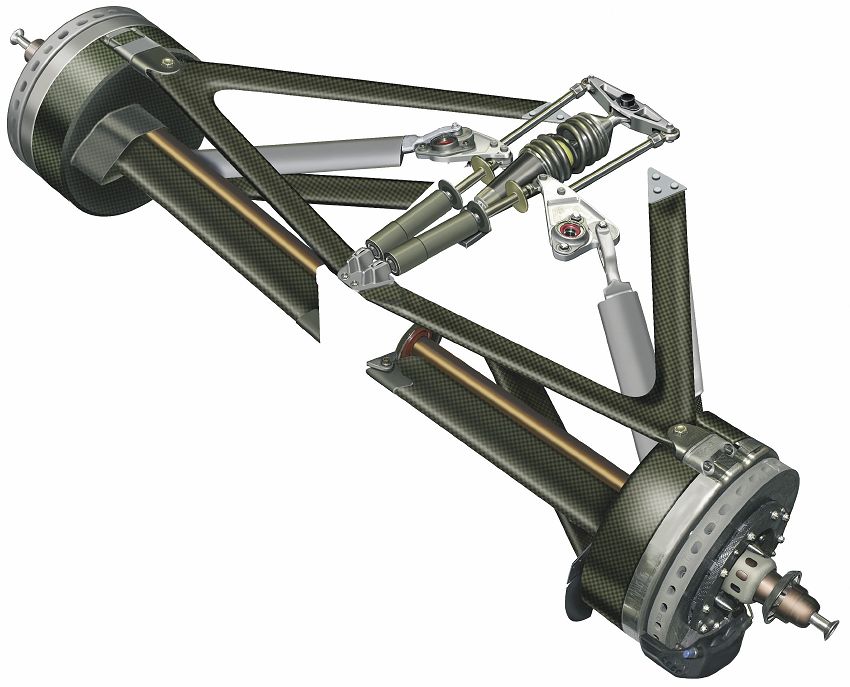
I think that's what 3rd spring/damper is used for (among other things).

Image

Posted: 22 Jun 2006, 18:41
by Ciro Pabón
I do not know if this thread seems relevant to karkai (do not give up on the first page of the thread).

Posted: 25 Jun 2006, 04:58
by Lukin
F1 Engineers love the third spring arrangement as it helps maintain ride heights without requiring steel blocks for springs.

One thing to remember is the wheelbase is usually 1.4-1.8 times bigger than the track so the weight transfer under longitudinal acceleration (even when the braking acceleration is bigger) will generally be smaller, requiring less effective 'rate' from an anti-pitch bar than would be required from an anti-roll bar.

Posted: 25 Jun 2006, 05:19
by DaveKillens
As kilcoo316 said, the geometry of the suspension is altered to deal with the front end dive under braking. If you left that task to the third spring, it would bottom out immediately under braking, leading to many problems.. lockup, broken suspensions, incredible forces transmitted to the drivers.
Just by moving the location of the A-arm locations, you can alter the braking dive characteristics, even design the front end to rise if you desire. The drawback is that the more anti-dive you put in, the wheel will move forward more as it moves up. With the smooth track surfaces, low suspension travel, and high aspect ratio tires, this is not really a bother.
What we have now is slight front end dive, just enough to allow the front wing to come very close to the road surface, giving maximum downforce under braking. This is a dynamic condition, and of course, at rest, the front wing is high enough to pass the minimum distance to the road as specified by the FIA's rules.

Posted: 25 Jun 2006, 05:25
by Ciro Pabón
DaveKillens wrote:Just by moving the location of the A-arm locations, you can alter the braking dive characteristics, even design the front end to rise if you desire. The drawback is that the more anti-dive you put in, the wheel will move forward more as it moves up.
DaveKillens, long time no see... good to see you around. A favor: do you know any reference or have any link at hand to try to understand how this work? Thanks in advance.

Posted: 26 Jun 2006, 03:56
by flynfrog
Ciro Pabón wrote:
DaveKillens wrote:Just by moving the location of the A-arm locations, you can alter the braking dive characteristics, even design the front end to rise if you desire. The drawback is that the more anti-dive you put in, the wheel will move forward more as it moves up.
DaveKillens, long time no see... good to see you around. A favor: do you know any reference or have any link at hand to try to understand how this work? Thanks in advance.
http://www.rqriley.com/images/fig-13.gif
not how the uper arms is not parall to the bottom

think of rolling a log up a hill but as you brake the hill push down harder

ok bad explanation but maybe the pics will help

Posted: 26 Jun 2006, 04:10
by DaveKillens
This sort of explains how anti-dive geometry works.
http://www.circletrack.com/techarticles/80727/
Most of what I describe came from the books I have read. I suggest Paul Van Valkenburgh's excellent book "Race Car Engineering & Mechanics " as a starting point.
http://www.amazon.com/gp/product/155788 ... e&n=283155

Posted: 26 Jun 2006, 04:42
by DaveKillens
Buenos dias, Ciro, I must apologize for my seeming cold indifference.
This is too nice a forum with such wonderful people to treat them with anything less than respect and warmth.

Posted: 26 Jun 2006, 06:03
by flynfrog
aww lets all hug :wink:

Posted: 26 Jun 2006, 06:33
by effuno
flynfrog wrote:
http://www.rqriley.com/images/fig-13.gif
not how the uper arms is not parall to the bottom

does the slanted arm not cause considerable aero drag in F1 cars?

Posted: 26 Jun 2006, 12:18
by RH1300S
effuno wrote:
flynfrog wrote:
http://www.rqriley.com/images/fig-13.gif
not how the uper arms is not parall to the bottom

does the slanted arm not cause considerable aero drag in F1 cars?
You can arrange the geometry to provide anti-dive - there is no reason to say you can't set the arms at a neutral angle of attack. Also, that sketch is quite exaggerated - the angle will be a lot smaller. The F1 car has a very low CofG and anti-dive geometry works through the CofG.

Posted: 26 Jun 2006, 19:24
by mep
Most of what I describe came from the books I have read. I suggest Paul Van Valkenburgh's excellent book "Race Car Engineering & Mechanics " as a starting point.
http://www.amazon.com/gp/product/155788 ... e&n=283155
I always wonder if I should buy Race Car Vehicle Dynamics
from William F. Milliken, Douglas L. Milliken.
But it's realy expensive and I don't know whether I'll understand it because it's written in english.
May somebody help me.

Posted: 26 Jun 2006, 20:34
by RacingManiac
mep wrote:
Most of what I describe came from the books I have read. I suggest Paul Van Valkenburgh's excellent book "Race Car Engineering & Mechanics " as a starting point.
http://www.amazon.com/gp/product/155788 ... e&n=283155
I always wonder if I should buy Race Car Vehicle Dynamics
from William F. Milliken, Douglas L. Milliken.
But it's realy expensive and I don't know whether I'll understand it because it's written in english.
May somebody help me.
Race Car Vehicle Dynamic is really THE book on the subject, and it is literally a text book. It is not easy to understand by any means, but it is usually the last word for many issues with the regards to vehicle dynamic. However to start out on the subject, Paul Van Valkenburgh's book, or Carroll Smith's "To Win" series(Tune to win in particular) is the most recommanded on the subject for someone with limited background.