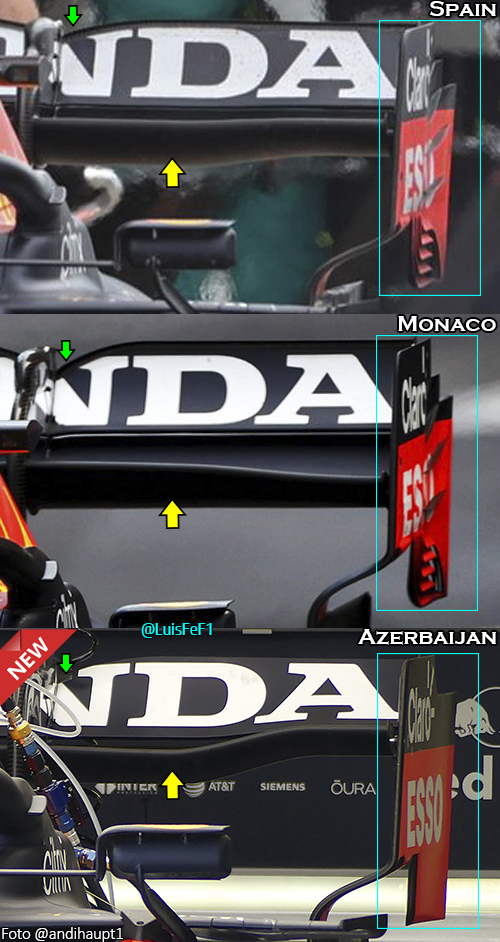
Rear wing and endplate interaction
Posted: 08 May 2021, 13:43
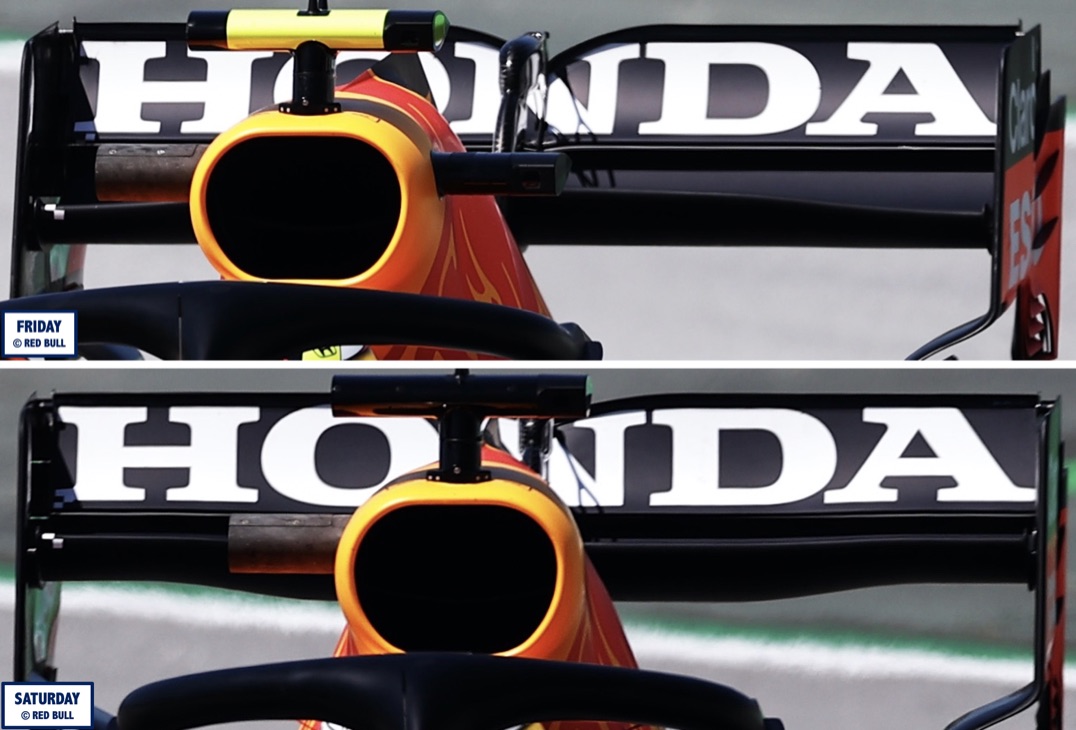
The retraction boundary layer chokes the underside of the high DF rear wing. The spoon one avoids this because there's more space for the retraction boundary layer.
The retraction is the angled part of the endplate that points towards the center of the car.
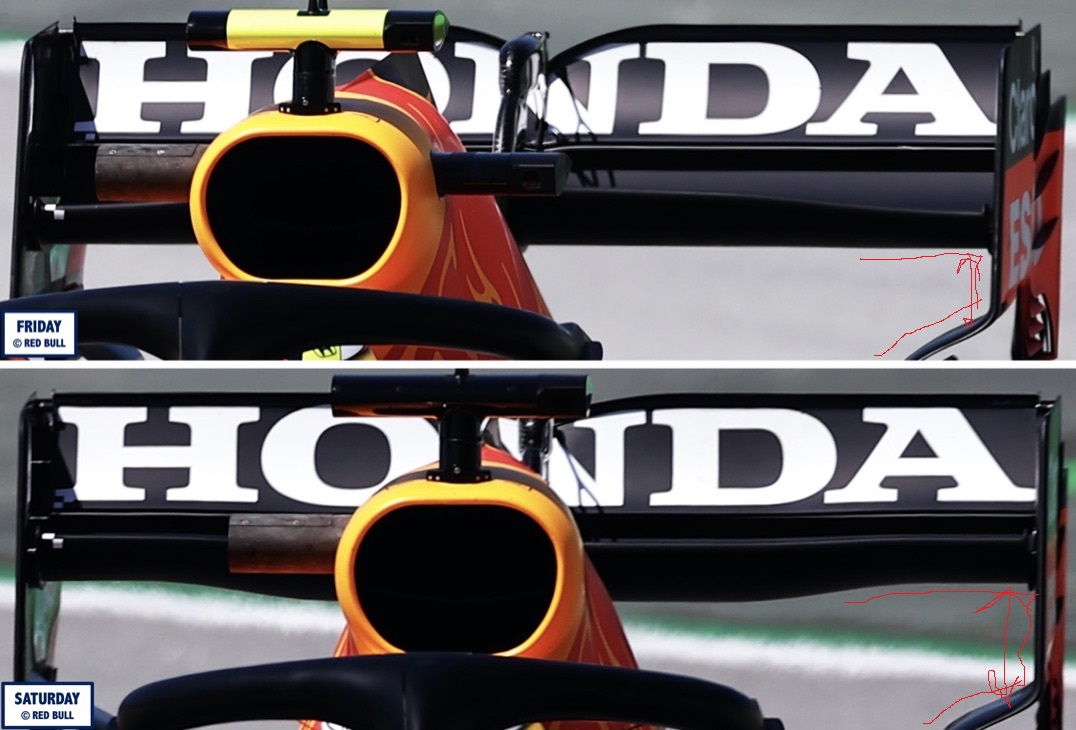
Does that mean that they won't really be able to run the high downforce rear wing and get the full benefit unless they make some changes to it?godlameroso wrote: ↑08 May 2021, 20:43The retraction is the angled part of the endplate that points towards the center of the car.
Notice the high downforce rear wing is closer to that part of the end plate.
The air that flows over the end plate retraction creates a boundary layer that was interfering with the airflow of the main element on the rear wing. The spoon shaped wing has a larger distance between the end plate retraction and main plane. Thus the boundary layers of each surface interact less.
https://files.catbox.moe/a2u1rf.jpg
It means when they get the high downforce wing working, it'll be a nice upgrade.SiLo wrote: ↑09 May 2021, 01:23Does that mean that they won't really be able to run the high downforce rear wing and get the full benefit unless they make some changes to it?godlameroso wrote: ↑08 May 2021, 20:43The retraction is the angled part of the endplate that points towards the center of the car.
Notice the high downforce rear wing is closer to that part of the end plate.
The air that flows over the end plate retraction creates a boundary layer that was interfering with the airflow of the main element on the rear wing. The spoon shaped wing has a larger distance between the end plate retraction and main plane. Thus the boundary layers of each surface interact less.
https://files.catbox.moe/a2u1rf.jpg
I think you should start again at the basic theory of boundary layers if you forgot or did not read it before. I am not going to assume you haven't!godlameroso wrote: ↑08 May 2021, 20:43The retraction is the angled part of the endplate that points towards the center of the car.
Notice the high downforce rear wing is closer to that part of the end plate.
The air that flows over the end plate retraction creates a boundary layer that was interfering with the airflow of the main element on the rear wing. The spoon shaped wing has a larger distance between the end plate retraction and main plane. Thus the boundary layers of each surface interact less.
https://files.catbox.moe/a2u1rf.jpg
Mercedes makes them canted downwards to increase the expansion of air at the end plates. And it's also more inline with the counter rotating vortecies shed by the floor. Those counter rotating vortecies are traveling downward at the endplates when looking at the car from behindPhillipM wrote: ↑09 May 2021, 01:35The staggered underplates these days have very little to do with that, the endplates already cause far more slowing and disruption to the flow as it is, the real reason is the effective aspect ratio is much closer to ideal in the centre of the wing than by the endplates, you start getting a lot of spanwise flow near the plates unless it's controlled.
The outer mounts make little difference, most teams have them canted vertically slightly to actually direct airflow there, there's actually less 'blockage' than there was with the old vertical mounts.
What are you talking about?

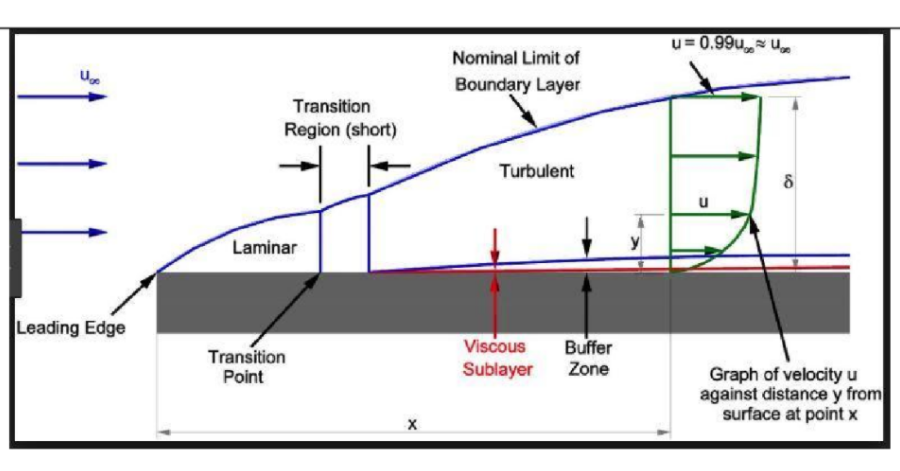
Based on flat plate theory, those BL are no more than a few cm thick ( may be lesser) and by your logic I still fail to see how the spoon wing is further from the endplate. The central part is closer . There would be a redistribution of pressure overall in that region, but I don't see how BL would interact given the distance.godlameroso wrote: ↑08 May 2021, 20:43The retraction is the angled part of the endplate that points towards the center of the car.
Notice the high downforce rear wing is closer to that part of the end plate.
The air that flows over the end plate retraction creates a boundary layer that was interfering with the airflow of the main element on the rear wing. The spoon shaped wing has a larger distance between the end plate retraction and main plane. Thus the boundary layers of each surface interact less.
https://files.catbox.moe/a2u1rf.jpg
That makes it even worse for you. The race car wing boundary layers are only a few milimeter thick at worse (assuming no stall).godlameroso wrote: ↑09 May 2021, 02:23I will guide you my friend, we go on an adventure together. What you say about wings is true, if and only if, the leading edge is relatively flat to oncoming air. F1 wings are NOT relatively flat to oncoming air, they expose the underside of the leading edge making it a high pressure surface with a thick boundary layer. This is because curving the leading edge of the underside upwards increases the strength of the trailing edge suction side. All F1 wings are scoops, the leading edge has a lip that curves upward. This is to channel more airflow to the low pressure side as that is the MOST important side of the wing.
Fluttering changes the boundary layer, a surface boundary layer changes significantly depending on how that surface interacts with air. In any case, looks like RBR were able to improve their rear wing by increasing the gap between the end plate retraction and the main plane. Will be interesting to see where else they race their new wing.PlatinumZealot wrote: ↑10 May 2021, 05:08That makes it even worse for you. The race car wing boundary layers are only a few milimeter thick at worse (assuming no stall).godlameroso wrote: ↑09 May 2021, 02:23I will guide you my friend, we go on an adventure together. What you say about wings is true, if and only if, the leading edge is relatively flat to oncoming air. F1 wings are NOT relatively flat to oncoming air, they expose the underside of the leading edge making it a high pressure surface with a thick boundary layer. This is because curving the leading edge of the underside upwards increases the strength of the trailing edge suction side. All F1 wings are scoops, the leading edge has a lip that curves upward. This is to channel more airflow to the low pressure side as that is the MOST important side of the wing.
They wont interfere as you say.
Look at the little flip ups.. Look at the gaps between the front wings. Imagine if the boundary layers were large things? Madness!
So best thing to do is go back to the fundamental theory and check again. Or do a simulation.
CFD sims i used to do the boundary layer is such a fine thing i coudlnt even set it up in my software. Dont ask me about ansys because i remember nothing. But its not this big giant thing that you imagine.
See how close the F1 floor gets to the road. And look at the space in the little gills at the rear of the diffuser. You can just think about it and use ur senses to see that these devices wont work if they had thick boundary layers stuffed up bentween them. Easy reasoning. Nothing to calculate.