Page 1 of 3
Venturi vs flat floor
Posted: 27 Apr 2025, 15:09
by hsg
<Mod edit>: A few posts have been moved here form the Ferriri team thread, as they were not really about Ferrari, just happen to use one as an example.
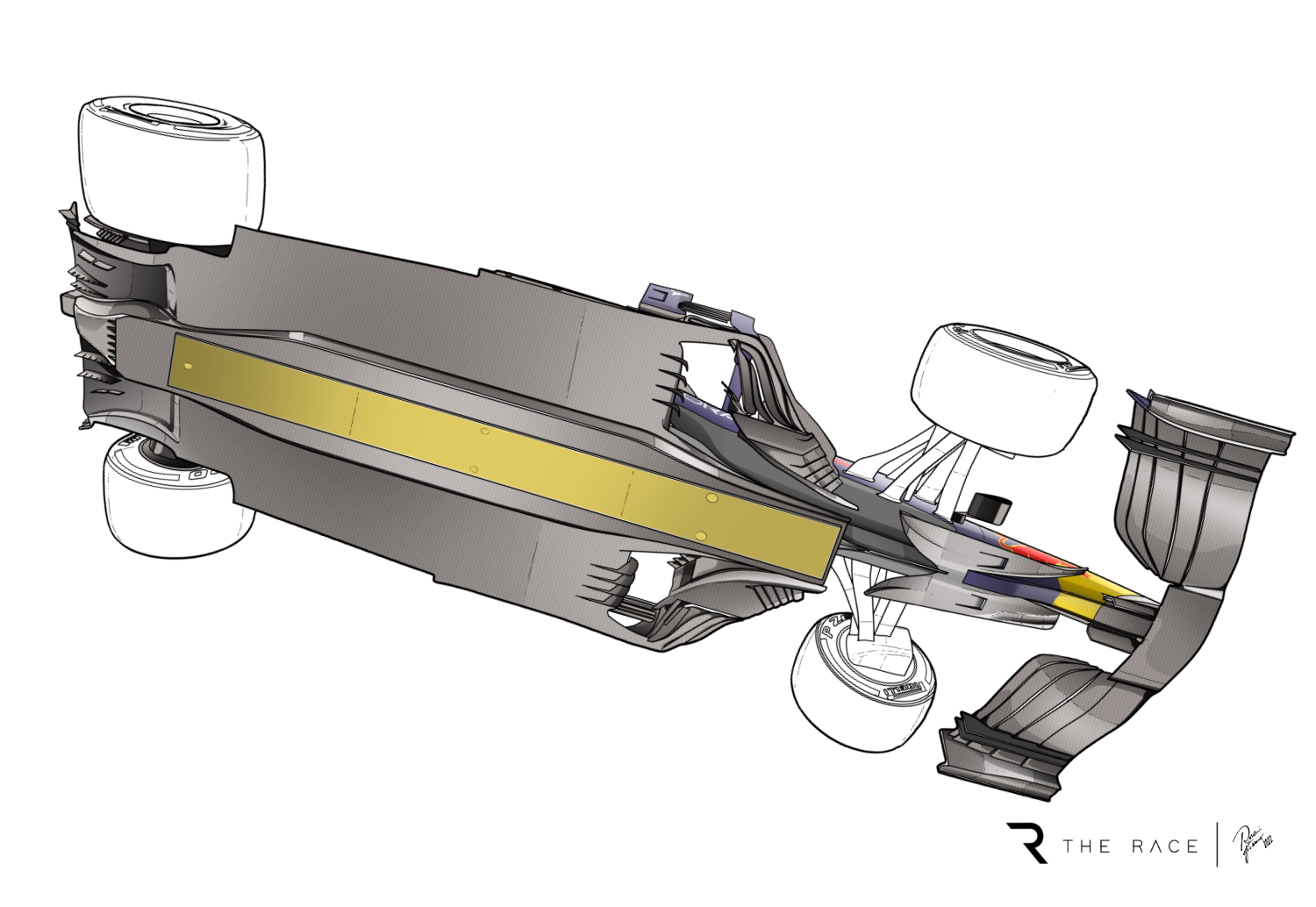
1. How such a small intake can feed all floor with air?
2. Air move from small volume(intake) to huge floor volume, so air must decelerate by Bernulli, so how this works, how this accelerate flow if we increase volume?
3. Are these fences here because of rules or because they are optimal solution for this floor, why F1 flat floor didnt use this outwash fences?
Can someone explain this?

Venturi vs flat floor
Posted: 27 Apr 2025, 16:08
by dialtone
hsg wrote:1. How such a small intake can feed all floor with air?
2. Air move from small volume(intake) to huge floor volume, so air must decelerate by Bernulli, so how this works, how this accelerate flow if we increase volume?
3. Are these fences here because of rules or because they are optimal solution for this floor, why F1 flat floor didnt use this outwash fences?
Can someone explain this?
Aero is not my field of engineering but… the car is moving so the fact that air would decelerate for Bernoulli doesn’t mean much at the speed the car is going, what matters is that it creates an area of extreme low pressure.
The other important factor is that you want to control that pressure making sure its peak suction happens at the right spot, and that it respects certain stability parameters as the car rolls, changes height and moves around.
Those fences are helpful to make sure the right amount of airflow gets under the car, which again is a dynamic platform, and help with managing the airflow on the edge of the floor and tire squirt. The volume of air flowing there isn’t just what is at the fence, there’s the area below the fences for example, and the airflow is that section times the speed of the car, and at high speed that’s a lot of air to manage still.
At least this is how I understand it.
Venturi vs flat floor
Posted: 27 Apr 2025, 17:33
by hsg
Is reason rules or aerodynamics?
Re: Venturi vs flat floor
Posted: 27 Apr 2025, 17:41
by Silent Storm
Old cars had bargeboards...
Re: Venturi vs flat floor
Posted: 27 Apr 2025, 18:05
by hsg
Silent Storm wrote: ↑27 Apr 2025, 17:41
Old cars had bargeboards...
Does race cars with flat floor use outwash fences?
Re: Venturi vs flat floor
Posted: 27 Apr 2025, 18:23
by Silent Storm
hsg wrote: ↑27 Apr 2025, 18:05
Silent Storm wrote: ↑27 Apr 2025, 17:41
Old cars had bargeboards...
Does race cars with flat floor use outwash fences?
cant find any photo, expect 911
I could dig through examples and spend time explaining, but based on how you’ve handled previous replies, it would be a complete waste of effort...
I’m not here to hold anyone’s hand. If you’re serious, you’ll do your own research. Good luck.
Re: Venturi vs flat floor
Posted: 27 Apr 2025, 18:56
by Sevach
hsg wrote: ↑27 Apr 2025, 17:33
Why old car with flat floor didnt have outwash fences at inlet of floor, something that today cars have?
Is reason rules or aerodynamics?
If you put a canard guiding the air towards the outside the floor would not be flat anymore and would be illegal.
Even then teams still ran vestigial fences at the floor leading edge trying to smooth the air flow
Venturi vs flat floor
Posted: 27 Apr 2025, 19:42
by ringo
hsg wrote: ↑27 Apr 2025, 15:09
1. How such a small intake can feed all floor with air?
2. Air move from small volume(intake) to huge floor volume, so air must decelerate by Bernulli, so how this works, how this accelerate flow if we increase volume?
3. Are these fences here because of rules or because they are optimal solution for this floor, why F1 flat floor didnt use this outwash fences?
Can someone explain this?
https://i.ibb.co/Xxd6S1Pm/FQ9-9-Rl-WUAYLMNA.jpg
Density is changing. The air is compressible and expandable. Bernoulli in simple terms assumes no density changes for basic fluid flow, and no changes in internal energy. So simple Bernoulli cannot apply to the analysis.
The flow theories are a combination of fluid dynamics and thermodynamics.
As for point #3, I havent read the ground effect era technical regs in detail, and I also asked that question. The vanes are positioned differently among the teams, but are generally of similar number and shape.
Re: Venturi vs flat floor
Posted: 27 Apr 2025, 20:26
by hsg
Sevach wrote: ↑27 Apr 2025, 18:56
hsg wrote: ↑27 Apr 2025, 17:33
Why old car with flat floor didnt have outwash fences at inlet of floor, something that today cars have?
Is reason rules or aerodynamics?
If you put a canard guiding the air towards the outside the floor would not be flat anymore and would be illegal.
Even then teams still ran vestigial fences at the floor leading edge trying to smooth the air flow
https://storage.googleapis.com/the-race ... -floor.jpg
You want to say if they are allowed to use outwash fences on flat floor, they will use it?
Venturi vs flat floor
Posted: 27 Apr 2025, 20:31
by hsg
ringo wrote: ↑27 Apr 2025, 19:42
Density is changing.
Yes in super sonic flow, in subsonic effect is minimal.
Re: Venturi vs flat floor
Posted: 27 Apr 2025, 22:09
by ringo
No it is not minimal.
A lot his happening under the car outside of basic flow equations, with energy of the flow, density, pressure etc.
A density change happens very easily. Remember with the F-1 car the body of the car is working the air.
The car is squashing the air head on underneath it. You will have density changes quite easily far away from anything supersonic.
The car rams the air through that section between the vane and the body, then the air expands and density will drop in this case as the molecules open out into the bigger volume.
Re: Venturi vs flat floor
Posted: 28 Apr 2025, 01:35
by Sevach
hsg wrote: ↑27 Apr 2025, 20:26
Sevach wrote: ↑27 Apr 2025, 18:56
hsg wrote: ↑27 Apr 2025, 17:33
Why old car with flat floor didnt have outwash fences at inlet of floor, something that today cars have?
Is reason rules or aerodynamics?
If you put a canard guiding the air towards the outside the floor would not be flat anymore and would be illegal.
Even then teams still ran vestigial fences at the floor leading edge trying to smooth the air flow
https://storage.googleapis.com/the-race ... -floor.jpg
You want to say if they are allowed to use outwash fences on flat floor, they will use it?
Yup.
Ferrari for example use outwashing vanes on the floor of their (road)cars.
Re: Venturi vs flat floor
Posted: 28 Apr 2025, 08:28
by hsg
Sevach wrote: ↑28 Apr 2025, 01:35
hsg wrote: ↑27 Apr 2025, 20:26
You want to say if they are allowed to use outwash fences on flat floor, they will use it?
Yup.
Ferrari for example use outwashing vanes on the floor of their (road)cars.
What is optimal volume ratio intake/throat/diffuser and floor/diffuser?
They use at rear as well.

Re: Venturi vs flat floor
Posted: 28 Apr 2025, 14:37
by SharkY
ringo wrote: ↑27 Apr 2025, 22:09
No it is not minimal.
A lot his happening under the car outside of basic flow equations, with energy of the flow, density, pressure etc.
A density change happens very easily. Remember with the F-1 car the body of the car is working the air.
The car is squashing the air head on underneath it. You will have density changes quite easily far away from anything supersonic.
Whoah there. Please inform yourself. The air can be treated as incompressible up to around 0.3 Ma (speed of sound varies with temperature, but for standard atmosphere calculations (15*C) 0.3 Ma is around 360 kph).
However, given that's an upper limit of F1 car and to have the most presice results, I'd assume teams include the energy equations in their simulations, but from our perspective it's not necessary.
https://www.cradle-cfd.com/media/column/a149
ringo wrote: ↑27 Apr 2025, 22:09
The car rams the air through that section between the vane and the body, then the air expands and density will drop in this case as the molecules open out into the bigger volume.
When the air expands it slows down, but the molecules don't have more space to move around. What they have is more freedom of movement. When they are crammed in a tight space, they are being pushed from behind and so their movement is restricted to a narrower band of vectors (if they try to move backwards they quickly bounce off of the molecules behind. In a forward direction they have a more unobstructed travel (they're less likely to bounce off of other molecules), so that their average velocity increases in that direction).
When the walls expand, the molecules are more likely to travel in different directions (up, down, back), as they aren't being pushed from behind so much, and so their average velocity decreases.
hsg wrote: ↑28 Apr 2025, 08:28
What is optimal volume ratio intake/throat/diffuser and floor/diffuser?
There are optimal slope angles of the intake/diffuser, but the volume ratio depends on desired drop in pressure.
hsg wrote: ↑27 Apr 2025, 15:09
1. How such a small intake can feed all floor with air?
2. Air move from small volume(intake) to huge floor volume, so air must decelerate by Bernulli, so how this works, how this accelerate flow if we increase volume?
I'm going to disregard vortices, which greatly influence the flow, as I have no idea about them.
But is the cross sectional area at inlet actually smaller than behind? Note, that the roof at the inlet is much higher than dowstream.
Re: Venturi vs flat floor
Posted: 28 Apr 2025, 18:45
by ringo
SharkY wrote: ↑28 Apr 2025, 14:37
ringo wrote: ↑27 Apr 2025, 22:09
No it is not minimal.
A lot his happening under the car outside of basic flow equations, with energy of the flow, density, pressure etc.
A density change happens very easily. Remember with the F-1 car the body of the car is working the air.
The car is squashing the air head on underneath it. You will have density changes quite easily far away from anything supersonic.
Whoah there. Please inform yourself. The air can be treated as incompressible up to around 0.3 Ma (speed of sound varies with temperature, but for standard atmosphere calculations (15*C) 0.3 Ma is around 360 kph).
However, given that's an upper limit of F1 car and to have the most presice results, I'd assume teams include the energy equations in their simulations, but from our perspective it's not necessary.
https://www.cradle-cfd.com/media/column/a149
ringo wrote: ↑27 Apr 2025, 22:09
The car rams the air through that section between the vane and the body, then the air expands and density will drop in this case as the molecules open out into the bigger volume.
When the air expands it slows down, but the molecules don't have more space to move around. What they have is more freedom of movement. When they are crammed in a tight space, they are being pushed from behind and so their movement is restricted to a narrower band of vectors (if they try to move backwards they quickly bounce off of the molecules behind. In a forward direction they have a more unobstructed travel (they're less likely to bounce off of other molecules), so that their average velocity increases in that direction).
When the walls expand, the molecules are more likely to travel in different directions (up, down, back), as they aren't being pushed from behind so much, and so their average velocity decreases.
hsg wrote: ↑28 Apr 2025, 08:28
What is optimal volume ratio intake/throat/diffuser and floor/diffuser?
There are optimal slope angles of the intake/diffuser, but the volume ratio depends on desired drop in pressure.
hsg wrote: ↑27 Apr 2025, 15:09
1. How such a small intake can feed all floor with air?
2. Air move from small volume(intake) to huge floor volume, so air must decelerate by Bernulli, so how this works, how this accelerate flow if we increase volume?
I'm going to disregard vortices, which greatly influence the flow, as I have no idea about them.
But is the cross sectional area at inlet actually smaller than behind? Note, that the roof at the inlet is much higher than dowstream.
What is your background and experience with CFD?
Let's start there.
Air is very compressible. Familiar with the humble air compressors, turbo, or the humble piston engine?
Or air pressure at sea level vs on top of a mountain?
No Mach speeds there.
Edit: What website/ap can be used to post images here?