Page 1 of 2

What is the optimum intake air temperature?

Posted: 27 Jun 2008, 16:52
by Conceptual
Is it simply "The colder, the better" or is there a temp that is too cold?

If I was able to make the air in my vehicles air box say, -10C, would the computer be able to adapt the curve, or would a remap be needed?

Also, if I were to be able to create said air temp, and add a bit of PSI boost (2-12lbs), would that be automatically understood by the computer, or would it need a remap?

Thanks in advance!

Chris

Re: What is the optimim intake air temperature?

Posted: 27 Jun 2008, 17:15
by DaveKillens
Don't forget the effects of icing.

Re: What is the optimim intake air temperature?

Posted: 27 Jun 2008, 18:55
by Conceptual
DaveKillens wrote:Don't forget the effects of icing.

That is precisely the point of this post!

IS there a perfect compression ratio/air temp/fuel temp/fuel amount chart somewhere?

It seems like these very basic questions are the hardest for me to find!

Thanks!

Chris

Re: What is the optimim intake air temperature?

Posted: 27 Jun 2008, 20:18
by Ciro Pabón
Well, I have no graphs to show. I'm positive that at lower air temperatures the engine operates at an increased volumetric intake efficiency. I know of no lower limit to this "increased density" effect, although it could exist a limit. I imagine that if this limit exists, it falls well below "normal" temperatures in our planet, that is, as long as steel doesn't break because of the cold. Of course, I don't know what would happen in space or some exotic place, but I doubt very much that you'll find engineers trying to figure out what would happen if you feed your car with liquid air (hey, there you have an idea! Please, warn me so I don't walk by your garage by coincidence, in case the car explodes or something...).

The reason why car intake temperature is controlled and, in many cars, air is heated if below some minimum temperature, is because lower intake air temperatures tend to cause poor carburation, sometimes even leading to carburetor icing, especially under full load operation. In addition, the intake of very cold raw air will also delay the warmup of the engine during cold start, thereby prolonging operation in a poorly lubricated state. Lastly, a rapid warmup is important for ecological reasons, because the emission of exhaust pollutants is much higher when the engine runs cold.

I'd ask if I were Conceptual (I'm starting to know you, guys:)) : OK, so why poor carburation?

At low intake-air temperatures, especially in the case of diesel engines, an inadequate final compression temperature occurs, and therefore an increasing emission delay, that is to say the time from the entry of the fuel into the combustion chamber until the ignition of the same becomes too long. Furthermore, at low intake temperatures, local over-enrichment, incomplete combustion and high pressure gradients occur as a result of abrupt mixture conversion in the cylinder.

I imgagine everybody has noticed the amount of smoke a diesel produces when started in cold weather...

Another possible question: what's the deal with carburetor icing? I'm also positive (because I fly) that carburetor icing occurs when the air is humid. As DaveKillens insinuated, there is a temperature drop in the venturi because of Boyle-Mariotte's law. Below some intake air temperature, this causes the water vapour to freeze. So, you'll get ice on throat, making it narrower. This, in turn, increase the venturi effect which makes the temperature to drop even more, maybe blocking the carburetor completely. You can also jam the butterfly or other parts.

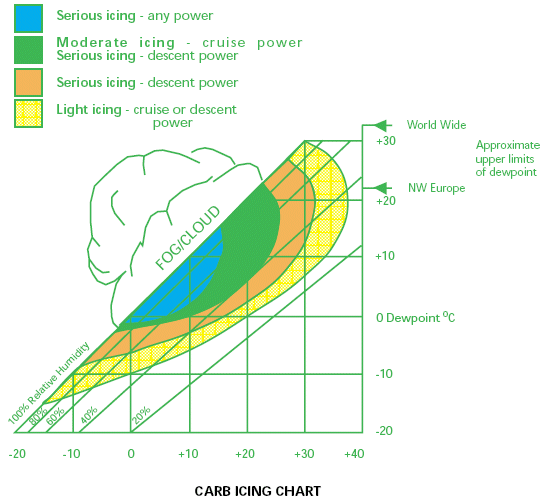
This is the chart for airplane pilots, just in case:
Image

On the X-axis is temperature in centigrades, on the Y-axis is the dew-point, the diagonals represent relative humidity (which can be deduced from dew point and air temperature). The coloured curves represent the kind of trouble you're in.

Final question I imagine Conceptual would make: all right, give me some numbers for temperature vs power.

Final answer: sorry, I have not, don't be so lazy, I also have a life. :) From the chart you can easily deduce that under minus 20 centigrades, there will be blockage of the venturi, unless you pre-heat the air (which is what most cars do, that's one of the reasons for the existance of the intake air temperature sensor your car has).

Re: What is the optimim intake air temperature?

Posted: 27 Jun 2008, 20:34
by Conceptual
Ciro Pabón wrote:Well, I have no graphs to show. I'm positive that at lower air temperatures the engine operates at an increased volumetric intake efficiency. I know of no lower limit to this "increased density" effect, although it could exist a limit. I imagine that if this limit exists, it falls well below "normal" temperatures in our planet, that is, as long as steel doesn't break because of the cold. Of course, I don't know what would happen in space or some exotic place, but I doubt very much that you'll find engineers trying to figure out what would happen if you feed your car with liquid air (hey, there you have an idea! Please, warn me so I don't walk by your garage by coincidence, in case the car explodes or something...).

The reason why car intake temperature is controlled and, in many cars, air is heated if below some minimum temperature, is because lower intake air temperatures tend to cause poor carburation, sometimes even leading to carburetor icing, especially under full load operation. In addition, the intake of very cold raw air will also delay the warmup of the engine during cold start, thereby prolonging operation in a poorly lubricated state. Lastly, a rapid warmup is important for ecological reasons, because the emission of exhaust pollutants is much higher when the engine runs cold.

I'd ask if I were Conceptual (I'm starting to know you, guys:)) : OK, so why poor carburation?

At low intake-air temperatures, especially in the case of diesel engines, an inadequate final compression temperature occurs, and therefore an increasing emission delay, that is to say the time from the entry of the fuel into the combustion chamber until the ignition of the same becomes too long. Furthermore, at low intake temperatures, local over-enrichment, incomplete combustion and high pressure gradients occur as a result of abrupt mixture conversion in the cylinder.

I imgagine everybody has noticed the amount of smoke a diesel produces when started in cold weather...

Another possible question: what's the deal with carburetor icing? I'm also positive (because I fly) that carburetor icing occurs when the air is humid. , There is a temperature drop in the venturi because of Boyle-Mariotte's law. Below some intake air temperature, this causes the water vapour to freeze. So, you'll get ice on throat, making it narrower. This, in turn, increase the venturi effect which makes the temperature to drop even more, maybe blocking the carburetor completely. You can also jam the butterfly or other parts.

This is the chart for airplane pilots, just in case:

Image

On the X-axis is temperature in centigrades, on the Y-axis is the dew-point, the diagonals represent relative humidity (which can be deduced from dew point and air temperature). The coloured curves represent the kind of trouble you're in.

Final question I imagine Conceptual would make: all right, give me some numbers for temperature vs power.

Final answer: sorry, I have not, don't be so lazy, I also have a life. :) From the chart you can easily deduce that under minus 20 centigrades, there will be blockage of the venturi, unless you pre-heat the air (which is what most cars do, that's one of the reasons for the existance of the intake air temperature sensor your car has).
Thank you Ciro, as always, very informative, and leaving me with more questions!

I guess dialing it into 33 degrees farenheit would still be very good. Higher density charge, without "icing", unless you could go colder if the air has less water content...

I will do more research, and if I can find a graph, I'll post it here!

Chris

Re: What is the optimim intake air temperature?

Posted: 27 Jun 2008, 20:59
by rjsa
Adding to Ciros post, not only colder air is more dense, but it also takes less power from the engine to be compressed. My thermodinamics is past due, but I remmember this bit very well.

Re: What is the optimim intake air temperature?

Posted: 27 Jun 2008, 23:17
by Conceptual
rjsa wrote:Adding to Ciros post, not only colder air is more dense, but it also takes less power from the engine to be compressed. My thermodinamics is past due, but I remmember this bit very well.

So, technically, if I could send dry, -20C, 14.7lb atmosphere into the intake, it would have less vampiric loss than normal? Does this have to due with compressing the cylinder causing heat?

So many questions....

And thank you for the replies!

Chris

Re: What is the optimim intake air temperature?

Posted: 28 Jun 2008, 00:52
by rjsa
Conceptual wrote:
rjsa wrote:Adding to Ciros post, not only colder air is more dense, but it also takes less power from the engine to be compressed. My thermodinamics is past due, but I remmember this bit very well.

So, technically, if I could send dry, -20C, 14.7lb atmosphere into the intake, it would have less vampiric loss than normal? Does this have to due with compressing the cylinder causing heat?

So many questions....

And thank you for the replies!

Chris
OK, I'm really rusty with this but I think I found an explanation http://air-compressors-info.blogspot.co ... ssors.html that has an equation that should expalin it. Temperatures are Kelvin (absolute):

{gave up on tex...}

Look at the final part of the polytropic process equation, work to compress the gas is directly dependant on T0 - intake temperature.

This is the work needed to compress some gas in a polytropic process - ie, when all three V,P & T vary.

Re: What is the optimim intake air temperature?

Posted: 29 Jul 2008, 12:05
by HKS
Conceptual wrote:
rjsa wrote:Adding to Ciros post, not only colder air is more dense, but it also takes less power from the engine to be compressed. My thermodinamics is past due, but I remmember this bit very well.

So, technically, if I could send dry, -20C, 14.7lb atmosphere into the intake, it would have less vampiric loss than normal? Does this have to due with compressing the cylinder causing heat?

So many questions....

And thank you for the replies!

Chris

Hey Chris,
I have been working on my IAT (Intake Air Temperature) sensor. I have tested it between -2 deg. C to 40 deg. C. Upto -2 deg. C the resistance of the sensor increases. Ofcourse it was the NTC (Negative Temperature Co-efficient ) Sensor. I can't say about carbs., but in fuel injection, the lesser the temperature the richer the air fuel ratio. I'm from a place where winter temperatures are 15-20 deg. C, on an average. so I have no clue about that. But in drier cold climatic conditions, it would surely make the A/F ratio richer. As the sensor's resistance keeps going on increasing with decrement of temperature.

Cheers

Re: What is the optimum intake air temperature?

Posted: 05 Aug 2008, 18:35
by Conceptual
I know a guy that made a million dollars off of a device that intercepts the AIT sensor, and lowers the value, so the computer adds more gas, and increases horsepower.

And it is nothing but a 1/4 watt resistor on the positive wire!

My device will pump 35ishCFM of -20C air into the intake hose from the airbox, and I am hoping that it will decrease the temp of the other 315CFM coming in...

You know, actually lowering the AIT, instead of tricking it.

Chris

Re: What is the optimum intake air temperature?

Posted: 05 Aug 2008, 23:02
by zac510
I am not sure if the average engine computers that will be able to calculate the air mass at such a low temperature, but if you're only looking to lower the average a little then it should cope.

Where is all the energy coming from to cool the air that much?

Re: What is the optimum intake air temperature?

Posted: 06 Aug 2008, 00:53
by Ciro Pabón
Simple, Zac, it's a "consequence" of the Boyle Mariotte, Charles and Gay Lussac laws: pressure times volume divided by temperature is a constant.

In short: the energy comes from the piston, sucking air in the intake stroke.

In simpler terms: imagine the air made of little spheres. They move around bouncing from the walls of the container (assuming the gas is bottled into something). This bouncing is what causes pressure.

Image

For example, if you increase the volume of the container, the spheres will bounce of a larger area, thus decreasing the pressure.

Now, about the temperature: temperature is a measure of the speed of the spheres; the higher the temperature, the faster the spheres move.

Actually, the temperature is a measure of the kinetic energy (mass times speed squared), but if the mass is a constant (like when you have a fixed mass of air in a container), the only way to change kinetic energy is by changing the speed of the molecules. A hot gas is bouncing off your skin with more speed, it's that bouncing what burns you.

So, if for example, you keep pressure constant and you increase the volume, the energy of spheres bouncing off your skin is lower (they're distributed over a larger area, because you increased volume): the temperature descends.

Next time you pump air into a bycicle tyre, you can feel how the increase in pressure increases the temperature: the conector between the pump and the air hose becomes quite hot. At double the pressure, you have twice the temperature.

In a car intake you have the opposite effect: you increase the volume and decrease the pressure inside the cylinder when it moves in the intake stroke (so the air will enter forced by the external atmospheric pressure), ergo, the temperature descends.

Same thing happens in the venturi: speed of air increases because of the carburetor throat, pressure descends, so temperature goes down. You do the same when you blow air with a fan to feel cooler in summer.

Also, the same thing happens when you rub alcohol or a cologne in your skin: the alcohol robs energy from the skin to evaporate (increasing the volume of it) and you feel cold because the little "spheres" of alcohol are robbing energy from you to fly away, hopefully (in the case of cologne) reaching the nose of your loved one.

A little poetry in engineering: it's your skin energy what makes you smell good.

Re: What is the optimum intake air temperature?

Posted: 06 Aug 2008, 10:25
by zac510
Hi Ciro, I think you misread my post! To get air that cool he is going to need to consume a lot of energy. If you're suggesting that energy come from the piston stroke, won't that draw from the amount of energy that the engine will ultimately produce? The gain from the intake temp dropped by a few degrees C surely would not make up for it.

If he uses electrical energy, to cool to that temperature he will need a lot of energy and there probably isn't enough on a car. and a big alternator or generator will have its own set of losses.

Re: What is the optimum intake air temperature?

Posted: 06 Aug 2008, 12:36
by HKS
Conceptual wrote:I know a guy that made a million dollars off of a device that intercepts the AIT sensor, and lowers the value, so the computer adds more gas, and increases horsepower.

And it is nothing but a 1/4 watt resistor on the positive wire!

My device will pump 35ishCFM of -20C air into the intake hose from the airbox, and I am hoping that it will decrease the temp of the other 315CFM coming in...

You know, actually lowering the AIT, instead of tricking it.

Chris
I was testing my IAT for the same reason itself. Even I have cheated my ECU. Now my future plan is to make a new ECM to improve the performance.

Cheers

Re: What is the optimum intake air temperature?

Posted: 08 Aug 2008, 00:12
by Conceptual
HKS wrote:
Conceptual wrote:I know a guy that made a million dollars off of a device that intercepts the AIT sensor, and lowers the value, so the computer adds more gas, and increases horsepower.

And it is nothing but a 1/4 watt resistor on the positive wire!

My device will pump 35ishCFM of -20C air into the intake hose from the airbox, and I am hoping that it will decrease the temp of the other 315CFM coming in...

You know, actually lowering the AIT, instead of tricking it.

Chris
I was testing my IAT for the same reason itself. Even I have cheated my ECU. Now my future plan is to make a new ECM to improve the performance.

Cheers
Check out www.nextlevelracing.com

You should email Brad and let him know that you are onto his scam!

LOL

Chris