
Carbon fibre
In the beginning of the sixties, Colin Chapman, chief designer and team principal of Team Lotus, introduced the monocoque to Formula One by placing thin plates around the bars of the monocoque. This new technology increased the stiffness of the chassis. Later on in the seventies, aluminium was mostly used for these constructions, but when these structures proved not be be resistant enough for the wings' downforce, John Barnard examined and produced as a first the self supporting chassis from carbon fibre. The engineer from McLaren had it produced by the American company Hercules Aerospace because McLaren didn't have the materials and knowledge to do this. In 1981, the McLaren drivers proved the safety and advantages of the new way of construction. John Watson finished two times second and once first in that season. Andrea De Cesaris proved its stiffness, with his numerous crashes during that season.
Properties
Carbon fibres are non isotropic and displays greatest strength lengthwise through the fibres. This means that when producing a sheet of carbon fibre, it is important to have all fibres aligned parallel to each other. Consequently, when using such sheet to produce a car part, the fibres must be aligned with the forces that will act upon that element to make sure it can handle the forces going through the item when in use.
Lengthwise through the fibres, carbon is an extremely strong material compared to its weight. The below table also shows that carbon fibres are both stronger and lighter than steel.
| Material | Tensile strength (MPa) | Density (g/cm³) | Tensile modulus (MPa) |
|---|---|---|---|
| Carbon fiber (Toray T700G) | 4900 | 1.80 | 230 |
| Carbon fiber composite (with Toray T700G) | 2550 | 135 | |
| Aramid (Kevlar 29) | 3757 | 1.44 | 70.5 |
| Steel (ASTM A36) | 450 | 7.90 | 200 |
| Pure copper | 220 | 8.92 | 120 |
Production
Most commonly, carbon fibres are produced from the polymere PAN, so we will only consider this type of manufacturing. After an improved Sohio process which involves an amonoxidation reaction between propene and ammonia, the result is acrylonitrile, which transforms into polyacrylonitrile after polymerisation.

Once this polymer has been produced, the manufacture of carbon fibre can proceed. The first step of the process is to stretch the polymer so that it is parallel to what will eventually become the axis of the fibre. Once this has been done, the polymer is oxidised at 200-300°C in air, which removes hydrogen and adds oxygen to the molecule and forms the basis of the hexagonal structure seen above.
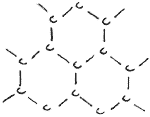 The white chain polymer had now become a black ring polymer, that has to be purified by carbonisation. This involves heating the polymer to up to 2500°C in a nitrogen rich environment, which expels impurities until the polymer contains 92 - 100% carbon, depending on the quality required for the fibre. The final stages in the production of carbon fibre involve weaving the fibres into sheets and embedding them in an epoxy resin, also called sizing. The result are sheets of black carbon fibre, that can be used to produce a variety of products.
Building in F1
F1 teams use carbon fibres, a pre-impregnated epoxy resin and an aluminium honeycomb layer, which is sandwiched between two layers of carbon fibre.
The chassis is usually the first part of the car to be built, due to the amount of time required. The main chassis usually comprises of about 8 parts (panels). The first stage of the manufacturing process is to build a solid (computer cut) pattern, from which a mould for the panel is produced. The moulds are constructed by laying a total of 10 layers of pre-impregnated (with resin) carbon fibre on top of each pattern to produce the mould. The production of the mould takes place in several stages, involving vacuum treatments, debulking and heating processes. The mould then has to be thoroughly cleaned and prepared for use.
The next phase is the actual fabrication of a car part, made from sheets of pre-cut, pre-impregnated carbon fibre, which are carefully laid inside the moulds. It is thereby vital orientate the carbon fibre sheets in pre determined directions in order to achieve the desired strength. A total of 5 layers of carbon fibre are laid, forming the outer skin of the chassis (to achieve a final, cured thickness of 1mm, a total of 3-4 layers of carbon fibre must be laid down).
The next stage of the process is to cure the carbon fibre in an autoclave. This exposes the carbon fibre to a number of temperature / pressure cycles according to the specific requirements of the materials and components being processed. During this treatment, the resin impregnated in the carbon fibre flows into the surrounding fibres and is activated, thereby curing the carbon fibre. Once the outer skin has been cured and cooled down, a honeyomb layer of aluminium is fixed onto the outer skin by a sheet of resin to ensure the materials stick stongly together. The chassis panel then returns to the autoclave for curing. After having cooled down again, one more layer, consisting of a number of pre-impregnated carbon fibre sheet is placed on top the existing skin, and again treated in the autoclave for a final time.
When the part is completely produced, it is sent to an evaluation department, and when proven good, it can be used for racing.
