Please discuss here all your remarks and pose your questions about all racing series, except Formula One. Both technical and other questions about GP2, Touring cars, IRL, LMS, ...
This is a sub thread for my main thread at Other Racing series that focuses on Aerodynamics
I need to find a way to attach bearings (and securing) to axle and tyres for a 1/12 scale car. the old ways were to use some sort of locking clips or bolts. but it induce friction when the bearing slides and touches the clips.
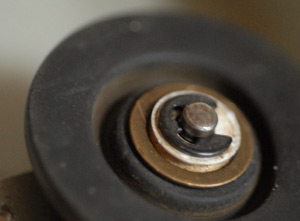
This is just a representation of how we did it the old ways.
The reason we are trying to get another way to do it is because the friction induced when the bearing touches the clips is decreasing performance.
Any suggestion is much appreciated. for information any part that needs machining is no problem and quite to say budget isn't the problem. just need to find THE BEST way. cheap and simple is a bonus
Thank you in advance
Last edited by mx_tifoso on 08 Dec 2010, 12:01, edited 1 time in total.
Reason:slightly changed title to more searchable form
Technical Engineer
Team Adroit
SMK Aminuddin Baki
We're Just Fast
Question is, Are YOU?
I would machine a cone washer, simply, with the narrower diameter resting on the inner ring of the bearing on the axle, and the wider diameter resting on the c-clip. ? That way you d have no friction of the rotating rings of the bearing on the shim.
I would recommend (if your regs allow it) a threaded axle and a nylstop, instead of a c-clip which are notoriously unreliable.
I would also work on the quality of bearings which vary tremendoulsy on the r/c size formats, ceramic would be the good way to go but they are price, but miles better than standard ones.
On standard bearings, Dont hesitate to throroughly get rid of any grease in them and lubricate only with light oil.
Anyhow, yes we are getting full ceramic bearings and imported. but order are not placed yet and not anytime soon since competition is next year's final term
anyhow.
can you elaborate more on the cone as well as the threaded axle and nylstop? i have no idea what they are
Technical Engineer
Team Adroit
SMK Aminuddin Baki
We're Just Fast
Question is, Are YOU?
depending on the axial load on the bearing, and how often you need to replace/dismantle it, you could shrink it onto the shaft.
Then you will not need and axial locator, and have no friction loses due to rubbing on your cirlip or nylon stop nut.
But using a conical spacer or just a simple small diameter washer should stop that anyway, very easily.
Will try to put up a sketch a bit later.
The inner race of the bearing will not (should not) turn in relation to the shaft, so if you use a spacer conical or constant diameter to get your circlip or nut surface away from the outer bearing race and/or the roller cage, you should have no problems with friction.
A 0.2 mm washer should be enough to get the clearance needed.
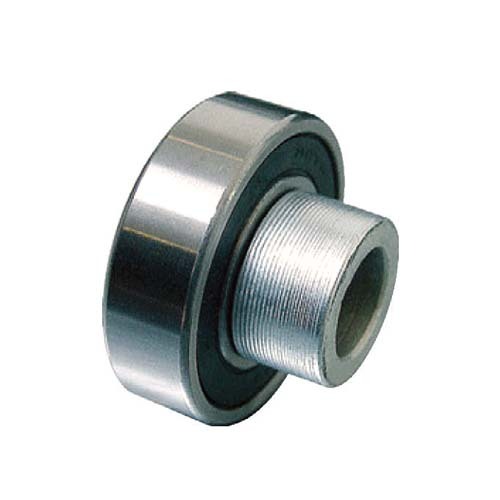
example for a conical spacer
or you can machine the back of your nut in a slight conical shape, so that it will only touch the inner race of the bearing, that should do the trick.
Something like this maybe:
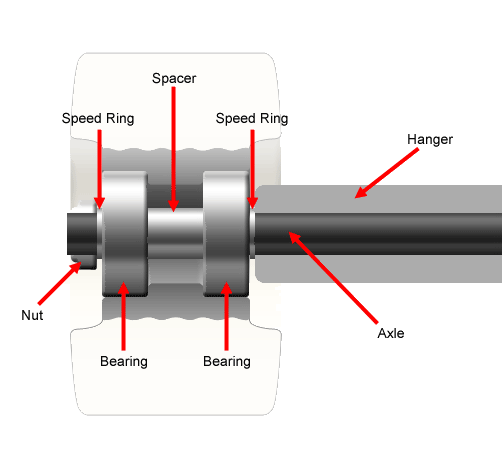
In this drawing, they call the small spacer/washer to get the axial clearance "speed ring".
It will eliminate the axial fiction you are talking about.
Last edited by 747heavy on 08 Dec 2010, 18:16, edited 1 time in total.
"Make the suspension adjustable and they will adjust it wrong ......
look what they can do to a carburetor in just a few moments of stupidity with a screwdriver." - Colin Chapman
“Simplicity is the ultimate sophistication.” - Leonardo da Vinci
oooh thank you 747heavy. that took care of some er thinking.
axial load is negligible, the car weighs 55 grammes and the bearing's outside diameter is 6 mm. it only need to last one championship (about 10 race max) so shrinking it is a viable option but how do i go about that?
as for another question is how do i make sure the inner race bearing doesnt slip and start spinning or something like that?
in this case the small size is prohibitive to gluing as the glue tends to work its way into the mechanism even how small we apply.
as for another should i go with double bearing per tyre or single bearing per tyre?
Technical Engineer
Team Adroit
SMK Aminuddin Baki
We're Just Fast
Question is, Are YOU?
Izzy410 wrote:
as for another should i go with double bearing per tyre or single bearing per tyre?
How wide are your tires and what would be the offset from the centre of the contact patch in relation to the centre of your bearing?
Seeing the mass of the car and assuming that it is an "F1 in school" project, I would go with one bearing, to reduce mass and friction.
I´m not an expert in this type of competition, but would think, that mass is the/one paramount performance factor.
to answer your question in regards of "how to shrink the bearing onto the axle", I would need to know what the material of your axle is.
Steel,Titanium, Aluminium, Wood or any composite plastic?
Last edited by 747heavy on 08 Dec 2010, 21:07, edited 1 time in total.
"Make the suspension adjustable and they will adjust it wrong ......
look what they can do to a carburetor in just a few moments of stupidity with a screwdriver." - Colin Chapman
“Simplicity is the ultimate sophistication.” - Leonardo da Vinci
Izzy410 wrote:
axial load is negligible, the car weighs 55 grammes
and the bearing's outside diameter is 6 mm.
6mm OD for the bearing is pretty small. what is your shaft OD (bearing ID)?
2mm?
And what would be the wide of your bearing?
2mm as well?
"Make the suspension adjustable and they will adjust it wrong ......
look what they can do to a carburetor in just a few moments of stupidity with a screwdriver." - Colin Chapman
“Simplicity is the ultimate sophistication.” - Leonardo da Vinci
6mm is quite a size actually. most team use 5mm. or do you suggest big OD and small ID? i heard something about geometry relation in reducing rolling resistance
The Shaft OD is 2mm and the width is 2.5mm.
The axle will be made of steel. but we are trying to see if aluminum or any composite would be good.
The axle used to be made of carbon (something like graphite) not carbon fibre. but the problem was it tend to flex. and flexing is the last thing we need. on high speed when the car launches the axle remained 'stationary' meaning the tyres touches the body until a fraction of a second later.
steel flex less but weighs a ton for us. aluminum is an option but we might need to heat treat it but we havent got hold of aluminum axle yet. titanium on the other hand (we heard off not researched) had problem with strain unless you treat it in certain ways.
The tyre's width is 16 mm and the bearing would be right in the centre of the contact patch if its a single bearing or if double, we would offset both to be at the most outer edges we can.
mass is a factor and i think rolling resistance can be reduced with only one bearing.
Technical Engineer
Team Adroit
SMK Aminuddin Baki
We're Just Fast
Question is, Are YOU?
aluminium is definitely the way to go for your axle given the low number of runs, wear should not be too much a factor.
The main issue i see with titanium is that it is much harder to machine..especially locally.
My car uses a straight 60 mm wide axle. not two piece. cause it runs across the whole width of the car.
off the shelves part are hard to find that specify our requirement. we have a place that can machine the parts. titanium like i said haven't been taken into serious consideration. partly because its denser than aluminum is. so it'll be heavier. what other metal are (hard aswell) lighter than aluminum? or any other composite?
The heat treatment for aluminum wasnt to decrease wear but to decrease flexing. we want a superbly hard material but light.
---------------------------------------------------------
Another part. how do you attach the bearing to the tyres? like. make it properly fix. the last time we used tolerance level so that its a tight fix. but it still slipped a bit. i cant think of this one.
Technical Engineer
Team Adroit
SMK Aminuddin Baki
We're Just Fast
Question is, Are YOU?
If there is not much in terms of wheelchanges why not glue the bearing to the axle?
loctite is an incredible stuff .with some inductive heat the loctite could be cracked quickly as well ...
Glueing the bearing is tricky considering needing just the right amount of glue etc..
You could look at Press fitting the bearing on the axle.
If you can have a custom machined axle, you have it milled just so that the bearing sits on the axle by itself.. the tolerances must be a b*tch to manage but it would solve your rubbing and maintaining issue.
Considering the low stress and no side loads, it would not be an issue.
I would also strongly recommend some serious break-in of the bearings before you compete.. trust me it helps.
Patriiick wrote:Glueing the bearing is tricky considering needing just the right amount of glue etc..
You could look at Press fitting the bearing on the axle.
If you can have a custom machined axle, you have it milled just so that the bearing sits on the axle by itself.. the tolerances must be a b*tch to manage but it would solve your rubbing and maintaining issue.
Considering the low stress and no side loads, it would not be an issue.
I would also strongly recommend some serious break-in of the bearings before you compete.. trust me it helps.
loctite product 248 is made for this.press fit is something to consider .With certain material combinations you may arrive at even more severe interlock -think of titanium galling or stainless/stainless fretting..
as for the bearing size, no I was not suggesting anything, as it is not really my field of expertise, I was just curious.
Maybe Riff_Raff or Xpensive can make some suggestions from a tribology PoV.
But I did look up some bearings, and have seen that you can get smaller ones, as you say 5mm OD is possible and you could go for 1,5mm shafts etc.
As for the shrinking, it goes along the same lines as a pressfit.
You would oversize your shaft in relation to the ID of your bearing.
Then to be able to assemble it, you can either press it onto the shaft, which has some drawbacks and risks such as fretting etc, or you can make use of the CTE. Which means you would heat up your bearing (depending from the material and seals/lubrication used ~100°C perhaps for a steel bearing) and cool down your shaft (in liquid nitrogene (-196°C - be very careful!!) or dry ice (~-56°C, easier and safer to handle).
The temperature difference will affect your tolerances/clearance, so that you are able to slide your bearing onto the shaft in place.
After both parts return to ambient temperature the bearing will clamp onto the shaft.
The clamping force will depend on the tolerances (oversize) you choose.
You will need to look up the correct tolerances in a book, it will also define your bearing preload.
For your application a pressfit should be possible and I would secure it with some Loctite as Marcus suggested.
But its difficult to get Loctite between the bearing and the shaft if you pressfit it, using the shrinking method is easier, because the Loctite does not get scraped off as much while you press the bearing on.
Some other radom thoughts, not sure if it is possible, just wanted to mention it, and then let you run with it.
As I understand it, you use one solid axle going from one side to the other, and have the bearings inside the wheels.
There is the one bearing per wheel vs. the two bearing per wheel argument with sideforces due to tilting of the wheel in mind.
Maybe you can put your bearings inboard (into the body) and fix the wheels ridgid onto the shaft instead.
So the shaft turns inside the bearings, but you have no tilting forces on the bearing, and can use two bearings without any drawbacks.
Not sure if this agrees with your "no foreign objects or voids in the balsa block" rule, but the axle across is a foreign object as well - IMHO.
As for the axle material if you want/or need to keep your layout.
Mind about wood, I know it sounds crazy at first, but it is an quite versatile material, with some good characteristics if used correctly.
I played around with a 2mm tooth pick while at dinner last night, it´s pretty strong, and I don´t think, that this was any "special" wood.
That would make the press fit of the bearing easier to achieve.
If you go for steel, maybe a tube instead of an shaft will help safe some mass.
It´s difficult to drill a 0,5 m hole through a 2mm shaft, but I was thinking about a injection needle or something along these lines.
Maybe you can find something in the correct size, may need to harden the material a bit, as a injection needle is probably quite soft, to prevent it from breaking off.
Just some radom thoughts and brain storming, feel free to ignore the parts which are maybe too crazy.
Good luck anyway
Last edited by 747heavy on 09 Dec 2010, 20:27, edited 3 times in total.
"Make the suspension adjustable and they will adjust it wrong ......
look what they can do to a carburetor in just a few moments of stupidity with a screwdriver." - Colin Chapman
“Simplicity is the ultimate sophistication.” - Leonardo da Vinci

 Kuala Lumpur.