
- Login or Register
No account yet? Sign up



 so you could get easily confused alerted and all measuring the wear indicators.I assume the F1 tyres are more precise?
I wouldn't make that assumption.marcush. wrote:I assume the F1 tyres are more precise?

did that in historic racing.We had to use a spec tyre and you just tore out the thread blocks when using new tyres .Reducing thread depth on brand new tyres adressed this problem very well and on top of it you had much increased footprint and lower tyre temps -in effect the tyre lasted longer even when starting with half the thread ...Giblet wrote:A friend of mine told me that in some series, street tires are 'lathed' and the tread cut down to make them 'slicks'.

Giblet;A friend of mine told me that in some series, street tires are 'lathed' and the tread cut down to make them 'slicks'
Giblet...They do it in many series that require treaded/street tires just as I told you above. They do not make them into slicks as that would violate the rules.No it was definitely shaving a tire down to make them perform better.
I am drawing a blank on the series name. I found this though:
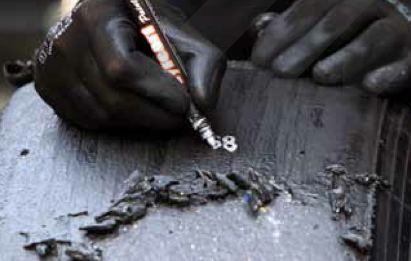
Tire shaving is an effective means of permitting more of a tire's performance capability to be realized early in its life. Tire shaving removes tread rubber and reduces tire weight by several pounds. A shaved tire's tread profile will usually result in a slight increase in the width of the tire's contact patch putting a little more rubber on the road. The resulting shallower tread depths reduce the tire's slip angle, increases its responsiveness and help stabilize its cornering power by minimizing tread block squirm. Minimizing tread block squirm also reduces heat buildup and the risk of making the tire go "off" by overheating its tread compound. And in many cases, shaved tires used in competition actually have a longer useful life than tires that begin being run at full tread depth.
So with all of these benefits, the next important question is: "How far should a tire be shaved?"
Hoosier R3S03, A3S03, R3S04 and A3S04 radials, as well as KUMHO ECSTA V710 tires are manufactured with 4/32 to 4.5/32" of molded tread depth and do not require tire shaving.
Most other DOT-legal Competition tires begin with about 6/32" of molded tread depth. While some tires do not require shaving for dry autocross use, all of them will benefit from shaving to about 4/32" tread depths for driver's schools, track days and competitive track use in dry conditions.
