Big Sidepods?

Here are our CFD links and discussions about aerodynamics, suspension, driver safety and tyres. Please stick to F1 on this forum.
0

Post Fri Jul 20, 2012 11:20 am

Hi All,
I am no areodynamics engineer. I have a question that has been bugging me for a while.

Why don't the teams try a huge (maximum size allowed under the regulations) sidepod with a huge intake?

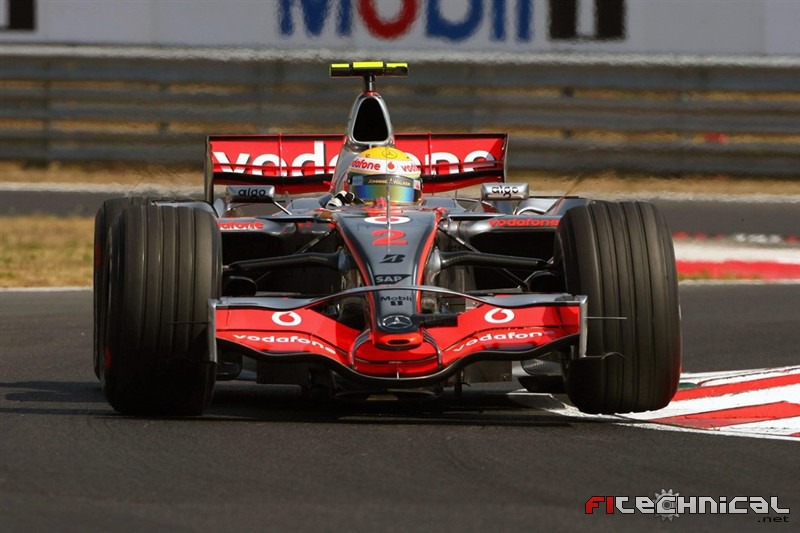
Before flaming - I am thinking of a sidepod that is designed as a wind tunnel to send the airflow to the back and send the air out of a big hole in the back with a perfect location and direction. They will be mostly empty with some inner surfaces to guide the airflow. The radiators are small enough now - they can be crammed into a corner where they will not affect/block the flow. This structure would also hide a portion of the front of the rear wheel, reducing its negative aerodynamic effects (one could even cut holes in the sidepots to push some air to exit above and around the rear tires). These huge intakes would also take in some of the disturbed air from behind the front wheel and make something useful out of it.

I have been looking at the amount of work that the teams are putting to get the perfect flow around the cars' sidepods to the diffuser area and was always confused why they didn't use a tunnel...
Skeptical scrutiny is the means, in both science and religion, by which deep thoughts can be winnowed from deep nonsense.
Carl Sagan
outer_bongolia
1
User avatar
 
Joined: 13 Feb 2009

0

Post Fri Jul 20, 2012 11:34 am

....

Air taken into a duct loses energy and becomes turbulent so not good.
Last edited by mx_tifoso on Fri Jul 20, 2012 11:40 am, edited 1 time in total.
Reason: removed quote of op
WilliamsF1
19
User avatar
 
Joined: 6 Jan 2010

0

Post Fri Jul 20, 2012 12:20 pm

Turbulent convection is more efficient than laminar convection.

The reason you wouldn't want big sidepods on an F1 car is because you don't want a big anything on an F1 car.
bhallg2k
147
User avatar
 
Joined: 28 Feb 2006

0

Post Fri Jul 20, 2012 1:21 pm

outer_bongolia wrote:Hi All,
I am no areodynamics engineer. I have a question that has been bugging me for a while.

Why don't the teams try a huge (maximum size allowed under the regulations) sidepod with a huge intake?

Before flaming - I am thinking of a sidepod that is designed as a wind tunnel to send the airflow to the back and send the air out of a big hole in the back with a perfect location and direction. They will be mostly empty with some inner surfaces to guide the airflow. The radiators are small enough now - they can be crammed into a corner where they will not affect/block the flow. This structure would also hide a portion of the front of the rear wheel, reducing its negative aerodynamic effects (one could even cut holes in the sidepots to push some air to exit above and around the rear tires). These huge intakes would also take in some of the disturbed air from behind the front wheel and make something useful out of it.

I have been looking at the amount of work that the teams are putting to get the perfect flow around the cars' sidepods to the diffuser area and was always confused why they didn't use a tunnel...


so basically the idea suggested the other day which has been discussed in the MP4-27 thread, you mean that idea?
I have already done Airflow Simulations on it, which was interesting :)
Last edited by N12ck on Sat Jul 21, 2012 3:50 pm, edited 1 time in total.
Budding F1 Engineer
N12ck
11
User avatar
 
Joined: 19 Dec 2010

0

Post Fri Jul 20, 2012 4:42 pm

Nick, you could have at least been a little more constructive instead of being an arse about it.


I've always wondered why they haven't put the radiators closer to the rear of the sidepod with a carbon tube like they did in the 2000's It'd stop that reverse flow issue that I read about in autosport.


That's probably already been discussed.

On topic I would think the (possibly) horrible turbulent flow from the rear of the radiators wouldn't be that helpful in comparison to the other solutions we see on modern cars tbh.
krisfx
2
 
Joined: 4 Jan 2012

0

Post Fri Jul 20, 2012 5:40 pm

krisfx wrote:Nick, you could have at least been a little more constructive instead of being an arse about it.


I've always wondered why they haven't put the radiators closer to the rear of the sidepod with a carbon tube like they did in the 2000's It'd stop that reverse flow issue that I read about in autosport.


That's probably already been discussed.

On topic I would think the (possibly) horrible turbulent flow from the rear of the radiators wouldn't be that helpful in comparison to the other solutions we see on modern cars tbh.


when I ran simulations on such a sidepod, I found a few problems, the airflow is very turbulent exiting the tunnel, it doesnt follow the cokebottle as well as the conventional sidepods, and rapidly changes direction when it gets close to the diffuser towards the outer edges of the diffuser, whilst some follows the coke bottle (not very cleanly) I suspect this can be solved with flow conditioners, and some VG's on the exit of the tunnel, although it still doesnt get round the problem of extra drag due to the boundary layers inside the tunnel
Budding F1 Engineer
N12ck
11
User avatar
 
Joined: 19 Dec 2010

0

Post Sat Jul 21, 2012 4:10 am

outer_bongolia wrote:Hi All,
I am no areodynamics engineer. I have a question that has been bugging me for a while.
Why don't the teams try a huge (maximum size allowed under the regulations) sidepod with a huge intake?


bongolia,

The huge intake would produce huge drag. The airflow over the radiator core is based on mass flow requirements. The radiator intake duct is shaped like a diffuser. It slows the velocity of the incoming air and increases its dynamic pressure ahead of the radiator core face. The exit duct is more convergent. It is designed to accelerate the discharged airflow so that its duct exit velocity is equal to or greater than the passing airflow, in order to minimize drag.

I also believe the height/width dimensions of the sidepods are somewhat controlled by regulations, since they also function as side impact structures.

slider
"Q: How do you make a small fortune in racing?
A: Start with a large one!"
riff_raff
79
 
Joined: 24 Dec 2004

0

Post Sat Jul 21, 2012 4:26 am

removed.
Skeptical scrutiny is the means, in both science and religion, by which deep thoughts can be winnowed from deep nonsense.
Carl Sagan
outer_bongolia
1
User avatar
 
Joined: 13 Feb 2009


Return to Aerodynamics, chassis and tyres

Who is online

Users browsing this forum: gt6racer, Nomore, SatchelCharge, Tim.Wright and 7 guests