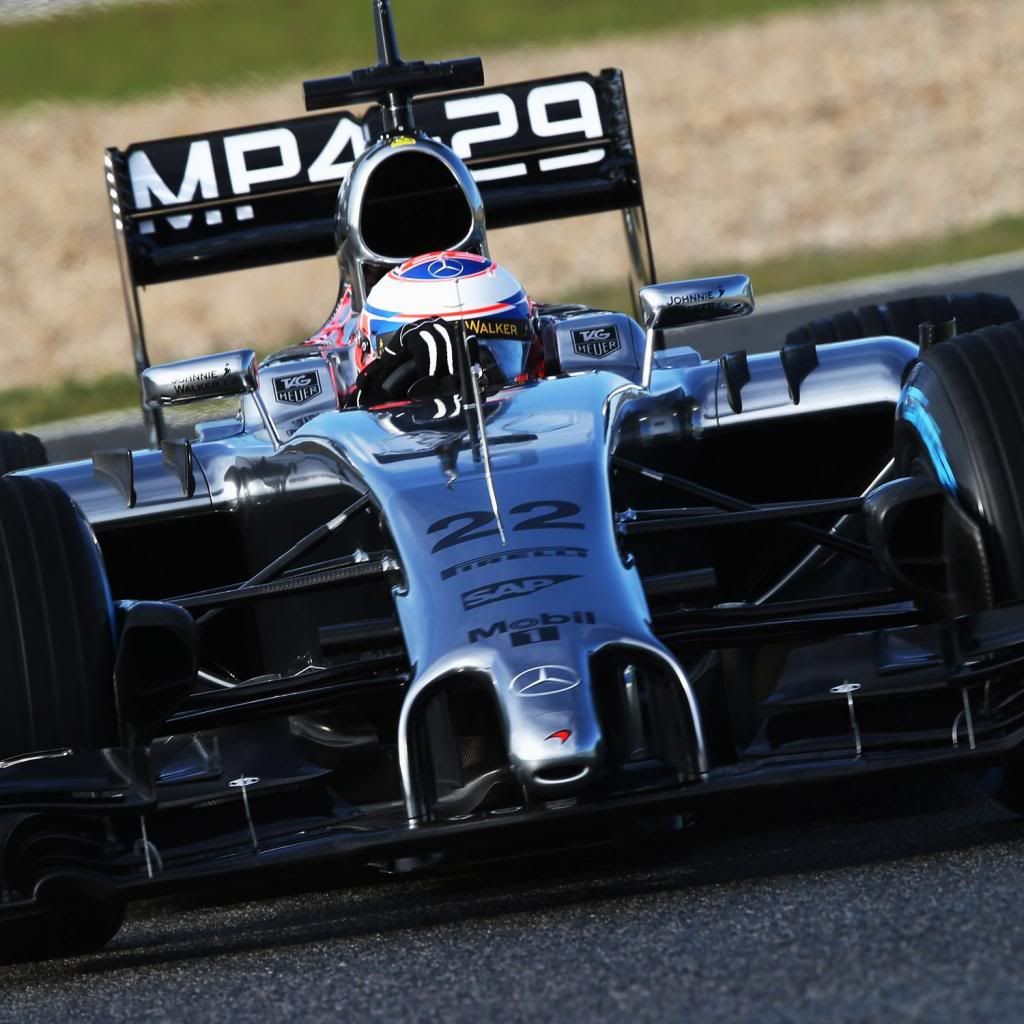
Hey all.. Just a question that randomly popped into my mind here. We know teams have wind tunnels, CFD, even their straightline aero days to test new aero packages/improvements/upgrades for themselves.
But what about the suspension stuff? The mechanical low-speed-grippy stuff? How do they test those other than on a free practice session?
While we're at it, how does Virgin go about doing that?
"Make the suspension adjustable and they will adjust it wrong ...... look what they can do to a carburetor in just a few moments of stupidity with a screwdriver." - Colin Chapman
“Simplicity is the ultimate sophistication.” - Leonardo da Vinci
i´m quite surprised that for Nick Wirth everything is virtual ..... but that is a trend in the industry as well.with time the predictions get a lot better of course..and tbh there are parts falling of other cars as well...
Sure test rigs can test bump-riding on the cars. But how do they test their suspension geometry for their traction.... their stability on braking... etc etc?
raymondu999 wrote:But what about the suspension stuff? The mechanical low-speed-grippy stuff? How do they test those other than on a free practice session?
raymondu999 wrote:Sure test rigs can test bump-riding on the cars. But how do they test their suspension geometry for their traction.... their stability on braking... etc etc?
Answering those questions requires a coupled aero/mechanical model, which can be addressed by modelling, including driver-in-loop modelling (simulators), assuming that the mechanical model & (unsteady) aero maps are accurate. I believe that, at present, track testing is the only definitive solution, unfortunately.
Good tire data and vehicle simulation to some degree. Don't think you're ever going to be able to completely decouple the mechanical from the aero in real testing. To some degree you can by really focusing on low speed corners or if you were to take it to the extreme and work on an asphalt pad.
raymondu999 wrote:To that extent then, how would a team like Virgin test their suspension geometry etc?
the test is on the track really ..for Virgin as for anybody else.The special situation of course with Carbonfibre is..the failure might occur very sudden if your calculations suck.
From my knowlege early signs of fatigue failures are very well understood andalso detectable ..so mechanical testimng for response to loads has its place for component checks .to check a subassembly for feasibility in terms of will it stand the loads offered to it in real world is more a function of have you really understood what will happen out there and less if you areactually testing the part on a rig.
raymondu999 wrote:To that extent then, how would a team like Virgin test their suspension geometry etc?
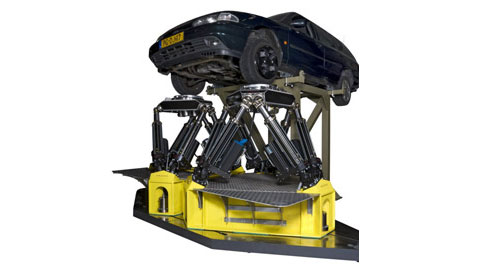
they can/would go to an institution which offers test rigs, if they do´t have their own ones.
For a 4 post-Rig this could be Multimatics/Dynamics in the U.K. , on top of the data you would get DaveW´s opinion/advice for free with it, if you are prepared to listen.
Not sure who offers K&C test rigs in the U.K., Cranefield maybe, Lotus Engineering I´m quite sure has one. But there will be different places where you can go. Toyota Motorspot would have both, plus other test rigs, and is open to rent them out.
It depends of what you want to test for, and how you discribe "performance".
A K&C test in simple terms, is holding the car steady/fixed, while a plateform under the tire(s) can be moved in 3 directions to simulate the tyre/road interface and the forces which are generated in the tire contact patch. Then you can measure, the changes in your toe, camber and caste values and the deflection in your components (wishbones, uprights, wheel bearings, rims !!!, pick up points etc.) It´s a quite realistic test, and you will be surprised more often then not, to see what´s actual happen in your suspension parts, when they are subject to real world loads.
Last edited by 747heavy on Mon Sep 20, 2010 4:33 pm, edited 1 time in total.
"Make the suspension adjustable and they will adjust it wrong ...... look what they can do to a carburetor in just a few moments of stupidity with a screwdriver." - Colin Chapman
“Simplicity is the ultimate sophistication.” - Leonardo da Vinci
"Make the suspension adjustable and they will adjust it wrong ...... look what they can do to a carburetor in just a few moments of stupidity with a screwdriver." - Colin Chapman
“Simplicity is the ultimate sophistication.” - Leonardo da Vinci
"Make the suspension adjustable and they will adjust it wrong ...... look what they can do to a carburetor in just a few moments of stupidity with a screwdriver." - Colin Chapman
“Simplicity is the ultimate sophistication.” - Leonardo da Vinci
raymondu999 wrote:To that extent then, how would a team like Virgin test their suspension geometry etc?
They can also contract out to test their stuff elsewhere. A lot of the testing have been around in the industry, and you don't necessarily need to have the equipment yourself. For example thats the business Toyota Motorsports is in now, they have a fully equipped facility that contracts out to do testing for whoever needs it...