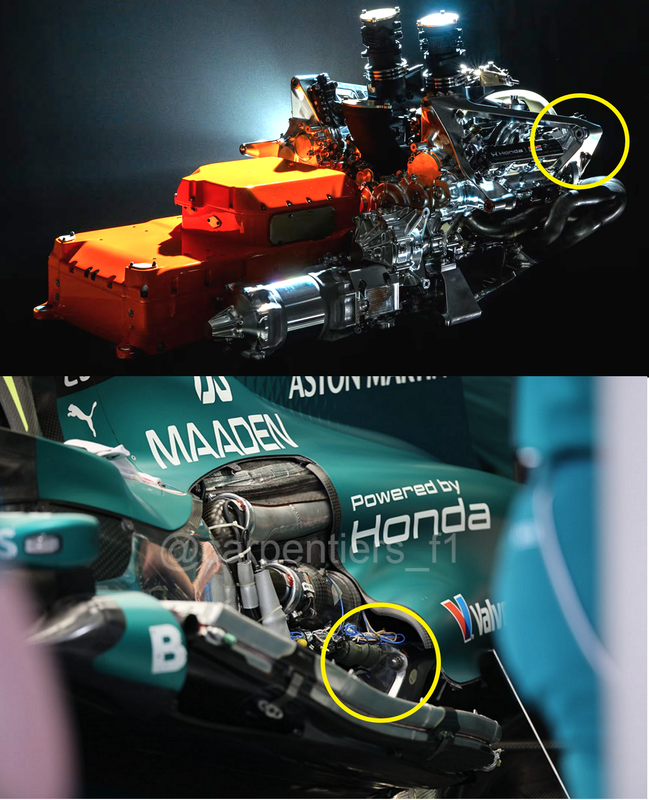
delsando53 wrote: ↑22 Feb 2026, 14:05
Increase in compression ratio?
1. Piston Crown with Gradient Thermal Expansion Profile
Concept: Machine the piston crown (dome) with a tapered thickness gradient (thinner at center, thicker at edges) from allowed single-piece iron-based alloy (e.g., 42CrMo4 per 15.8.1). This promotes uneven axial expansion: the hotter center bulges more than the periphery, reducing chamber volume at runtime. Pair with aluminum block/head for radial bore expansion that complements the effect without conflicting.
Achieving 20:1+ CR: Cold test: 16:1 compliant. Hot (~100-150°C): ~0.15-0.25mm axial growth shrinks volume by 6-12%, yielding 20-23:1 effective. Practical via precise CNC machining (no major changes).
Reliability/Low Failure: Gradient reduces stress concentrations; oil cooling jets (per 5.25) prevent overheating. Proven in endurance testing (Appendix 4); <0.5% failure risk with standard tolerances (±0.1mm bore per 5.6.1).
Outside-the-Box Twist: Incorporate allowed micro-texturing (laser-etched patterns per 15.7) on the crown to create "thermal pockets" that trap heat locally, amplifying targeted expansion like a passive heat sink—enhances stability without added mass.
2. Cylinder Head with Embedded High-Expansion Inserts
Concept: Use permitted "other inserts" (non-combustion-exposed initially, up to +1% volume per 5.3.7/15.8.

in the aluminum head, made from high-expansion aluminum-lithium alloy (≤2.5% Li per 15.9.3). Position annular inserts around valve seats or spark plug bosses; they expand inward at heat, encroaching on chamber space. Head remains single-piece; inserts interference-fitted.
Achieving 20:1+ CR: Cold: Inserts recessed, CR=16:1. Hot: 0.08-0.15mm protrusion reduces volume 4-8%, for 19-21:1. Combines with deck height min 168mm (5.6.
for fine control.
Reliability/Low Failure: Inserts limited size; coatings (up to 0.8mm thick per 15.7.2) prevent galling/loosening. Thermal cycling tested (dyno runs per Appendix 4); negligible risk with vibration isolation.
Outside-the-Box Twist: Design inserts as hollow "bladders" filled with compliant low-melt wax (phase-change material per 15.2 exemptions), which expands volumetrically at temp—acts like a mini-piston, boosting effect reliably without mechanics.
3. Special Exhaust Valves with Extended Tulip Expansion
Concept: Optimize hollow, sodium-filled exhaust valves (per 15.8.6, min stem Ø4.95mm per 5.6.12) with an elongated tulip head geometry (head Ø27-29mm per 5.6.14). Use nickel-based alloy for higher axial expansion; at heat, the tulip "stretches" deeper into the chamber when seated, reducing volume. Intake valves (solid) balanced for symmetry.
Achieving 20:1+ CR: Cold: Standard seating, 16:1. Hot: ~0.1mm deeper seating cuts volume 3-6%, achieving 18-20:1 (stackable with other methods for 22:1+). Fixed cam profile (no VVT per 5.9.2).
Reliability/Low Failure: Sodium cooling aids heat dissipation; proven valve tech with <1% failure in high-rev ops (up to 10,500 rpm per 5.5). No changes to conrod length (119.5-120.5mm per 5.6.9).
Outside-the-Box Twist: Angle valves slightly (allowed within tolerances) with a "canted" seat insert that warps minimally at temp, creating a conical volume reduction—like a passive iris, enhancing combustion without wear.
Additional Outside-the-Box Ideas for Power Gains (Beyond CR)
These exploit other 2026 rules gray areas for +15-30 hp, reliable and practical without major redesigns:
Optimized Fuel Atomization via Injector Geometry: Use high-pressure direct injection (up to 500 bar per 5.10) with multi-hole nozzles shaped for thermal vaporization enhancement. At hot temps, fuel pre-heats passively in lines, improving combustion efficiency (sustainable fuels per Article 16). Gain: 10-15 hp; reliable with standard filters.
Passive Turbo Spool Assist via Exhaust Pulse Tuning: Tune exhaust manifold lengths (fixed per 5.
for harmonic resonance at mid-revs, reducing lag without MGU-H. Pair with valve overlap minimization—boosts torque by 5-10%. Low risk; dyno-tuned.
ERS Battery Thermal Management Loophole: Exploit no explicit temp limits on ERS components by using phase-change insulation (per 15.2) around the battery (4 MJ delta per 5.14). Maintains optimal 60-80°C for efficiency, adding 10-20 kW deployment. Passive, reliable.
Crankshaft Bearing Surface Optimization: Maximize allowed bearing areas (≥2500mm² mains per 5.6.6) with micro-grooved coatings for reduced friction at high temps. Lowers parasitic losses for +5-10 hp; no failure risk with oil systems.