Re: 2 stroke thread (with occasional F1 relevance!)
Posted: 17 Mar 2020, 10:09
Hello Tommy Cookers
You write:
“again ....
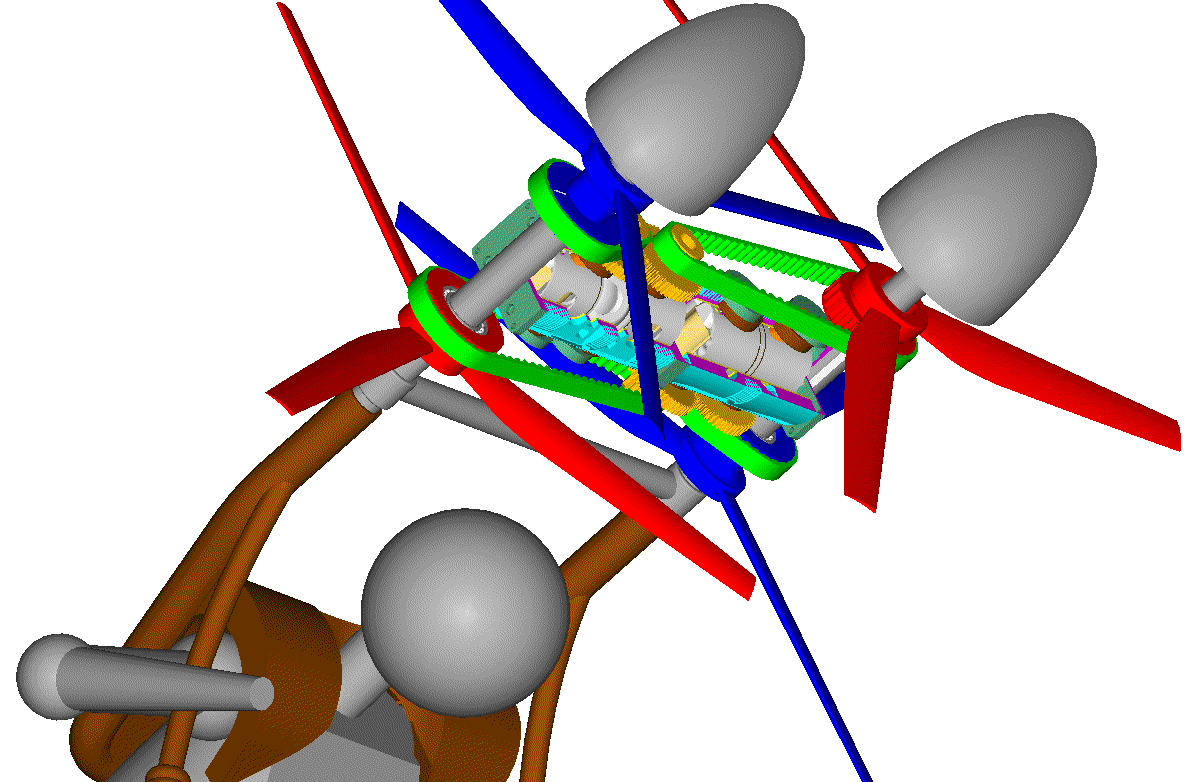
the Gen H-4 has a lot of rotor coning
put there to contribute stability”
The rotor coning of the GEN-H4 makes a difference in stability only on or near the ground. If the one side of the GEN_H4 elevates for a few inches relative to its opposite side, the aerodynamic force on each rotor blade maximizes each time it passes from the lower region of its path and minimizes after 180 degrees when it passes from the higher region of its path, away from the ground and looking somewhat to the side; a torque is created that restores the vehicle to a more upright / vertical position.
Above some height, say 5 - 10m, the rotor coning cannot improve stability.
In other words, if you lock the joint between the upper assembly (comprising the engines and the rotors) and the lower assembly (where the pilot and the fuel tank are) and “freeze” the pilot, the Gen_h4 will turn and fall to the ground as the rocket of the “Pendulum rocket fallacy” article.
You also write:
“try this ....
www.nar-associates.com>cruise_propeller_efficiency_screen.pdf
or try searching for Propeller Efficiency - NAR Associates
it contains a full propeller performance diagram
it seems to show how hover power requirement is high (for PF-type speed range without ideal pitch variability).
The Portable Flyer as a transportation means will take-off vertically and in a few seconds it will turn to high-speed horizontal cruise till its destination where it will turn again to land vertically (in a few seconds again).
More than 90-95% of the time it will be in horizontal cruising with the propellers / rotors / engines revving / operating at their optimum.
When it is necessary to hover (say, during a rescue, or for demos etc) it can; but in such cases the efficiency is not important.
Thanks
Manolis Pattakos
You write:
“again ....
the Gen H-4 has a lot of rotor coning
put there to contribute stability”
The rotor coning of the GEN-H4 makes a difference in stability only on or near the ground. If the one side of the GEN_H4 elevates for a few inches relative to its opposite side, the aerodynamic force on each rotor blade maximizes each time it passes from the lower region of its path and minimizes after 180 degrees when it passes from the higher region of its path, away from the ground and looking somewhat to the side; a torque is created that restores the vehicle to a more upright / vertical position.
Above some height, say 5 - 10m, the rotor coning cannot improve stability.
In other words, if you lock the joint between the upper assembly (comprising the engines and the rotors) and the lower assembly (where the pilot and the fuel tank are) and “freeze” the pilot, the Gen_h4 will turn and fall to the ground as the rocket of the “Pendulum rocket fallacy” article.
You also write:
“try this ....
www.nar-associates.com>cruise_propeller_efficiency_screen.pdf
or try searching for Propeller Efficiency - NAR Associates
it contains a full propeller performance diagram
it seems to show how hover power requirement is high (for PF-type speed range without ideal pitch variability).
The Portable Flyer as a transportation means will take-off vertically and in a few seconds it will turn to high-speed horizontal cruise till its destination where it will turn again to land vertically (in a few seconds again).
More than 90-95% of the time it will be in horizontal cruising with the propellers / rotors / engines revving / operating at their optimum.
When it is necessary to hover (say, during a rescue, or for demos etc) it can; but in such cases the efficiency is not important.
Thanks
Manolis Pattakos