Page 210 of 433
Re: Ferrari Power Unit Hardware & Software
Posted: 18 Feb 2019, 03:35
by PlatinumZealot
PhillipM wrote: ↑13 Feb 2019, 20:20
For aluminium, yes, but for steel pistons?
Yes. I have seen that before.
But what i am saying is steel is stronger for this so it is another advantage.
Re: Ferrari Power Unit Hardware & Software
Posted: 18 Feb 2019, 04:25
by godlameroso
No material is perfect, but with enough engineering(IE endless amounts of cash flow), you can hide the flaws so that the strengths can work for you.
Steel pistons are a fascinating topic, and the timeline of when each manufacturer started using them would really tell a lot. Especially as I imagine they have a steep learning curve.
Re: Ferrari Power Unit Hardware & Software
Posted: 18 Feb 2019, 06:12
by PhillipM
PlatinumZealot wrote: ↑18 Feb 2019, 03:35
Yes. I have seen that before.
But what i am saying is steel is stronger for this so it is another advantage.
It's strength at high temperature is a lot higher than aluminium too so I'd think if you were suffering thermal deg on the crowns, it'd be even worse with ally ones anyway.
Re: Ferrari Power Unit Hardware & Software
Posted: 18 Feb 2019, 06:29
by ringo
With lean burn combustion i don't think the temperatures are widespread to the walls and pitons of the cylinders.
Less heat is rejected to cooling oil and water in these engines. Therefore i think the main advantage with steel is fatigue resistance; ie reliability as 3 engines are needed per year.
Saying that i think there needs to be more evidence that steel is being used. Not to say it's not feasible, but i am indifferent to either design, apart from aluminum being lighter and there being no drastic reason not to continue to use aluminum.The engine's dynamics favour the aluminum, unless they managed to make the steel ones lighter.
Re: Ferrari Power Unit Hardware & Software
Posted: 18 Feb 2019, 06:51
by Zynerji
ringo wrote: ↑18 Feb 2019, 06:29
With lean burn combustion i don't think the temperatures are widespread to the walls and pitons of the cylinders.
Less heat is rejected to cooling oil and water in these engines. Therefore i think the main advantage with steel is fatigue resistance; ie reliability as 3 engines are needed per year.
Saying that i think there needs to be more evidence that steel is being used. Not to say it's not feasible, but i am indifferent to either design, apart from aluminum being lighter and there being no drastic reason not to continue to use aluminum.The engine's dynamics favour the aluminum, unless they managed to make the steel ones lighter.
I think if we still only needed 2 races per engine, it would be aluminum for sure.
I imagine that the extreme reliability requirements have pushed these engines into "mass production with warranty" concepts, and the engineering evolution has been on improving those items more than "detuning" race engine components.
I could only imagine what a 1:1, detuned, current power unit would get for MPG/ miles between overhaul, and horsepower in a 4 door midsize car.
Re: Ferrari Power Unit Hardware & Software
Posted: 18 Feb 2019, 17:58
by Dr. Acula
ringo wrote: ↑18 Feb 2019, 06:29
With lean burn combustion i don't think the temperatures are widespread to the walls and pitons of the cylinders.
Less heat is rejected to cooling oil and water in these engines. Therefore i think the main advantage with steel is fatigue resistance; ie reliability as 3 engines are needed per year.
Saying that i think there needs to be more evidence that steel is being used. Not to say it's not feasible, but i am indifferent to either design, apart from aluminum being lighter and there being no drastic reason not to continue to use aluminum.The engine's dynamics favour the aluminum, unless they managed to make the steel ones lighter.
Well, the cooling requirements inside the Block are actually not so simple to consider. Overall the cooling requirement is smaller than with an NA engine. But how much heat have you to transport away per cylinder? I would say it's not that much different compared to the V8s. But because you run higher pressures overall in the cylinder, but especially at combustion you need thicker cylinderwalls for examble, which means the water channels are actually further away from the heat source, which makes cooling the cylinder walls already more challenging and it's the same with the pistons. So if you would have to use very thick Aluminium pistons to cope with the mechanical stresses, you could run into the problem that you simply can't get the heat away from the piston crown fast enough.
Re: Ferrari Power Unit Hardware & Software
Posted: 19 Feb 2019, 00:15
by gruntguru
I think use of a steel piston crown is very likely. Chief advantages are strength at elevated temperature, fatigue resistance and local stiffness under shock loading (think rapid pressure rise and shock waves hitting the piston crown).
Re: Ferrari Power Unit Hardware & Software
Posted: 19 Feb 2019, 14:23
by Morteza
Re: Ferrari Power Unit Hardware & Software
Posted: 19 Feb 2019, 15:37
by rgava
ringo wrote: ↑18 Feb 2019, 06:29
Saying that i think there needs to be more evidence that steel is being used. Not to say it's not feasible, but i am indifferent to either design, apart from aluminum being lighter and there being no drastic reason not to continue to use aluminum.The engine's dynamics favour the aluminum, unless they managed to make the steel ones lighter.
For me, a talk with a materials engineer working at the supplier of pistons for Ferrari and Honda in which I specifically asked him if they were using steel, receiving a positive answer is enough evidence.
You can always call for extra evidence, it's your right to doubt about what I'm telling here.
Regarding weight advantange of Al pistons, remember the rules impose a lower limit on piston weight, neglecting any advantage in this sense if steel designs can reach that limit.
For me, as these engines are working as close as possible to the knock limits, the main advantages of steel pistons is they probably can withstand more knocking events than Al ones.
Steel pistons developed by Mahle will become more and more used in the near future. I.E. soon BMW will be using them in their DTM contender (I was told by the same source).
Re: Ferrari Power Unit Hardware & Software
Posted: 19 Feb 2019, 15:44
by Tzk
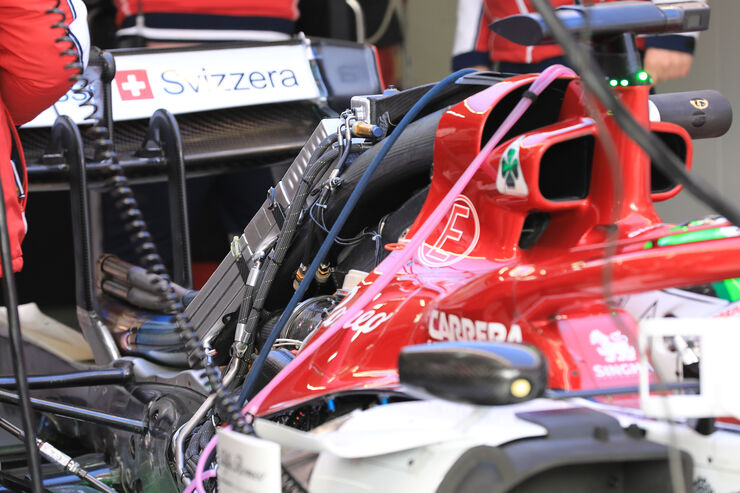
Judging from the pic above, the two wastegate pipes split in a Y scheme from the wastegate exit pipe. So no wastegate pipe trickery like shown by ferrari in 2018.
Re: Ferrari Power Unit Hardware & Software
Posted: 20 Feb 2019, 06:47
by wuzak
Is there still oil vapour coming from Ferrari engines?
Re: Ferrari Power Unit Hardware & Software
Posted: 21 Feb 2019, 09:08
by MarcJ
Tzk wrote: ↑14 Feb 2019, 23:14
It's about efficiency. You want as little weight as possible on the pistons and connecting rods, as this is wasted energy in a energy (fuel) limited formula. So in a perfect world you would reach the minimum weight, just as the teams try to with the whole car.
Having compatible thermal expansion between piston and liner, steel with surface finishing offering lower friction coefficient and piston skirt surface area reduced. The shape optimisations possible at operating temperature identified under numerical simulation at high mesh resolution only really limited by machine and tooling. Iterative optimisation they know the temperature and forces.
The kinematic behavior of the crank mechanism is improved, lower dead volume at top land, reduced blowby and more efficient combustion (less UHC, more complete) , K. Schreer "Analysis of aluminum and steel pistons" Journal of engineering for gas turbines and power.
The steel piston with or without tbc coating shown to improve combustion via various means, the surface temperature is more homogeneous.
With efficiency the #1 priority making steel pistons work was a priority to a big step change increase to overall engine efficiency.
TBC coatings on steel pistons are more durable than on aluminum, you can rely on the thermal behavior being consistent and improving combustion efficiency, lean limits and less coefficient of variance in the combustion phasing, less stresses on rotating assembly.
One thing to note with low temperature combustion with high bMEP is turning off the piston squirter leads to a 1.4% increase in Thermal efficiency, cooling the piston is killing TE.
Re: Ferrari Power Unit Hardware & Software
Posted: 21 Feb 2019, 13:41
by subcritical71
MarcJ wrote: ↑21 Feb 2019, 09:08
Tzk wrote: ↑14 Feb 2019, 23:14
It's about efficiency. You want as little weight as possible on the pistons and connecting rods, as this is wasted energy in a energy (fuel) limited formula. So in a perfect world you would reach the minimum weight, just as the teams try to with the whole car.
Having compatible thermal expansion between piston and liner, steel with surface finishing offering lower friction coefficient and piston skirt surface area reduced. The shape optimisations possible at operating temperature identified under numerical simulation at high mesh resolution only really limited by machine and tooling. Iterative optimisation they know the temperature and forces.
The kinematic behavior of the crank mechanism is improved, lower dead volume at top land, reduced blowby and more efficient combustion (less UHC, more complete) , K. Schreer "Analysis of aluminum and steel pistons" Journal of engineering for gas turbines and power.
The steel piston with or without tbc coating shown to improve combustion via various means, the surface temperature is more homogeneous.
With efficiency the #1 priority making steel pistons work was a priority to a big step change increase to overall engine efficiency.
TBC coatings on steel pistons are more durable than on aluminum, you can rely on the thermal behavior being consistent and improving combustion efficiency, lean limits and less coefficient of variance in the combustion phasing, less stresses on rotating assembly.
One thing to note with low temperature combustion with high bMEP is turning off the piston squirter leads to a 1.4% increase in Thermal efficiency, cooling the piston is killing TE.
MarkJ, you wouldn’t have a free link to that paper would you?
I have often thought TBC would be the perfect solution on top of the piston as it’s used extensively on gas turbine parts which are also subjected to very high combustion temperatures. While I was trying to find a link to that paper I came across this one (
https://ac.els-cdn.com/S235197891730368 ... 4b1c9c6c82), page 648 has a CAD representation of what a steel piston could look like.
Re: Ferrari Power Unit Hardware & Software
Posted: 21 Feb 2019, 16:29
by F1NAC
wuzak wrote: ↑20 Feb 2019, 06:47
Is there still oil vapour coming from Ferrari engines?
yup

Re: Ferrari Power Unit Hardware & Software
Posted: 21 Feb 2019, 16:36
by saviour stivala
wuzak wrote: ↑20 Feb 2019, 06:47
Is there still oil vapour coming from Ferrari engines?
Today the fourth day of testing the FERRARI was still smoking driving out from the pit lane but not on track.