Page 56 of 431
Re: Ferrari Power Unit
Posted: 14 Feb 2018, 17:00
by Morteza
Re: Ferrari Power Unit
Posted: 15 Feb 2018, 21:20
by 63l8qrrfy6
So no steel pistons for Ferrari then (according to
https://www.autosport.com/f1/news/13437 ... 018-engine).
Quite dissappointing since they worked so well in Le Mans diesels.
Re: Ferrari Power Unit
Posted: 15 Feb 2018, 22:42
by F1NAC
roon wrote: ↑15 Feb 2018, 22:39
Source?
Italian motorsport claimed that they abandoned this because it proved unreliable/didn't meet expectations
Re: Ferrari Power Unit
Posted: 17 Feb 2018, 15:08
by PlatinumZealot
As I predicted. The ring lands is the problem area in compact steel pistons. High heat in a small space would seriously harm oil passing in that area.
Re: Ferrari Power Unit
Posted: 17 Feb 2018, 15:24
by 63l8qrrfy6
But one of the major advantages of a steel piston is that you can have a higher top ring/ shorter top land with a smaller crevice volume.
Or did you mean that the higher crown temperatures promotes oil coking? That sounds plausible.
You can cut back lower lands if land contact is an issue. This tends to be better for ring dynamics too as it reduces inter ring pressure due to the larger volume.
I really want to know why they don't work - it's just one of those things that look so good on paper.
Re: Ferrari Power Unit
Posted: 17 Feb 2018, 15:45
by johnny comelately
Carbon pistons maybe?
Re: Ferrari Power Unit
Posted: 17 Feb 2018, 19:22
by roon
Disallowed.
Re: Ferrari Power Unit
Posted: 17 Feb 2018, 22:18
by PlatinumZealot
Mudflap wrote: ↑17 Feb 2018, 15:24
But one of the major advantages of a steel piston is that you can
have a higher top ring/ shorter top land with a smaller crevice volume.
Or did you mean that the higher crown temperatures promotes oil coking? That sounds plausible.
You can cut back lower lands if land contact is an issue. This tends to be better for ring dynamics too as it reduces inter ring pressure due to the larger volume.
I really want to know why they don't work - it's just one of those things that look so good on paper.
The higher temps at the ring lands come from precisely that, not to mention the smaller dimensions of the piston versus aluminum and the lower local heat conductivity. These problems were documented in experiments carried out by research on steel pistons for motor cycles and are really the major challenge they face - the whole thermal aspect of it all. The tribology aspect won't work if the piston keeps coking the oil on the side of it.
Re: Ferrari Power Unit
Posted: 17 Feb 2018, 22:49
by johnny comelately
roon wrote: ↑17 Feb 2018, 19:22
Disallowed.
Yes, i see what you mean after reading the FIA specs.
But is also a grey area where the definition of ceramic and ceramic matrices is so broad as to be not clear enough to exclude the carbon that is used in pistons (based on the very non specific definition of ceramics chemical and crystalline structure).
So, an arguable point that they could take cap in hand and traipse up to Paree and try it on?
And then once you have been told not to let the door hit you on the way out, you would apply to the Hague for a crime against the advancement of man, leak it to the hungry (F1) press and claim it as an advertising expense, send an invoice to liberty and the other teams for services rendered, go back to court that afternoon and apply for an injunction for two years, go home and fit said pistons and win. Thus making it impossible for the FIA to disallow the win and then serve them with a writ for damages if they pursue the matter as it causes losses of non engineering type.

They really are dudes without hats
Oh, and as a footnote, use Ecclestone, B as a consultant.
Hang on, this is a Ferrari topic/post, there is no need to do any of the above

Re: Ferrari Power Unit
Posted: 17 Feb 2018, 22:53
by 63l8qrrfy6
Yet steel pistons dominated Le Mans in audi/peugeot diesels.
In terms of durability, cylinder pressure and temperatures I think those diesels are comparable to current F1 engines.
While oil coking is probably a genuine issue for production engines, I can't see it being such a problem for less than 10k km.
Re: Ferrari Power Unit
Posted: 18 Feb 2018, 00:30
by PlatinumZealot
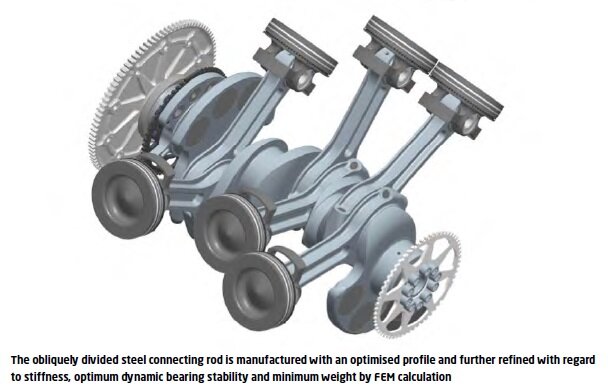
Not an expert here.. But looking at the steel diesel pistons they have very tall crowns with more rings compared to formula 1. If i am not wrong the piston body is also made of two or more peices. One part the main crown and yoke and another part to channel the oil cooling.
From reading the link below the crank stroke and connecting rods had been very long to reduce loadings leading to a taller engine block? Might be restricted in F1.
The harmony among the engine block, the steel piston, the heat and pressure of combustion and the engine speed proves must be difficult to attain in the light weight F1 engine package.
http://zero-100.ru/index/audi_r18_3_7_l ... ines/0-269
Re: Ferrari Power Unit
Posted: 18 Feb 2018, 00:39
by J.A.W.
To be fair, steel pistons were trialled in the Ducati Panigale Superbike, a high rpm big-bore S.I. design.
Re: Ferrari Power Unit
Posted: 18 Feb 2018, 01:38
by 63l8qrrfy6
PlatinumZealot wrote: ↑18 Feb 2018, 00:30
Not an expert here.. But looking at the steel diesel pistons they have very tall crowns with more rings compared to formula 1. If i am not wrong the piston body is also made of two or more peices. One part the main crown and yoke and another part to channel the oil cooling.
From reading the link below the crank stroke and connecting rods had been very long to reduce loadings leading to a taller engine block? Might be restricted in F1.
The harmony among the engine block, the steel piston, the heat and pressure of combustion and the engine speed proves must be difficult to attain in the light weight F1 engine package.
http://zero-100.ru/index/audi_r18_3_7_l ... ines/0-269
http://zero-100.ru/englih/72.jpg
2 part construction is only required for gallery cooled steel pistons. Box bridged steel pistons can be single piece.
The crown is tall just because it contains the bowl - should not be an issue in F1.
Long rods are usually a consequence of the higher compression height (pin bore moves up in the steel pistons) arguably reducing friction. Piston side loads are not generally a structural concern, in fact many production steel pistons are of an articulated design with a separate aluminium skirt.
Can the higher crown temperatures cause combustion issues ? Detonation/preigntion ?
I wonder if sintered steels with high copper content can be used. These are commnly used as valve seat and valve guide material in high performance bikes and proivde better conductivity than tool steels.
Re: Ferrari Power Unit
Posted: 18 Feb 2018, 04:18
by PlatinumZealot
Can your sintered steel of high copper content be easily machined though?
Re: Ferrari Power Unit
Posted: 18 Feb 2018, 04:23
by Maritimer
PlatinumZealot wrote: ↑18 Feb 2018, 04:18
Can your sintered iron of high copper content be easily machined though?
Why wouldn't it be?