
Rear wing aerodynamics
How it works
The basic principle of a formula one wing is exactly the same as with a common aircraft. The greatest difference is the direction air is pressed and how that aerodynamic force is generated. Knowing that an aircraft wing does the opposite of an F1 wing, I'll explain a formula one wing. I will start from the idea that we are testing a single rear wing in a wind tunnel. The main advantage of this theoretical example is that it leaves out some natural factors. With a single wing, we do not have to think about turbulence that is generated by the car itself (the engine cover mainly), neither do we have to take in account the direction and speed of outside wind. It is obvious that both these factors decrease the efficiency of a aerofoil.
As you can see in the picture below, air flows onto the rear wing with a straight direction (which is often called clean air) at the speed of the car. The white flaps push the air up. Following Newton's law, an action causes a reaction, which is why the aerofoil is being pushed towards the ground by the air. Having in mind that air flowing onto the flaps is pushed upwards, and under flowing air keeps going its own way, a low pressure area (nearing a vacuum at very high speeds) is created right behind the horizontal aerofoils. This 'vacuum' causes a suck up of the air passing under that flap. The air passing underneath on the other hand again flows faster in an attempt to equalize pressure on both sides of the aileron, and thereby increasing the total wing efficiency. Because of the car's speed this is impossible, which is why the effect is maintained. The force that is created by this type of wing, so that the car is pressed onto the ground, is called downforce.
| Straight forward gong air at the speed of the car. | 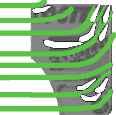 |
Rear wings
About a third of the car's total downforce can come from the rear wing assembly. The rear wings are the ones that are varied the most from track to track. As the rear wings of the car create the most drag the teams tailor the rear aerodynamic load to suit a particular track configuration.
As air flows over the wing, it is disturbed by the shape, causing a drag force. Although this force is usually less than the lift or downforce, it can seriously limit top speed and causes the engine to use more fuel to get the car through the air.
From the year 2001, the FIA regulations have changed concerning the rear wing. To increase the ability of overtaking and slipstreaming, the number of rear wing elements is now being limited to 3. This should decrease the downforce and acceleration. The only effect that might have come with this regulation change, is at high downforce circuits, there will be a little more air resistance to produce the same downforce.
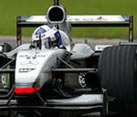
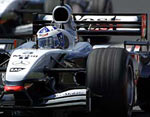
The pictures below both show David Coulthard in his MP4/17 from 2002. The picture of the left shows him at Monza 2002, whilst the picture on the right was taken at the Nurburgring. You can see that the rear wing profiles are very different. On the left picture, very little of the rear wing can be seen, whilst the Monaco wing has much of the profile visible:
The diffuser
The smallest thing which you can count to the wings part is the diffuser. Actually, it does exactly the opposite of a rear or front wings. Instead of pushing the air up, it sucks the air up. The volume of the diffuser increases towards to the end of the car.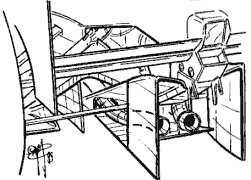 Where a certain amount of molecules filled for example 1dm³ under the car, these now fill 2dm³. This drop of pressure causes a car to be sucked towards the ground. Driving at a speed of 300 km/h, the groundeffect of the car would be extreme if there was no air under the car itself. Therefore, the FIA has forbidden strokes and sloping car bottoms because of safety reasons. Instead of raising the back of the car, the diffuser sucks the air away from under the car because the low pressure. The diffuser us placed under the rear wing and is actually a sweep up of the car's floor. It consists of many tunnels and splitters which carefully control the airflow to maximize this suction effect. The design of the bottom of the car, and thereby the diffuser is a critical area, because it can greatly influence the car's behaviour in corners. More importantly, the designers have to be careful that the car keeps working good in all circumstances, and at any distance from the ground. Losing all of the diffuser's generated downforce when riding over a curb will greatly generate a nervous behaviour of the car itself. The strokes and flips withing the diffuser have lately become that advanced (curbed and even foreseen by gurney flaps sometimes) that any track distance is insufficient to guarantee good performance. It is still a part where a lot of time can be gained on current F1 cars, partly by pulling more air towards the diffuser by inducing the coke-bottle effect.
