
Ferrari 312T
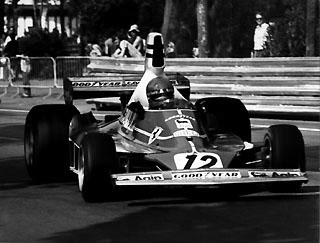
Active: 1975 - 1976
Team: Scuderia Ferrari SpA
Designers: Mauro Forghieri (CD), Franco Rocchi (HE)
Drivers: Niki Lauda (12), Clay Regazzoni (13)
After two difficult years in 1972 and 1973, Ferrari established itself again as a powerful force in Formula One. The surge was the result of many changes within Ferrari's structure, including re-instating Mauro Forghieri as Chief Designer and appointing Luca Di Montezemolo as team manager. Niki Lauda, the promising young Austrian driver stayed with the team after missing out on the championship title in 1974.
When the team presented its brand new Tipo 312T to the press on 27 September 1974, it was clear that Forghieri had closely looked at Derek Gardner's Tyrrell and Robin Herd's March cars to seek a more tight packaging of the car's components. The resulting lower polar inertia produced a highly manoeuvrable car that would prove more agile in the corners than any of its predecessors.
The front suspension had been completely redesigned and attached to the tubular chassis ahead of the frontal bulkhead of the monocoque. The wheels were actuated by two long push rods nearly extending to the very centre of the car where they connect to Koni dampers.
The monocoque's front end was also made considerably smaller while the shovel nose connected to it was constructed from moulded GRP. The aluminium front wing was simply attached on top of the nose.
The side pods, extending from between the front wheels to the frontal face of the rears accomodates oil and water coolers, parts of the engine and the mandatory side impact crash structures. Around the rear wheel, the body was also curved up to direct airflow away from the wide rear Goodyear tyres. These rear wheels were hung up with the rear suspension based on reversed lower wishbones, replacing the original toe-steer restricting parallel link system to reduce weight.

This Ferrari however thanks his name to its most important technical innovation, the transverse gearbox. Contrary to previous designs, this box has most of its weight ahead of the rear axle to enhance the central mass concentration. The gearbox input was turned 90 degrees by bevel gears to enable the gearbox shafts to be arranged alterally, final drive being via spur gears.
Powering this car is a flat V12 engine, a thoroughly developed version of the 1974 version. It was at the time claimed that the engine produced 500hp at 12200 rpm, topping the Cosworth DFV engine that most other teams were equipped with.
Despite intensive testing by Lauda at Ferrari's new Fiorano track, the car did not make its debut until the South African Grand Prix, the third race of the championship. There, the car made a disappointing debut but later on in the season proved its superiority. Lauda went on to win 4 races in 5 mid-season before clinching the championship at Monza. The car was good for 9 pole positions that year, 6 fastest laps and 8 race wins - 6 of which during championship races - , 6 for Lauda and 2 on the account of Regazzoni.
After 1975, the car was also used in the beginning of 1976 until the Ferrari 312T2 was ready to be raced. The car completed the Brazilian, South African and US GP West at Long Beach with Lauda winning the first two and Regazzoni the third.
Specifications
Chassis: Type 015 monocoque body, aluminium panels riveted to rectangular section tubular steel structure with boxed supports
Front Suspension: Double wishbones, rocker arms, inboard spring/dampers units and anti-roll bar
Rear Suspension: Reversed lower wishbones, upper arm, and central radius arm
Brakes: Discs and Lockheed calipers, inboard at rear
Steering: Rack and pinion
Length: 4143 mm
Width: 2030 mm
Height: 1275 mm
Wheelbase: 2518 mm
Front/Rear Track: 1510 mm / 1530 mm
Kerb Weight (with water and oil): 575 kg
Front Tyres: 9.2-20.0-13", Goodyear
Rear Tyres: 16.2-26.0-13", Goodyear
Wheels: split rim, front 10x13", rear 17/18x13"
Fuel Tank: 200 litres, 2 side and 1 central tanks
Bodywork: Single-seater aluminium body and composite elements
Transmission: Rear-wheel drive, Borg & Beck multi-plate clutch, 015 transverse-mounted inboard 5-speed gearbox + reverse, friction plate limited-slip differential
Gear Ratios: Variable depending on track
Engine
Type: Type 015 rear-mounted 180° V12, light alloy cylinder block and head, aluminium wet liners, 112 mm connecting rods, water cooled
Bore & Stroke: 80 x 49.6 mm
Unitary and Total Displacement: 249.317/2,991.801 cc
Compression Ratio: 11.5:1
Max. Power Output: 495 bhp at 12,200 rpm
Timing Gear: 4 valves per cylinder, 2 overhead camshafts per cylinder bank, gear driven off the rear of the engine
Fuel Feed: Lucas indirect injection
Ignition: Single plug, Dinoplex electronic capacitive discharge, coil-ignition
Lubrication System: Dry sump