
Lotus 88 Cosworth
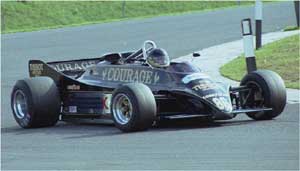
Active: 1981
Team: Team Lotus
Crew: Colin Chapman, Peter Wright, Tony Rudd, Martin Ogilvie
Team: Essex Lotus
From 1981 on, the FIA forbade movable skirts at the side of the car, and thus seriously limited the ground effect of cars drastically. Steady skirts 60mm from the ground were the only alternative. As this reduced cornering speed, all teams were looking for replacements and new things to make this disadvantage melt away.
After the revolutionary Lotus 86 was conceived back to end 1979 at the time when the last attempt to cure the type 80 failed. While the 80 could create massive ground effect, the car became unbalanced as the ground effect was sensitive to movements of the car and altered during braking, acceleration and cornering. The trick was to maintain ride height all around the race track.
With active suspension unavailable back in the days, the only feasible solution was to fit really stiff springs in the suspension, though this would make the car nearly undriveable, as it would equal a car without any suspension at all. Lotus boss and designer Colin Chapman, already legendary at that time, believed the solution was to eliminate the aerodynamic and suspension loads exerted on the chassis. That's why the Lotus 88 was built, a car which by careful (yet legal) manipulation of the rule book, featured two chassis!
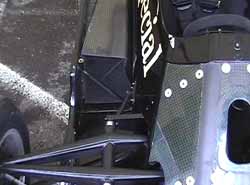
Basically, the car consisted of a primary, external chassis that carried the aerodynamic bodywork, side pods, skirts and wings. The secondary, internal chassis carried the wheels, carbon fibre monocoque, fuel tank, the engine and the transmission. The inner, primary chassis was relatively soft sprung, which allowed the driver to be in quite a comfortable position, as he would not feel all those harsh bumps. The outer chassis, designed to cope with aerodynamic downforce, was attached on the primary chassis' suspension, close to the uprights by an extremely stiff coil spring damper arrangement.
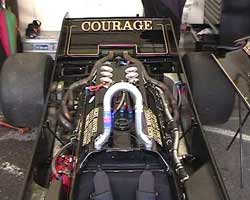 The car appeared at Long Beach and was declared illegal and disqualified - by means of a black flag - during the middle of the Saturday practice sessions. Despite the fact that the scrutineers had declared the car legal, rival teams had protested and the car was destined never to compete in a Grand Prix. The FIA motivated that the second chassis was actually an aerodynamic device that acted directly on the wheel uprights, a feature that had been banned to improve the safety of fitting aerofoils onto cars. Despite the protests of Lotus the car never raced in a Grand Prix.
Elio De Angelis (driver for Lotus in 1981, with Nigel Mansell) - Grand Prix International, by Mike Doodson
Q: Now that you have driven the secret new Lotus, what do you think of its chances in 1981?
"To be perfectly honest, it's not working yet. But I am hopeful that it will make a big improvement when we have done some more work."
 After the ban at Long Beach, Colin Chapman threatens to pull Lotus out of Formula One and boycotts the new San Marino Grand Prix at Imola. When the teams arrived at Imola for the first San Marino GP (temporarily replacing Monza because it was modernizing), one of the sport's most legendary names was missing. Chapman afterwards had taken his Lotus 88 to the Brazilian and Argentinian rounds only to have it banned. He argued that the rule-makers, with their lack of vision, were destroying what was meant to be the pinnacle of motorsport. Balestre therefore fined him $100,000, however this was later cancelled after pressure from the same rival teams who had protested the car's legality in the first place.
So it was, that the 1981 San Marino GP marked the first time that a Grand Prix did not see a Lotus at the start since Monaco 1958. A little over a year later Chapman died of a heart attack and it's widely believed that following the '88 issue' the Lotus genius never saw the sport in quite the same light again.
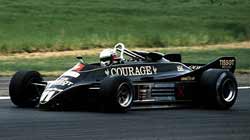 Colin Chapman designed the Lotus 88 to race in the 1981 Formula One championship. The theory behind it was to reduce the buffeting to which the driver of a Formula 1 car had become accustomed since the introduction of ground effect cars, again pioneered by Chapman, in 1977.
However, at the first race of the season, in Long Beach, USA, 10 of the 15 teams protested the car, claiming it contravened a rule that mandated all aerodynamic parts to be rigidly attached to the sprung part of the car. Since the car originally passed the stewards' scrutineering, Chapman took the case to the Automobile Competition Committee for the United States, who supported the stewards. The car however was black flagged in practice the next day as teams continued their protests. The same thing happened at the next two races, forcing Chapman to go to the Court of Appeal in Paris, where he lost his case, despite having hired Robert Hinerfeld, previously a lawyer for Richard Nixon. The dispute eventually came to an end when Chapman backed out after Jean-Marie Balestre forced the RAC at Silverstone to ban the car, threatening to take away the championship points of the British GP if they would allow the car to race.
Many believe that this situation was the beginning of Chapman's demise in F1, having seen his novel ideas being outruled, despite his own firm belief that his car was legal. The brilliant designer would only see one of his cars win once again, before succumbing to a heart attack in December 1982.