Idea for a little extra aero efficiency..

Here are our CFD links and discussions about aerodynamics, suspension, driver safety and tyres. Please stick to F1 on this forum.
0

Post Fri Dec 25, 2009 12:40 am

How are engine temps controlled with an air cooled engine without forced draft cooling?

And onto the wing cooling concept, it would have to dissipate 750hp through a small area, there should be a lot of thermal expansion and weakening of the wing and maybe a little thermal fatigue.

kinda related to the topic but check out this bomber, the wings panels normally leak fuel, they only seal properly when they expand at high temps at mach 3:

For Sure!!
ringo
45
User avatar
 
Joined: 29 Mar 2009

0

Post Fri Dec 25, 2009 2:57 am

only nit-picking but the SR-71 / A-12 was never a fighter or a bomber...although i do believe the former role was once planned. They did, however, carry plenty of cameras and the occasional supersonic drone for photography.
newbie
0
 
Joined: 29 Sep 2009

0

Post Fri Dec 25, 2009 7:06 am

right! :)
I was thinking of the b2 and f117 for some reason or the other. #-o
I had the privelage to see the sr71 on the intrepid air craft carrier in New York years ago; very impressive aircraft
For Sure!!
ringo
45
User avatar
 
Joined: 29 Mar 2009

0

Post Fri Dec 25, 2009 8:56 am

ringo wrote:How are engine temps controlled with an air cooled engine without forced draft cooling?

kinda related to the topic but check out this bomber, the wings panels normally leak fuel, they only seal properly when they expand at high temps at mach 3:


Good question, but I don't know if you actually adjust the fan-speed or the water-flow of a racing engine either?

The leaking fuel-tank of the SR-71 sounds suspiciously like an urban-legend to me?
"Bernoulli is a nine-letter name"
xpensive
12
User avatar
 
Joined: 22 Nov 2008

0

Post Fri Dec 25, 2009 1:56 pm

actually the problem is not the high speed stuff but the low speed high load part of the game.
If f1 adjusts waterpump speed for cooling demand i don´t know ,one would only have to check if the pump was driven by the crank or had an extra means of propulsion.
The real question is if you delete the watersystem ,will this speed up the change in temp in the engine or not and will load peaks at low vehicle speeds be a problem to
dampen out with such a system.
marcush.
105
 
Joined: 9 Mar 2004

0

Post Sat Dec 26, 2009 8:43 pm

xpensive wrote:
ringo wrote:How are engine temps controlled with an air cooled engine without forced draft cooling?

kinda related to the topic but check out this bomber, the wings panels normally leak fuel, they only seal properly when they expand at high temps at mach 3:


Good question, but I don't know if you actually adjust the fan-speed or the water-flow of a racing engine either?

The leaking fuel-tank of the SR-71 sounds suspiciously like an urban-legend to me?


Watch from 6 minutes in the video, you will see the fuel dripping out!
For Sure!!
ringo
45
User avatar
 
Joined: 29 Mar 2009

0

Post Sat Dec 26, 2009 11:08 pm

ref the aircooling - you'll still need pretty large oil rads for the engine oil and the gearbox oil.

Air cooling, in a sealed engine bay, won't quite cut it IMO.

Loving Porsches though!
IMPERATOR REX ANGLORUM
CMSMJ1
3
 
Joined: 25 Sep 2007
Location: Sheffield, United Kingdom

0

Post Sat Dec 26, 2009 11:22 pm

CMSMJ1 wrote:ref the aircooling - you'll still need pretty large oil rads for the engine oil and the gearbox oil.

Air cooling, in a sealed engine bay, won't quite cut it IMO.

Loving Porsches though!


this will be one of the big blows for such a concept .You will have to increase oil cooling capacity ,negating the original aim to get rid of the two big airducts for the radiator cores.....so instead of an aero advantage you might face additionaldrag as you need to channel a lot of air through the engine bay at low car speed .the problem will be this will add up to even more air going through the car at high speed ,adding drag...or you will have to devote a lot of time into -passive -air redirection at higher speeds via design of the inlet arrangement....
marcush.
105
 
Joined: 9 Mar 2004

0

Post Sun Dec 27, 2009 6:13 am

Well with body work like this:

Image

sorry about the size; now with something like this over the engine, air cooling could be less of a problem.
For Sure!!
ringo
45
User avatar
 
Joined: 29 Mar 2009

0

Post Sun Dec 27, 2009 11:43 am

It could be Ringo...but the thread is about aero efficiency...and lots of gills in the engine cover would not promote efficiency.
IMPERATOR REX ANGLORUM
CMSMJ1
3
 
Joined: 25 Sep 2007
Location: Sheffield, United Kingdom

0

Post Mon Dec 28, 2009 4:52 am

CMSMJ1 wrote:It could be Ringo...but the thread is about aero efficiency...and lots of gills in the engine cover would not promote efficiency.

True, it kinda drifted to the air cooled thing. :mrgreen:
The gills are in a pressure recovery area. They won't take away much from the performance. May cause some eddies, but generally i rhink they can be used beneficially.

I am not too sure of the total effect of gills but seeing that lamborghini uses them a lot on their cars, and I have also seen them put on race cars in pressure recovery areas, they may have some performance benefits along with it's compromise.

Image

fender louvres can be classified similarly:
Image
Last edited by Ciro Pabón on Wed Dec 30, 2009 6:14 am, edited 1 time in total.
Reason: Broken link
For Sure!!
ringo
45
User avatar
 
Joined: 29 Mar 2009

0

Post Mon Dec 28, 2009 5:02 pm

Water thermal condutivity is around 20 times bigger than air, so not bothering with the other factors involved, like speeds and Reynold's numbers inside the water piping and outside the wing, you will need something in the order of 20 times air contact area compared to water's. That's why radiators have a very thin grid to create greater air contact surface.

It's not for no reason that nothing like this is used today. It was tryied and failed: http://en.wikipedia.org/wiki/Brabham_BT46
rjsa
12
 
Joined: 2 Mar 2007

0

Post Mon Dec 28, 2009 5:16 pm

ringo wrote:
xpensive wrote:
ringo wrote:How are engine temps controlled with an air cooled engine without forced draft cooling?

kinda related to the topic but check out this bomber, the wings panels normally leak fuel, they only seal properly when they expand at high temps at mach 3:


Good question, but I don't know if you actually adjust the fan-speed or the water-flow of a racing engine either?

The leaking fuel-tank of the SR-71 sounds suspiciously like an urban-legend to me?


Watch from 6 minutes in the video, you will see the fuel dripping out!


Yeah this is the truth, has been so since around 62. My father and grand father are both avid aviators and have talked about this plane, and many others, for my whole life.

I beleive the original YF-12A concept was meant to be a bomber as well, but the SR-71 was all about the eyes in the sky.

Neat story. On the last flight of the SR-71, it went ahead and resmashed it's old altitude and speed records.

I did a project on this plane when I was in grade 4.

The AF-12s would take the seventh through ninth slots on the A-12 production line and have them completed in the YF-12A interceptor configuration.[4] The main changes involved modifying the aircraft's nose to accommodate the Hughes AN/ASG-18 fire-control radar originally developed for the XF-108, and the addition of a second cockpit for a crew member to operate the fire control radar. The nose modifications changed the aircraft's aerodynamics enough to require ventral fins to be mounted under the fuselage and engine nacelles to maintain stability. Finally, bays previously used to house the A-12's reconnaissance equipment were converted to carry four Hughes AIM-47 Falcon (GAR-9) missiles.[5]

Before I do anything I ask myself “Would an idiot do that?” And if the answer is yes, I do not do that thing. - Dwight Schrute
Giblet
0
User avatar
 
Joined: 19 Mar 2007
Location: Downtown Canada

0

Post Mon Dec 28, 2009 5:25 pm

rjsa wrote:Water thermal condutivity is around 20 times bigger than air, so not bothering with the other factors involved, like speeds and Reynold's numbers inside the water piping and outside the wing, you will need something in the order of 20 times air contact area compared to water's. That's why radiators have a very thin grid to create greater air contact surface.

It's not for no reason that nothing like this is used today. It was tryied and failed: http://en.wikipedia.org/wiki/Brabham_BT46


call me dumb or watever I did not get the thoughts leading to your statement.
the water still has to disperse the heat into free air ....so in effect the area needed is still the same as you need to get rid of the haet of the engine still..

The Bt46 was liquid cooled ,of course ,so for sure the surface area was way too small for the efficiency those surface cooling modules could provide.To me this is
only proof to Gordon Murray completely missing the boat with his calculations presumably based on wrong efficiency numbers.

A aircooled setup is for sure feasible. As far as I know nobody yet got very sophisticated in cooling ribs and duct design to match the designs in water cooler cores with louvered folded and what have you special bits to improve heat transfer assuming someone is willing to start pumping recources into such a project it would surely work ,at least in f1
marcush.
105
 
Joined: 9 Mar 2004

0

Post Mon Dec 28, 2009 6:56 pm

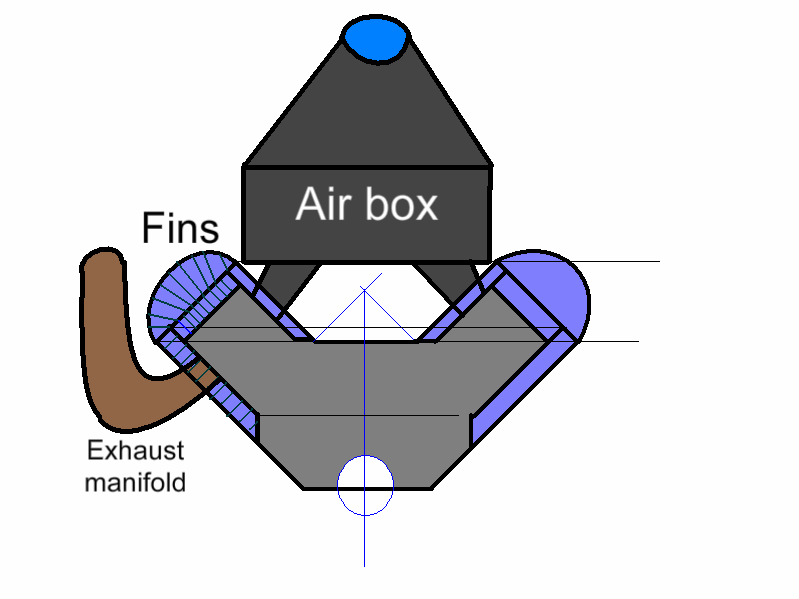
The louvers sure do work.. But my main concern is how do we get the required air flow around the fins of the engine. I made a quick MS paint sketch to show what I am talking about. This is a Formula 1 90* V8 with fins.
Image

Notice the area around the cylinders are smaller because there are no more water jackets. Fins are there now. So yes, lets just assume that the temperature distribution is all figured out. How and where would the air flow be entered into under the cover and onto the engine fins?

Various shielded ducts?
From the front where the radiators used to be or the top (or the bottom)?

Extend the fins into the air flow?

We must also think about the required size of the inlet openings. :-k Will they be much smaller than the present openings?
"I was blessed with the ability to understand how cars move," he explains. "You know how in 'The Matrix,' he can see the matrix? When I'm driving, I see the lines."
n smikle
0
User avatar
 
Joined: 12 Jun 2008

PreviousNext

Return to Aerodynamics, chassis and tyres

Who is online

Users browsing this forum: turbof1 and 13 guests