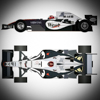
Sucked wing idea

Here are our CFD links and discussions about aerodynamics, suspension, driver safety and tyres. Please stick to F1 on this forum.

Post Thu Jun 03, 2010 8:17 pm

It's the overcapacity that builds pressure by the relative speed at the inlet.

If you are travelling at 83 m/s (300 km/h) and the inlet speed is one fourth of that, the relative speed will be 62 m/s.

Dynamic pressure is Density times Speed squared over two, in this case 2300 Pa if the density of air is 1.2 kg/m^3.
2300 Pa is 2.3% of the atmospheric pressure, which in principle means that you boost engine power with the same.

With 750 hp at atmo, 2.3% means an xtra 17 Hp.

But at the same time, Drag will cost you Power as in Force times speed. Force is 2300 Pa times inlet area 0.0225 equals 52 N.
Drag Power then is 52 N times 83 m/s resulting in 4300 W or 6 Hp.

Net gain is 17 - 6 = 11 Hp.
"Bernoulli is a nine-letter name"
xpensive
 
Joined: 22 Nov 2008

Post Fri Jun 04, 2010 7:10 pm

Is the diameter of inlet limited by FIA?
manchild
 
Joined: 3 Jun 2005

Post Fri Jun 04, 2010 7:28 pm

er Fluids flow from High pressure to low pressure. The Airbox is designed to slow the air down and increase static pressure and is at a higher pressure. I don't think it'll suck anything from the rear wing.

It did appear to be a great idea at the outset, sadly I don't think it will work.
Shrey
 
Joined: 2 May 2010

Post Fri Jun 04, 2010 7:52 pm

Shrey wrote:er Fluids flow from High pressure to low pressure. The Airbox is designed to slow the air down and increase static pressure and is at a higher pressure. I don't think it'll suck anything from the rear wing.

It did appear to be a great idea at the outset, sadly I don't think it will work.

Top of rear wing has higher pressure, otherwise it wouldn't be able to push the wing down. It faces air stream at full span, aided with endplates that prevent sideways spilling, unlike airbox that faces only what can pass trough inlet that is much smaller than airbox's volume.
manchild
 
Joined: 3 Jun 2005

Post Fri Jun 04, 2010 8:52 pm

Top of rear wing has higher pressure, otherwise it wouldn't be able to push the wing down. It faces air stream at full span, aided with endplates that prevent sideways spilling, unlike airbox that faces only what can pass trough inlet that is much smaller than airbox's volume.


I guess someone with enough knowledge of Aero would be able to best answer on the idea's feasibility. But I'm guessing that for there to be any benefit,the pressure difference would have to be substantial for the air to be able to be sucked in by 180 degrees. Boundary layer suction devices I've read about on aircraft are not passive, they are powered and for it to work a separate pump would be required which is of course not allowed in F1.
Shrey
 
Joined: 2 May 2010

Post Sat Jun 05, 2010 4:55 pm

To make xpensives statement more visible I made a little graph. You can see that the useful range where the engine demands more air than the airbox can deliver is at relatively low speed. At this speed you will indeed have low pressure in the airbox. You can notice that at some race cars with restrictor, there you can see the airbox breathing while applying high revs on a standing car. In fact the airbox has to withstand the forces produced there.

data: engine with 2,4L at 18.000 1/min
Airbox with diameter of 15cm
Image

Uploaded with ImageShack.us

I guess this idea makes little sense for F1, the airbox is just to big for it and the speed where you get low pressure is therefore to low. Anyways there are other racing series where you have a restrictor and run at lower speeds.
So guys please make some comments about the idea of sucking/blowing the underside of a wing. It could well fit to a FSAE car in terms of speed and high downforce demand. I know you don’t necessarily need downforce there but when you have a high efficient wing you could produce enough downforce to get an advantage by this.


mep wrote:Last time I was a bit in a hurry because I was at work so I just fly over the thread. You where writing about sucking top surface but I and maybe others to think about sucking lower surface.

What I want to do is to keep airstream attached to the wings profile and therefore running it at higher angles of attack. For this I make several slits over whole wing span and connect them with the airbox. The engine doesn’t even need to suck anything in. It just provides low pressure and helps to keep air attached. Due to the low pressure and the higher airspeed you create more downforce during low speed and cornering.
Image

Uploaded with ImageShack.us

At higher car speed more and more air gets collected by the duct above the airbox and starts to blow through the same holes under the wing. This causes the air to detach from the profile. Increased mass flow, changed flow and reduced air speed under the wing rises the pressure and reduces drag and downforce at high speed. So you get all what you want high downforce at low speed and low drag at high speed.
Image

Uploaded with ImageShack.us
mep
 
Joined: 11 Oct 2003
Location: Germany

Post Sat Jun 05, 2010 5:13 pm

A most educative graph mep, do you think you could add the dynamic pressure as a function of the relative speed between car and inlet?
See my last posting above.
"Bernoulli is a nine-letter name"
xpensive
 
Joined: 22 Nov 2008

Post Sun Jun 06, 2010 2:18 am

That 180 degree bend alone is a lot of drag. The momentum change is more than even the wing does on its own.
Imagine a parachute and it's bowl shape, imaging air going in it then being turned around completely? wouldn't that push the chute back? Imagine all the reaction force as that air is turned around?
I will put up a momentum calculation in a little while.

The sucked wing idea adds more drag than widening the air intake. Gimme a while to put up the calcs.
For Sure!!
ringo
 
Joined: 29 Mar 2009

Post Sun Jun 06, 2010 5:12 am

manchild wrote:Is the diameter of inlet limited by FIA?


No idea really, but I can remember in the panic after Sennas death, the FIA demanded holes in the the air-box to relieve pressure.
It looked stupid in 1995, with cars going around with those big airboxes having a cut-out in the back, wonder when that was lifted?
"Bernoulli is a nine-letter name"
xpensive
 
Joined: 22 Nov 2008

Post Sat Jul 03, 2010 8:16 pm

manchild wrote:
ringo wrote:Manchild can you draw a picture including the wing?
I am kind of confused as to what is happening..


Image

I'm not an aero guy so I'm only guessing the position of the slit. Perhaps it should be near the leading edge. I'm not sure. Just thinking out-loud.

Image


Had to quote myself since I'm calling upon previous post based on finding that is new to me.

Check first animated gif, the position of inlets from where the air is skimmed of the wing's top is identical with mine. So, Mercedes system sucks air from the top since the duct exit is behind upper blade with low pressure zone.

Image
manchild
 
Joined: 3 Jun 2005

Post Sat Jul 03, 2010 9:52 pm

I still don't think it makes sence to suck the top surface. You just need to suck in to much air when the car goes with 300km/h. I think they blow out some air there and create a curtain of air who changes the direction of flow.

I can also imagine that these slits are airintakes.
mep
 
Joined: 11 Oct 2003
Location: Germany

Post Wed Aug 18, 2010 8:38 pm

I love all the concepts with this idea. i think also reducing the front facing air inlet could increace the affect of the wing and reduce drag at the wing and inlet. Imagine being able to ajust the drag of your rear wing by ajusting the frontal area of the air inlet. Easy way to have track dependant areo.

BUT i also read with interest the increase in horsepower. 2.3% or 17hp (minus 6hp for drag?) I remember reading. the positives of this system maybe out weighed by the negatives. increase in power adds to increase fule consumption. 2.3% extra fuel of a 150ltr tank (3.45ltr) has to be carried practically the whole race. giving a ltr of race fuel is around 0.9kg, thats an extra 3.1kgs. At most tracks thats a tenth or two a lap. ALL of this of corse is based on comsumption being based on power and consumption are linear which is probably not the case. Also the less drag you have, the quicker you will reach top speed and hence higher revs sooner.
This is probably why mclaren were finding there consumption rates higher than expected with the f-duct.

Anyway, that weight may reduce overall lap time or cancel out the drag benefits. But with the pain of extra weight, tire were and the posiablity of backing off to save fuel if an underestimation of consumption is made.
Richied76
 
Joined: 18 Aug 2010

Previous

Return to Aerodynamics, chassis and tyres

Who is online

Users browsing this forum: Google [Bot], Twitter [Bot] and 3 guests