Fasteners used in Formula 1

Here are our CFD links and discussions about aerodynamics, suspension, driver safety and tyres. Please stick to F1 on this forum.

Post Thu Aug 05, 2010 4:15 pm

riff_raff wrote:n smikle,

Lots of titanium fasteners are used because they are lightweight and have good compatibility with carbon composites. Care must be taken with titanium fasteners though, since their threads readily tend to gall/seize. Titanium is also very notch sensitive, so any fastener that is nicked or gouged must be replaced.

Multiphase steel alloys (like MP35N) are used where very high strength is needed, but not corrosion resistance.

718 Inconel has a good combination of strength, corrosion resistance and high temperature capability.

13-8PH stainless has good strength and corrosion resistance.

Hope that helps.
riff_raff


The cobalt nickel alloys MP35N and MP159 actually have a better corrosion resistance than nickel based superalloys such as Inconel 718. They offer a higher strength too, but cobalt alloys are expensive. They are usually the choice for high temperature corrosive environments where alloys such as Inconel isn't up to the task.

http://www.spstech.com/aero/prod_lit/su ... ochure.pdf

For fasteners attached to carbon fibre bits titanium is a good choice since it's a very noble metal, close to graphite in the galvanic series.

Of course, a high quality screw is forged and has rolled threads.
Edis
 
Joined: 31 Jan 2010

Post Sun Aug 08, 2010 3:43 am

Edis,

Thanks for the correction.

I checked my references on multiphase alloys and they do have good resistance to corrosive environments and stress corrosion. However, an active coating such as cadmium is required where multiphase will contact aluminum, to prevent galvanic corrosion of the aluminum.

Regards,
riff_raff
"Q: How do you make a small fortune in racing?
A: Start with a large one!"
riff_raff
 
Joined: 24 Dec 2004

Post Wed Feb 02, 2011 12:16 pm

Sorry to dig up the old thread, just in case someone still has any interest in this.

On F1 engines they do not cad plate aluminum when in contact with MP alloys, simply because the short life usage of the joint. MP alloys are very strong, both in tensile and shear. Very good corrosion resistance and off course due to the composition (high % of cobalt and nickel) very heavy compared to steel. They are still used on F1 engine etc...

Some years back most of the fasteners were specially designed for F1. Use of standard aerospace fasteners was limited to some non-critical parts. Bear in mind most of the aerospace fasteners are in Inch threads, while most of the F1 application require Metric. But dut to cost cuts, engine freeze, rev limiting and titanium being banned, they started using more and more standards.

Hope it helps, cheers
nobeard
 
Joined: 31 Jan 2011

Post Tue Jul 12, 2011 8:13 am

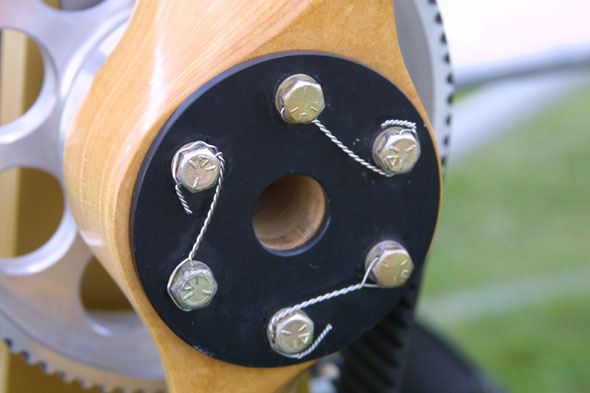
DaveKillens wrote:Here's a simple application that is very common. It's basically six bolts torqued down, and secured by safety wire.

Image

I'm sure that those who know aviation would fail this safety wire attempt. The idea for safety wire is first, to keep the bolt from backing out, and secondly, if it does back out, to minimize the damage. If you examine the bolt at 12 o'clock, it is obvious the bolt could back out quite a bit before the safety wire contained it. The bolts at 2, 6, and 10 o'clock aren't going anywhere, although I would do over 10 o'clock because the safety wire appears to be handled harshly, and has a few odd bends that don't belong.

The actual wire for the job has to be considered carefully, just any old iron wire won't do. In my day, inconel was the standard.

Here's a specialized tool just for the job.
Image

I like this model because it has some rubber between the cutting jaws. Think it through, you are safety wiring, and complete the final twist. Then you cut the wire back ...... but you're not doing your job if that short cut of wire flies off and lodges itself in some important position. So the rubber captures the cut wire, and allows the technician to do a proper job without spreading wire and crap around the aircraft/car.

Old school would have done this as one unit instead of 3 separate ones,... by hand and not use the pliers. The pliers can damage the wire creating a place for it to break...
slime
 
Joined: 31 May 2011
Location: Discount City @US 129

Post Wed Jul 13, 2011 4:43 am

slime,

Lock wire is definitely "old school" in the modern aircraft industry. It is almost never used on new aircraft designs. Instead, self-locking fasteners are now the preferred approach.

In fact, the specific example shown in the photo would not be acceptable under FAA FAR part 25 regulations, even if the lock wiring were done correctly. FAR part 25 requires flight critical fasteners (like those prop bolts) to have 2 separate forms of locking device. The safety wire would only provide 1 form of locking.

With bolts that are clamping a structure that is subject to creep/relaxation (like a wooden prop), the proper dual-locking fastener installation would be something like through bolts and self-locking castellated nuts secured with cotter pins.

Regards,
riff_raff
"Q: How do you make a small fortune in racing?
A: Start with a large one!"
riff_raff
 
Joined: 24 Dec 2004

Post Wed Jul 13, 2011 5:26 am

riff_raff wrote:slime,

Lock wire is definitely "old school" in the modern aircraft industry. It is almost never used on new aircraft designs. Instead, self-locking fasteners are now the preferred approach.

In fact, the specific example shown in the photo would not be acceptable under FAA FAR part 25 regulations, even if the lock wiring were done correctly. FAR part 25 requires flight critical fasteners (like those prop bolts) to have 2 separate forms of locking device. The safety wire would only provide 1 form of locking.

With bolts that are clamping a structure that is subject to creep/relaxation (like a wooden prop), the proper dual-locking fastener installation would be something like through bolts and self-locking castellated nuts secured with cotter pins.

Regards,
riff_raff
safety wire is still used quite a bit in even new aircraft. Even more so on rotating parts.
"The question isn't who is going to let me; it's who is going to stop me."
flynfrog
 
Joined: 23 Mar 2006

Post Wed Jul 13, 2011 5:50 am

In most cases where I've used safety wire, they are meant for blind threaded bolts, where you can't/don't use a nut on the other side....

While there are self locking bolt(and even self mechanically locking thread, done with special tap), a safety wired bolt in those blind thread is just a fail-safe mechanism....
RacingManiac
 
Joined: 22 Nov 2004

Previous

Return to Aerodynamics, chassis and tyres

Who is online

Users browsing this forum: scottracing and 7 guests