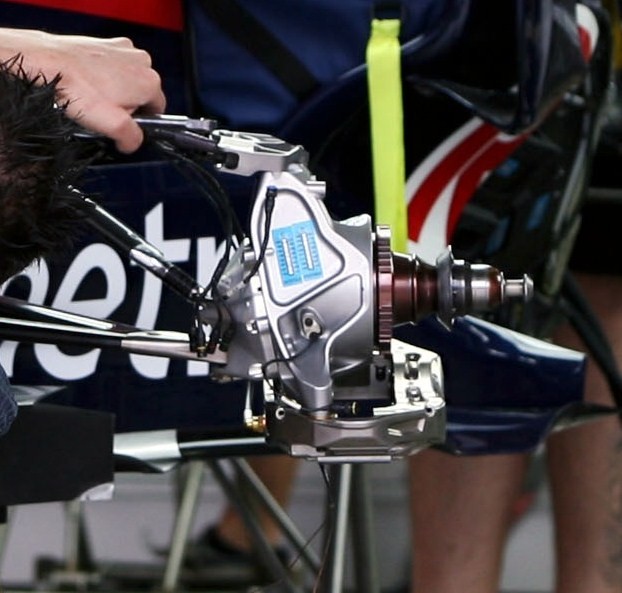
scarbs wrote:The car is running with a Pushrod On Upright set up, often termed (POU or PROU). Many teams run with this set up, the offset from the pushrod pickup and the king pin axis is a tuneable set up parameter. I have seen F1 set up sheets with figures of 8mm offset.
I had it explained to me by an ex-f1 designer: "When the the car turns outside wheel will drop and inside will rise, this helps grip at low-speed. Its often used in conjunction with Anti-Ackermann suspension (meaning that the outside wheel steers faster than the inside), this can then result in an overall reduction in front-ride-height as you add steering lock."
So,the main purpose is the reduction in front-ride-height when steering?
silente wrote:In my opinion, this solution can have two main good aspects:
1) normally if you connect the pushrod to the upright, your assembly is stiffer and has an higher strength;
2) Maybe you would like to create an inside spring compression effect when you steer, similar to that you can obtain with caster. This effect helps to reduce understeer above all in slow corners, because it works against front weight transfer in a way proportional to the steering angle you are using.
In this way, you should feel it just a little in fast corners, where you like to have some understeer, but a lot more in slow corners where the car tends to be naturally more understeering.
Maybe this set up can change the zero point of rolling stiffness. Then coupled with rear axle, change the front wheels' load transfer when cornering .
scarbs wrote:
I had it explained to me by an ex-f1 designer: "When the the car turns outside wheel will drop and inside will rise, this helps grip at low-speed. Its often used in conjunction with Anti-Ackermann suspension (meaning that the outside wheel steers faster than the inside), this can then result in an overall reduction in front-ride-height as you add steering lock."
Won't this increase the steering forces a lot because you kinda have to steer against the roll of the car?
Now when you have a high force overlapped over the tire forces the driver might lose the "feeling" of tire grip trough the steering?
scarbs wrote:The car is running with a Pushrod On Upright set up, often termed (POU or PROU). Many teams run with this set up, the offset from the pushrod pickup and the king pin axis is a tuneable set up parameter. I have seen F1 set up sheets with figures of 8mm offset.
I had it explained to me by an ex-f1 designer: "When the the car turns outside wheel will drop and inside will rise, this helps grip at low-speed. Its often used in conjunction with Anti-Ackermann suspension (meaning that the outside wheel steers faster than the inside), this can then result in an overall reduction in front-ride-height as you add steering lock."
draving a line through upper aand lower wishbone svivel you got KPI -not much of a distance there-so a rather small radius but still it will translate in a marked change in spring force .
Obviously they want the steering to have an affect on springs so spring force is not the thing to worry about but how about the steering force?
Can we say it acts like some kind of anti-rollbar?
Where do you have to place the pushrod to get the desired effect of outside wheel drop and inside wheel rise?
Again, can´t speak much about F1 and what they want to achieve with such a set-up.
But a similar idea was quite commonly used in Supertouring car racing (perhaps still is), especially with front wheel drive touring cars.
Because these type of cars don´t use a push rod suspension (normally), they did connect the anti roll bar (via a link/pushrod) to the upright.
By doing so, as you say, you create a load transfer (anti roll if you like) across the front axle, transfering load from the outside wheel to the inside wheel, and therefore achieve a more even load at the front (and to an extent, assuming a sufficient stiff body, at the rear) axle.
The amount of load transfer is porportional to steering angle, so it´s more a solution for tight (slow) corners, especially hairpins.
And as you say, it causes additional load/stress to the steering system and it has an influence on "steering feel" for the driver.
I remember that at times, I have seen steering rack/pump failures while testing such arangements in some Touring cars.
This problems can be overcome, and if you design your steering system, with the additional forces in mind, it should be manageable without too much hassle.
It´s not confined to FWD cars, as I have seen these things used in RWD Touring cars as well, but in the mid-end 90´s it was quite a common layout on some FWD touring cars, to aid traction out of slow/tight corners.
At least, the teams I have worked with, used it track specific, and there where different offset´s (position of the rod at the upright) to achieve different characteritics, depending on the corner radius/speeds at a given circuit.
"Make the suspension adjustable and they will adjust it wrong ......
look what they can do to a carburetor in just a few moments of stupidity with a screwdriver." - Colin Chapman
“Simplicity is the ultimate sophistication.” - Leonardo da Vinci
mep wrote:Obviously they want the steering to have an affect on springs so spring force is not the thing to worry about but how about the steering force?
Can we say it acts like some kind of anti-rollbar?
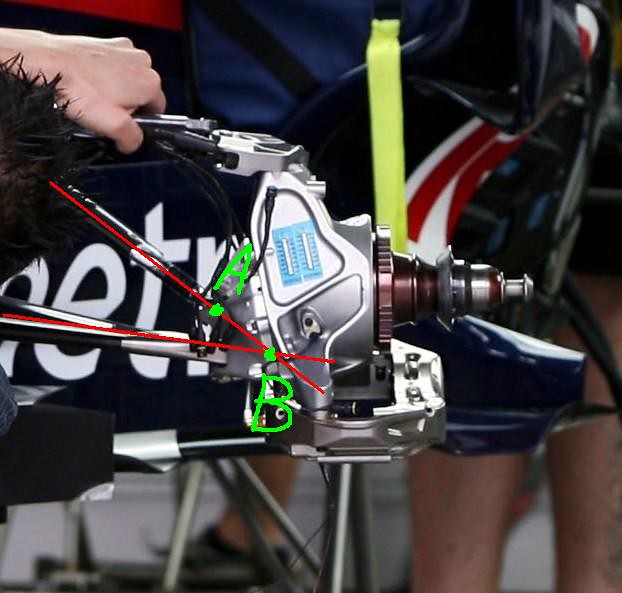
Where do you have to place the pushrod to get the desired effect of outside wheel drop and inside wheel rise?
If the point is A in the picture above, both left and right sides will drop in steering. With no steering, it should be the tallest point.
747heavy wrote:I think you are right on the money mep.
Again, can´t speak much about F1 and what they want to achieve with such a set-up.
But a similar idea was quite commonly used in Supertouring car racing (perhaps still is), especially with front wheel drive touring cars.
Because these type of cars don´t use a push rod suspension (normally), they did connect the anti roll bar (via a link/pushrod) to the upright.
By doing so, as you say, you create a load transfer (anti roll if you like) across the front axle, transfering load from the outside wheel to the inside wheel, and therefore achieve a more even load at the front (and to an extent, assuming a sufficient stiff body, at the rear) axle.
The amount of load transfer is porportional to steering angle, so it´s more a solution for tight (slow) corners, especially hairpins.
And as you say, it causes additional load/stress to the steering system and it has an influence on "steering feel" for the driver.
I remember that at times, I have seen steering rack/pump failures while testing such arangements in some Touring cars.
This problems can be overcome, and if you design your steering system, with the additional forces in mind, it should be manageable without too much hassle.
It´s not confined to FWD cars, as I have seen these things used in RWD Touring cars as well, but in the mid-end 90´s it was quite a common layout on some FWD touring cars, to aid traction out of slow/tight corners.
At least, the teams I have worked with, used it track specific, and there where different offset´s (position of the rod at the upright) to achieve different characteritics, depending on the corner radius/speeds at a given circuit.
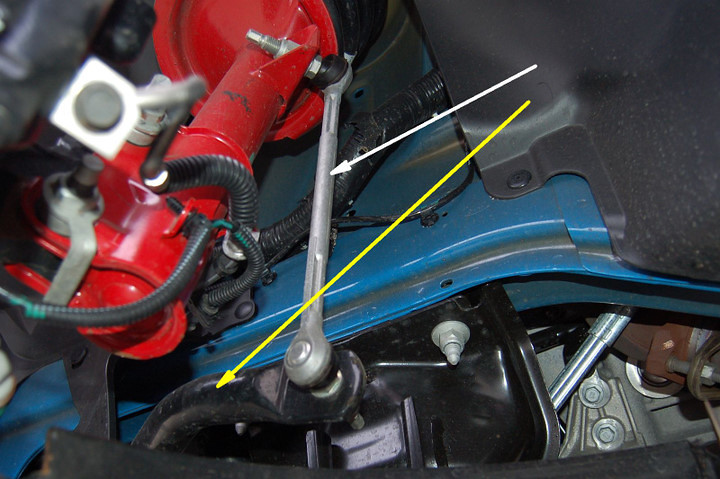
Do you mean this small link on anti roll bar? This is a Mustang GT500's front suspension.
It is connected to a very hight point of the strut, which is equal to the knuckle, I think.
I noticed may cars did so, such as VAG PQ35, BMW325, Mitsubishi lancer and so on.
Caster changes a car's corner-weights as a function of steering angle. The steering angle into a turn puts more static weight on the front-inner to rear-outer diagonal, and this typically increases weight transfer across the rear causing the car to turn/rotate more in the direction of the steering input. Great.
The interesting thing is that the caster effect is not linear with steering angle. The static corner weight change per degree of steer angle (?weight transfer gain?) will be greatest as you initially steer away from center and will increase less as you get into larger steering angles. It always increases, but at a decreasing rate. This is good if you want the corner weight change to influence high-speed (low steer angle) situations.
A typical Pushrod-On-Upright with offset between the steering axis and pushrod mount will transfer weight from one diagonal to the other in the same manner as caster. However, the POU setup increases the effect at an increasing rate. The initial steering angle away from center will not do much to static weight, but as you turn to larger angles you get more incremental weight transfer per degree steering angle. This is conducive to situations where you want the weight transfer to influence low-speed (high steer angle) situations. Think hairpin at Monaco.
In theory you can combine the weight transfer effects of caster and POU to get any combination of low-steer-angle and high-steer-angle weight transfer gain you want.
Caster and POU settings obviously come with a large array of other tradeoffs that others are addressing.
I'm only about 80-90% sure of this, do others have insight in this?