Mercedes, crankcase pressure and overrun

All that has to do with the power train, gearbox, clutch, fuels and lubricants, etc. Generally the mechanical side of Formula One.
0

Post Sat Jul 09, 2011 9:03 am

So in the ongoing blown diffuser debacle its said that Mercedes got a dispensation to run 10% throttle on overrun and to inject fuel into 4 cylinders at this time.
The reason stated for this was to relieve crankcase pressure to reduce engine braking.

A couple of questions:

1) How does crankcase pressure affect engine braking
2) How does running the engine on 4 cylinders and a retarded ignition relieve crankcase pressure
Crafty
0
 
Joined: 22 May 2005

0

Post Sat Jul 09, 2011 12:15 pm

When lifting off the throttle a vacuum will build up between the throttlebody and the pistons as they keep moving up and down pumping air.
This vacuum also sucks air from the crankcase.

Firing in the cylinders while the throttle is off kan cancel some of this vacuum by building preassure instead.


EDIT: Renault uses completly open throttle bodies so they dont get this vaccum plus it helps cool the exhaust valves.
Holm86
6
User avatar
 
Joined: 10 Feb 2010
Location: Copenhagen, Denmark

0

Post Sat Jul 09, 2011 10:11 pm

What is a completely open throttle body, how does it work?
nacho
0
 
Joined: 4 Sep 2009

0

Post Sun Jul 10, 2011 10:29 pm

the butterflys
There are two things in this world that take no skill: 1. Spending other people’s money and 2. Dismissing an idea.
strad
67
User avatar
 
Joined: 2 Jan 2010

0

Post Mon Jul 11, 2011 4:43 am

Crafty,

High rpm engines like in F1 are dry-sumped, and have very high volume oil scavenge pumps. The ratio of oil scavenge pump flow volume to the pressure pump flow volume is probably around 4:1. This means that quite a bit of air is also being sucked out of the crankcase, and the crankcase pressure can easily be below ambient. Keeping the crankcase sump free of oil is important, because if the rotating crank and rods splash through liquid oil it can result in high "windage" power losses.

Top fuel drag racing engines at one time used an extractor device in the exhaust flow to pull air out of the crankcase. Don't know if they still do.

Engine compression braking takes place in the cylinders, not the crankcase. Closing the throttles on overrun creates a low pressure in the intake volume, but this would not extract air from the crankcase volume, unless the two volumes were somehow connected.

riff_raff
"Q: How do you make a small fortune in racing?
A: Start with a large one!"
riff_raff
79
 
Joined: 24 Dec 2004

0

Post Sat Jul 16, 2011 11:02 pm

riff_raff wrote:Crafty,

High rpm engines like in F1 are dry-sumped, and have very high volume oil scavenge pumps. The ratio of oil scavenge pump flow volume to the pressure pump flow volume is probably around 4:1. This means that quite a bit of air is also being sucked out of the crankcase, and the crankcase pressure can easily be below ambient. Keeping the crankcase sump free of oil is important, because if the rotating crank and rods splash through liquid oil it can result in high "windage" power losses.

Top fuel drag racing engines at one time used an extractor device in the exhaust flow to pull air out of the crankcase. Don't know if they still do.

Engine compression braking takes place in the cylinders, not the crankcase. Closing the throttles on overrun creates a low pressure in the intake volume, but this would not extract air from the crankcase volume, unless the two volumes were somehow connected.

riff_raff


I would expect a greater ratio than 4:1 and a crankcase depression somewhere between 300 and 700 millibar. I've got a dry sump pump for a racing engine here and it appears to have a ratio of about 8:1.

If the engine isn't fired I suspect there will be less blowby and the crankcase pressure will depression will increase. This could be problematic for engine seals. Too little flow can also prevent the scavenge pumps from pumping oil out of the engine.
Edis
29
 
Joined: 31 Jan 2010

0

Post Mon Jul 18, 2011 3:12 am

Edis,

You make a valid point about the oil scavenge pump performance being negatively affected by sub-atmospheric inlet pressures. This leads to cavitation in the pump flows. Of course, with the high oil scavenge volume ratios and low crankcase pressures used in high rpm racing engines (regardless of whether the scavenge ratio is 4:1 or 8:1), the scavenge pumps will always naturally operate with some degree of cavitation.

To improve the liquid oil scavenge efficiency of the pumps, these racing engines (F1, Indycar, etc.) normally employ a separate pump element for each crank throw. The pump inlet location and sump walls are shaped to take advantage of prevailing crank windage to direct the oil into the pump inlet. So the low pump inlet pressure is not so much of an issue in this regard.

There is also a drawback with having excessive scavenge volume ratio. Any scavenge volume ratio over 1:1 means that some air is being mixed with the scavenged oil, and higher scavenge ratios mean more air. Before the oil is fed to the pressure pump inlet, it is essential that as much of that air is removed from the oil as possible. Having even small amounts of air entrained in the oil flowing to the main/rod journal bearings can cause bearing damage. So there is some justification for keeping the scavenge volume ratio low.

riff_raff
"Q: How do you make a small fortune in racing?
A: Start with a large one!"
riff_raff
79
 
Joined: 24 Dec 2004

0

Post Mon Jul 18, 2011 8:59 pm

What is the vaporisation pressure of the oil at those temperature (130*C)? You sure you will have cavitation?
"I was blessed with the ability to understand how cars move," he explains. "You know how in 'The Matrix,' he can see the matrix? When I'm driving, I see the lines."
n smikle
0
User avatar
 
Joined: 12 Jun 2008

0

Post Tue Jul 19, 2011 1:05 am

Only thing I found about engine oil vapor pressure:

http://www.havoline.com/images/products ... oroils.pdf
http://www.micaprintmaking.com/wp-conte ... or_oil.pdf


Both state minus than .01mmHg at 100°C.


Don't know if it's representative of an actual F1 engine oil but it shouldn't be that far away.
Come back 747, we miss you!!
Caito
7
 
Joined: 16 Jun 2009
Location: Argentina

0

Post Wed Jul 20, 2011 3:14 am

n smikle wrote:What is the vaporisation pressure of the oil at those temperature (130*C)? You sure you will have cavitation?


n smikle,

Cavitation in gear/gerotor/rootes type positive displacement oil pumps is more of a localized phenomena, so the bulk oil temp is not the most important thing. Instead it's the local fluid pressures.

http://www.simerics.com/animation/gear_pump_cav_ani.gif

riff_raff
"Q: How do you make a small fortune in racing?
A: Start with a large one!"
riff_raff
79
 
Joined: 24 Dec 2004

0

Post Thu Jul 21, 2011 10:30 pm

riff_raff wrote:Edis,

You make a valid point about the oil scavenge pump performance being negatively affected by sub-atmospheric inlet pressures. This leads to cavitation in the pump flows. Of course, with the high oil scavenge volume ratios and low crankcase pressures used in high rpm racing engines (regardless of whether the scavenge ratio is 4:1 or 8:1), the scavenge pumps will always naturally operate with some degree of cavitation.

To improve the liquid oil scavenge efficiency of the pumps, these racing engines (F1, Indycar, etc.) normally employ a separate pump element for each crank throw. The pump inlet location and sump walls are shaped to take advantage of prevailing crank windage to direct the oil into the pump inlet. So the low pump inlet pressure is not so much of an issue in this regard.

There is also a drawback with having excessive scavenge volume ratio. Any scavenge volume ratio over 1:1 means that some air is being mixed with the scavenged oil, and higher scavenge ratios mean more air. Before the oil is fed to the pressure pump inlet, it is essential that as much of that air is removed from the oil as possible. Having even small amounts of air entrained in the oil flowing to the main/rod journal bearings can cause bearing damage. So there is some justification for keeping the scavenge volume ratio low.

riff_raff


I think you misunderstood my point about the crankcase pressure. The lower pressure isn't a concern for the scavenge pumps but can lead to higher stress in other parts of the engine.

The scavenge pumps themselves are more air pumps than oil pumps and when you suck air, or more correctly crankcase gases out of the engine the oil will follow. Without airflow the oil will stay inside the engine, increasing the oil level inside the crankcase. The flow of crankcase gases isn't related to the ratio between pressure and scavenge pumps but to how much gas leaks past the piston rings when the engine is operating. Larger scavenge pumps do however result in a lower crankcase pressure which is normally a good thing.

Separating oil from gases in a dry sump lubrication system isn't a problem, a well designed tank does that job well (using swirl). But in some cases, F1 included, a centrifugal separator is used to separate the oil from the gas. This allows the use of a smaller oil tank.

The sealed crankcases with one scavenge pumps per section is mostly to reduce losses due to crankcase pumping.

It do however seem like this whole issue is more related to engine braking than crankcase pressure.

Roots type scavenge pumps and centrifugal oil separator of a Cosworth F1 engine:
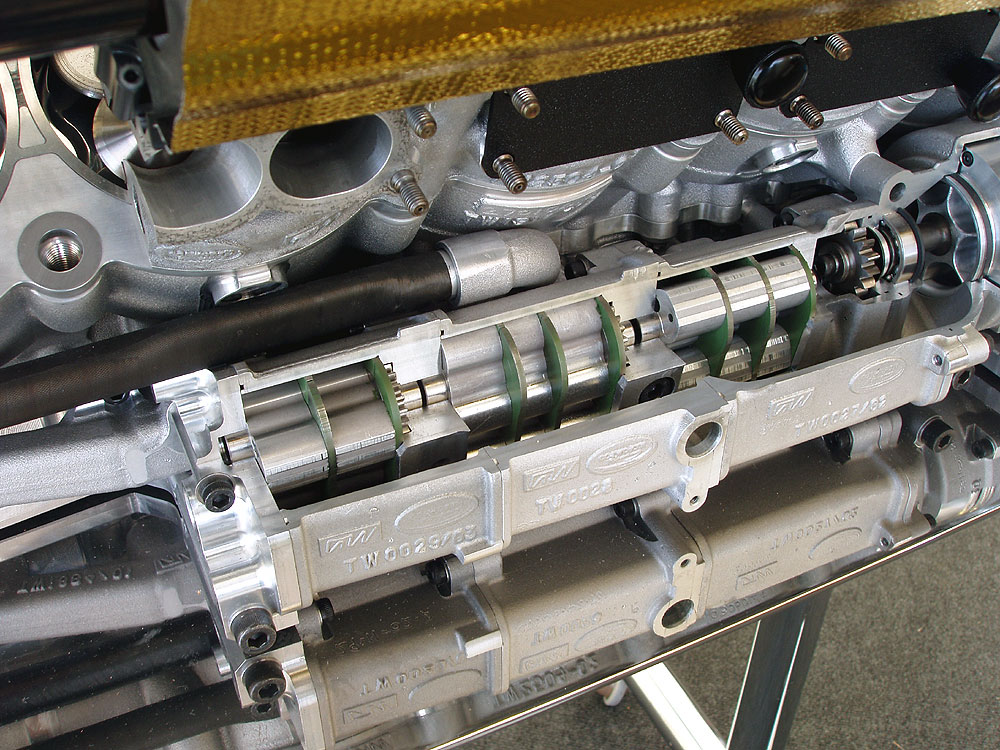
Image
Edis
29
 
Joined: 31 Jan 2010

0

Post Thu Jul 21, 2011 11:02 pm

Has anyone realised that if renault use NO fuel on the over-run and merc DO use 10% of throttle, injecting fuel, this has most probably been the reason why the merc is less fuel efficent? Hence we now have an shred of ACTUALL fact with regards to all the bickering about engine equivalence that has plagued this forum in numerous threds since forever!
Richied76
0
 
Joined: 18 Aug 2010

0

Post Fri Jul 22, 2011 1:26 am

Edis,

Thanks for the nice cutaway picture of the Cossie scav pump. Judging by the scoring on the rotor lobe tips, that pump has seen some hard service!

riff_raff
"Q: How do you make a small fortune in racing?
A: Start with a large one!"
riff_raff
79
 
Joined: 24 Dec 2004

0

Post Fri Jul 22, 2011 1:46 am

Is there no way of combining the hot/cold blowing?

Having 100% open throttle on overrun but no ingnition and a small amount of fuel??
Holm86
6
User avatar
 
Joined: 10 Feb 2010
Location: Copenhagen, Denmark


Return to Engine, transmission and controls

Who is online

Users browsing this forum: No registered users and 0 guests