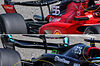
TECH REVIEW: How has Mercedes upgraded its 2026 car so far?

The 2026 Formula One season has opened under unusual circumstances, with only three races — Australia, China, and Japan — taking place before the championship entered a five‑week break caused by the cancellation of the Bahrain and Saudi Arabian Grands Prix.
Yet despite the disrupted calendar, one trend has been unmistakable: Mercedes has dominated the early season, and it has done so with remarkable confidence in its baseline package.
Unlike Ferrari, which introduced updates at all three rounds, and unlike McLaren, which at least brought a foundational package to Australia, Mercedes elected to introduce only one upgrade package, at the season‑opening Australian Grand Prix. The team then ran the same specification in China and Japan without submitting any further updates. This decision speaks volumes about the strength of the W15’s successor — the Mercedes R01 — under the radically revised 2026 technical regulations.
The Australian package reveals a car concept that is both aggressive and well‑understood, allowing Mercedes to prioritise correlation, consistency, and race execution rather than early‑season development firefighting.
Australia: Establishing a High‑Load, High‑Confidence Aerodynamic ConceptMercedes’ Australian Grand Prix update package consisted of three components: revised bodywork, a new front wing, and an updated rear wing. All three updates were aimed at local load generation, indicating that Mercedes entered the season with a clear aerodynamic philosophy and sought to refine — rather than reinvent — its baseline.
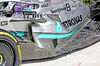
Bodywork – Increased Downwash and a High InletThe R01’s bodywork features a more pronounced downwash profile compared to the initial 2026 starting point, combined with a high‑mounted sidepod inlet. This geometry pulls high‑energy airflow downward toward the rear of the car, improving the quality of the flow feeding the rear floor and diffuser.
The high inlet increases the stream tube directed toward the floor, ensuring that the simplified 2026 underbody receives as much clean, energised airflow as possible. With the new regulations reducing the authority of the floor and removing many of the complex vortical structures teams relied on from 2022–2025, Mercedes’ approach focuses on maximising the energy delivered to the rear aerodynamic surfaces.
Front Wing – Increased Camber, No StrakeThe front wing update introduced increased camber across the elements and removed the strake that had been part of the initial 2026 configuration. Increasing camber boosts front‑end load, while the spanwise loading distribution has been optimised to condition the airflow entering the floor.
This is a crucial detail: with the 2026 regulations reducing the floor’s ability to generate downforce independently, the quality of the airflow entering the underbody becomes far more important. Mercedes’ front wing is therefore designed not only to generate load but also to shape the aerodynamic platform in a way that stabilises the car’s behaviour across a wide range of conditions.
Rear Wing – Increased Camber for Load and BalanceThe rear wing update mirrors the front wing philosophy. Mercedes increased the camber of the rear wing elements, optimising the chord distribution to balance performance between SLM (Sustainable Low‑drag Mode) closed and SLM open configurations.
This indicates that Mercedes is already deeply comfortable with the 2026 active aerodynamic systems and is fine‑tuning the wing to deliver strong downforce in standard race trim while ensuring efficient drag reduction when SLM is deployed. The team’s early dominance suggests that this balance has been achieved with exceptional precision.
China and Japan: No UpdatesMercedes did not submit any upgrades for the Chinese or Japanese Grands Prix. This is particularly noteworthy given the diversity of the circuits:
Shanghai demands high‑speed efficiency and stability through long, sweeping corners.
Suzuka is one of the most aerodynamically punishing circuits on the calendar, exposing any weakness in platform stability, load consistency, or flow conditioning.
That Mercedes chose to run the same specification at both events — and continued to dominate — indicates that the R01’s aerodynamic platform is exceptionally well‑balanced and robust. The team appears to have achieved a level of correlation between wind tunnel, CFD, and track performance that allows them to avoid early‑season development risks.