F1TECH: How did Ferrari take inspiration from Mercedes’ front suspension?

Ferrari returned to the track at Monza during the five‑week gap before Miami, completing a tightly controlled 200‑km filming day that doubled as a crucial technical validation session.
While officially promotional, the outing marked the first on‑track appearance of the SF‑26’s Miami upgrade package and provided the team with its earliest opportunity to correlate aerodynamic and hybrid‑system updates under the FIA’s revised energy‑management regulations confirmed on 20 April.
A split programme with a clear purposeCharles Leclerc handled the morning running, logging just over 100 km before handing the car to Lewis Hamilton for the afternoon. With filming‑day rules requiring a single configuration throughout, Ferrari used the driver split to gather clean data across two driving styles and two track conditions — a strategic choice given the importance of energy deployment and aero stability at the upcoming Miami Grand Prix.
Monza’s long straights and heavy braking zones made it the ideal venue to stress‑test the updated hybrid deployment logic. Ferrari relied on internal load cells and onboard sensors — the only tools permitted — to validate correlation between CFD, wind‑tunnel predictions, and real‑world behaviour.
New front suspension joins the Miami pcvackageBeyond the widely reported new front wing, rear wing, and revised floor, Ferrari also evaluated a new front‑suspension configuration — a development that had gone largely unnoticed until now.
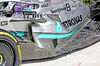
The technical drawing of the SF‑26’s rear suspension reveals a key design philosophy: adjustable mounting points for the upper wishbone, allowing the team to vary anti‑dive/anti‑squat characteristics depending on circuit demands. The image shows two possible pickup‑point positions, a concept reminiscent of the 2024 Mercedes W15.
Ferrari has now extended this logic to the front suspension, introducing a layout that allows similar adjustability in anti‑dive geometry. This gives engineers a broader setup window to balance braking stability, pitch control, and aerodynamic platform consistency — all critical under the 2026 regulations, where energy‑deployment behaviour is tightly linked to car attitude.
Although Ferrari did not publicly confirm the front‑suspension change, the Monza run provided the first real‑world data on how the new geometry interacts with the updated floor and front wing.