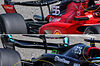
F1 TECH: Ferrari show off their heavily updated SF26 for the Miami Grand Prix

Formula One returns this weekend at the Miami Grand Prix after a five‑week break triggered by the cancellation of the Bahrain and Saudi Arabian Grands Prix.
For Ferrari, the pause has provided an opportunity to refine the SF‑26’s aerodynamic platform and introduce a series of updates aimed at improving flow conditioning, drag efficiency and rear‑end stability. The team’s upgrade list for Miami addresses key areas of the car’s lower and upper rear and front aerodynamics.
Front Wing Endplate: Stabilising the Front‑Wheel WakeFerrari begins its update list with the front wing endplate, describing the change as “Revised footplate outboard channel, addition of top forward vane.”
This indicates a refinement of the outboard airflow structures that govern how the front‑wheel wake is pushed away from the car. Improved stability here directly benefits downstream components, especially the floor’s leading edge.
Front Corner: Improved Flow ConditioningThe front corner receives “Detailed development of front deflector upper and lower edges, addition of rear deflector lip.” This suggests a more controlled and energised airflow around the front wheels, helping the car maintain consistent front‑end load across different steering angles.
The front suspension update is described as “Reprofiling of front suspension leg fairings.” Ferrari notes that “Various steps have been done on load distribution across legs and span of the different front suspension elements, leading to load gains whilst still managing properly downstream impacts.”
This is a continuation of the front‑end aerodynamic clean‑up, reducing interference drag and improving the quality of the airflow feeding the floor.
The team explains that “Front wing endplate and front corner updates are working hand‑in‑hand, focusing on flow feature stability and front wheel wake management throughout the entire car operating envelope.”
Floor Body: Reoptimised for Net Load GainThe floor body receives one of the most substantial updates, with Ferrari listing “Front central keel volume optimisation, additional front floor board vertical elements and revised board stays. Reprofiled front floor leading edge and leading edge devices.”
The team states: “Benefiting from enhanced upstream flow conditions, the front floor geometry and devices have been reoptimized, returning a net load advantage.”
This confirms that the front‑end updates were designed to feed a more efficient floor, which remains the primary downforce‑generating surface even if floors have been heavily simplified compared to the ground-effect era.
Ferrari describes the floor‑edge update as “Main floor outboard trailing edge scoops extended further inboard. Working together with the front floor update, the rear part of the floor and diffuser have been developed focusing on load increase across the full operating window.
"In addition, the rear trackrod fairing update together with the rear tail devices provides a favourable pressure gradient for the diffuser, in an efficient manner.”
This shows a coordinated effort to strengthen the floor’s suction effect and improve diffuser feeding.
Diffuser: Reprofiled Expansion and New DetailingThe diffuser update is extensive, with Ferrari listing “Central boat and diffuser expansion reprofiling, diffuser fence shedding edge detailing, trailing edge vertical flap addition and inboard lip detail.”
The team repeats the same explanation as above, emphasising the combined development of the floor, diffuser and rear‑suspension fairings. These changes aim to increase downforce robustness, especially in low‑speed corners where diffuser stability is critical.
Ferrari describes the rear suspension update as “Rear trackrod fairing reprofiling.” Again, the team notes that this works with the floor and diffuser to create “a favourable pressure gradient for the diffuser, in an efficient manner.”
This is a subtle but important aerodynamic tweak, reducing blockage and improving the quality of the airflow entering the diffuser’s upper surfaces.
 Updated Macarena rear wing
Moving to the rear‑end assembly, Ferrari lists the beam wing update as “Updated inboard connection.” This typically improves the interaction between the beam wing and the diffuser’s exit flow, stabilising the rear platform and improving straight‑line efficiency.
Ferrari describes the rear‑tail update as “Revised tail devices and profiles.” This region often includes small aerodynamic elements that influence the wake behind the car.
The update likely improves local load and enhances the flow entering the beam wing.
The 'Macarena', flip-flop rear wing receives the most detailed update description: “Mainplane and flap detail reprofiling, addition of central bracket flap, reworked pylon/mainplane junction.”
Ferrari summarises the intent of this development phase with a key statement: “This iteration of rear wing development has been focused on increasing load in cornering mode in a robust way, whilst maximizing aerodynamic drag shedding in straight mode.”
This dual‑mode optimisation is essential for Miami’s long straights and slow‑speed complexes.
The final update concerns the endplate, described as “Addition of upwashing volumes, upper endplate detailing.” These features help reduce vortex drag and improve the efficiency of the mainplane and flap, complementing the rear‑wing changes.
A fully integrated package for MiamiFerrari’s Miami upgrade package is not a collection of isolated parts but a tightly coordinated aerodynamic overhaul. The front‑end changes improve wake management and flow quality; the floor and diffuser updates convert that improved flow into more stable load; and the rear‑end revisions enhance drag efficiency and cornering performance.
With the championship fight tightening and Miami offering a mix of long straights and technical sections, Ferrari’s comprehensive approach reflects a clear intent: maximise efficiency, stabilise load, and close the gap to Mercedes as the season resumes.