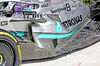
F1TECH: Mercedes forced to modify diffuser after FIA clarification on spike‑like extensions

Ahead of the Austrian Grand Prix, it has now emerged that Mercedes were instructed to modify the diffuser and remove the serrated extensions entirely. The team has complied, reverting to a more conventional upper‑deck geometry.
Since winter testing, Formula 1 teams have been searching for creative ways to recover rear downforce and extend the diffuser’s influence — a key challenge under the current regulations, which rely less on pure ground‑effect than the 2022–2025 ruleset.
One of the most aggressive interpretations came from Mercedes, whose Montreal upgrade package included a diffuser design that immediately drew the paddock’s attention.
Teams have been experimenting with methods to “extend” the diffuser by manipulating airflow structures around the rear crash structure. Some attempted physical extensions, others used shaping tricks to energise the upper deck of the diffuser.
Mercedes’ solution, however, stood out. The W17 appeared with serrated, spike‑like profiles mounted along the upper section of the diffuser, covering more than half of its width.
These protruding elements effectively acted as aerodynamic extensions, helping the diffuser maintain attached flow for longer and increasing its expansion capability — a direct gain in rear stability and downforce.
Rivals immediately took notice. Ferrari, along with several other teams, quickly questioned whether the serrated profiles complied with the regulations.
The Scuderia formally approached the FIA, asking whether such extensions could be considered legal and whether they themselves would be permitted to develop a similar concept. The answer was no.
The FIA clarified that the spike‑like vanes were considered extensions beyond what is permitted in the diffuser volume. While Mercedes had initially passed scrutineering, the governing body’s subsequent interpretation meant the design could not be replicated — nor retained.
Mercedes required to remove the spike‑like vanesAhead of the Austrian Grand Prix, it has now emerged that Mercedes were instructed to modify the diffuser and remove the serrated extensions entirely. The team has complied, reverting to a more conventional upper‑deck geometry.
The diffuser has become a critical battleground in 2026. With teams no longer able to rely on strong ground‑effect suction, the upper surfaces and expansion zones of the diffuser are more important than ever. Mercedes’ now‑outlawed serrated profiles were an attempt to exploit this area to the limit — and perhaps beyond it.
The FIA’s intervention ensures that the diffuser remains within a tightly controlled geometry, preventing a potential escalation of “external extension” concepts that could have spiralled into an expensive and complex development war.