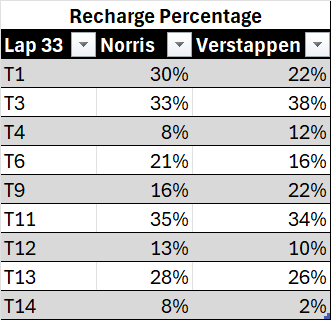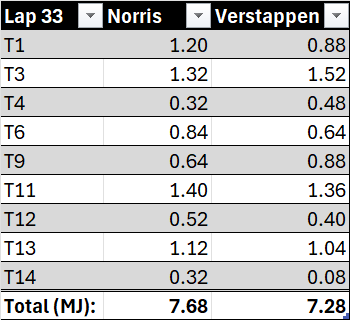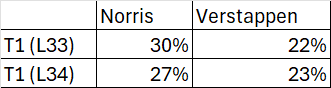
Detune the MGU-K enough and it simply isn't worth it to give up the speed for the acceleration boost out of the following corner, even if you don't reach the harvesting allowance.wuzak wrote: ↑09 Mar 2026, 15:55Super-clipping is a function of the allowed energy recovery and the ability of the cars to recover energy by other means (braking, part-throttle charging).bananapeel23 wrote: ↑09 Mar 2026, 12:50The adjustment we need is a reduction in peak output large enough to remove the incentive to clip through fast corners or at the end of straights.gearboxtrouble wrote: ↑09 Mar 2026, 02:11The driver has no input into that decision to slow the car down in the fast corners. We're going to see cars slow similarly in Eau Rouge and Copse and it will be awful. The rules need to be adjusted to effectively end super clipping on any track.
This also applies to lift-and-coast.
In Australia they were super-clipping and/or lift-and coasting for at least 10s per lap. Accounting for around half the allowed energy recovery.
Other tracks will see less of this because they have more braking zones, especially heavy braking zones, and more part-throttle application.
In other news. I just tried to look at how much energy the MGU-H used to harvest. I'm astonished that they chose to cut it. I can't find any actual numbers, but it was apparently doing at least 2/3 of the energy harvesting in the last regulation set. Assuming the MGU-K was harvesting the maximum permitted 2MJ per lap, the MGU-H must've been harvesting at least another 4 MJ. Cut fuel flow to 70 kg/hr and it would still be harvesting ~2.8 MJ per lap.
That would have gone a long way in this regulation set, providing 1/3 of the maximum permitted regen. If cars are currently super clipping or doing LiCo for 15 seconds per lap in order to reach the full 8.5 MJ of harvesting, the MGU-H would cut that to just over 5 seconds. In reality it would likely do more than that since the MGU-H is most effective on energy starved tracks like Monza or Albert Park.


 You're burning fuel and reducing speed to make electricity in a region where you wouldn't be slowing if the battery wasn't going to be empty somewhere after the corner.