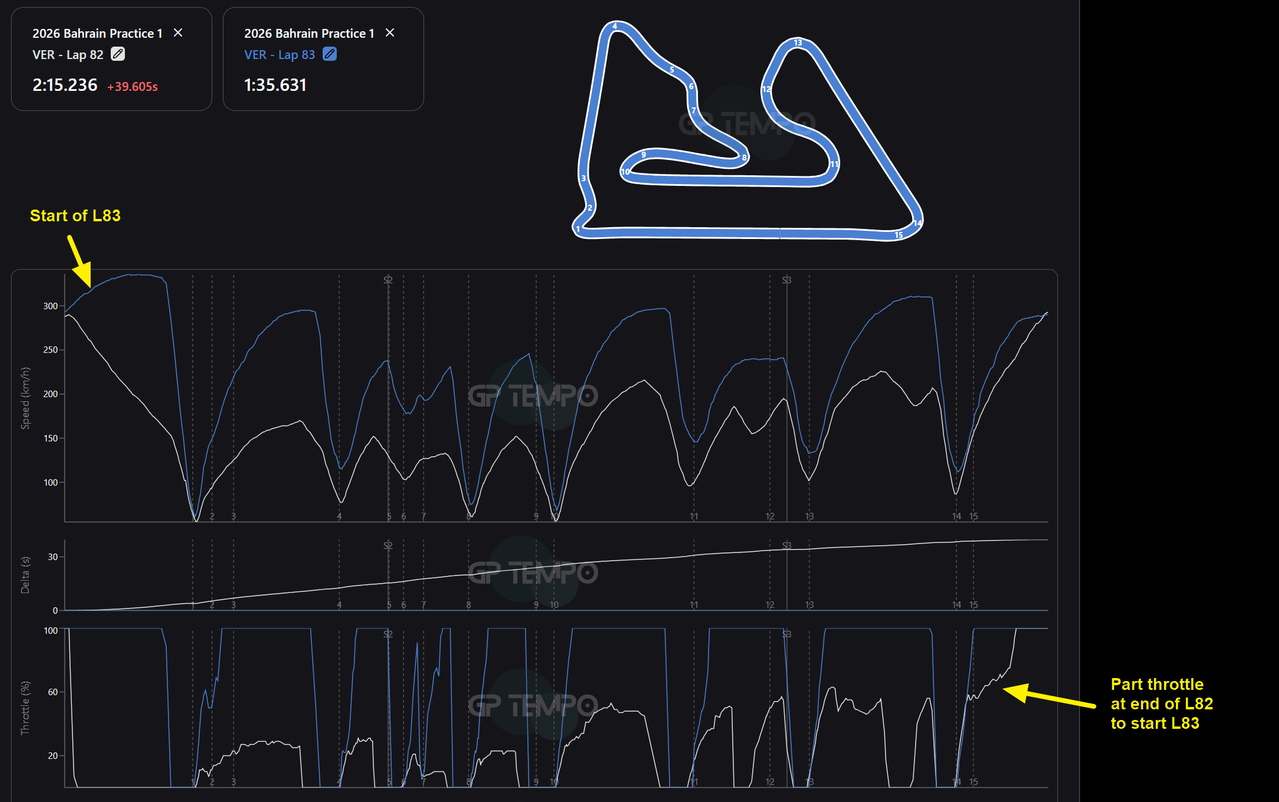
(1) If the driver drives flatout exiting the last corner, they won't have a topped-up battery at the finish line. That means they will have much less energy to use inside the lap. (let's say 0.5-1MJ) and the 8.5MJ recovery limit which is around 9-10MJ instead of the maximum of 4MJ + 8.5 which is 12.5 MJ.
(2) If they hold back and charge the battery to 4MJ just before the line, they will be able to deploy 4MJ and the 8.5MJ recovery limit inside the next lap.
So which one has the potential to be faster? The fact that we have to even consider this shows how broken the PU regs and qualifying are going to be, but that's for another thread

Back to the original point. If you don't go flat-out out of the last corner, lose some time in the run to T1, but then have 12.5MJ which can be deployed for the rest of the lap, can it actually be faster than starting the lap by going flat out of the last corner and only have 8.5-9.5MJ of electric power to use inside the hot lap?
Imo, this is basically a "loophole" on certain tracks to use more electric energy. It's especially powerful on circuits where there is a relatively shorter run to T1 after the finish line (Baku, Monaco, etc) so that the time you lose is relatively lower, in exchange for being able to use an extra 3-4MJ inside the hot lap.
Now there might be a counterargument by some that the energy you put in before the start finish line carries into the next lap so this is not really a loophole, but using that 4MJ getting up to speed before the start of the lap comes at a cost. It's less efficient (drag) to drive at top speed than it is to drive at low speed so that energy you put in before the lap starts is basically worth less when its being "re-used" at high speed.