Ferrari SF-26

A place to discuss the characteristics of the cars in Formula One, both current as well as historical. Laptimes, driver worshipping and team chatter do not belong here.
User avatar
Stu
Moderator
Joined: 02 Nov 2019, 10:05
Location: Norfolk, UK

Re: Ferrari SF-26

Post

nico5 wrote:
07 May 2026, 11:33
sucof wrote:
06 May 2026, 20:20
SilviuAgo wrote:
06 May 2026, 19:23
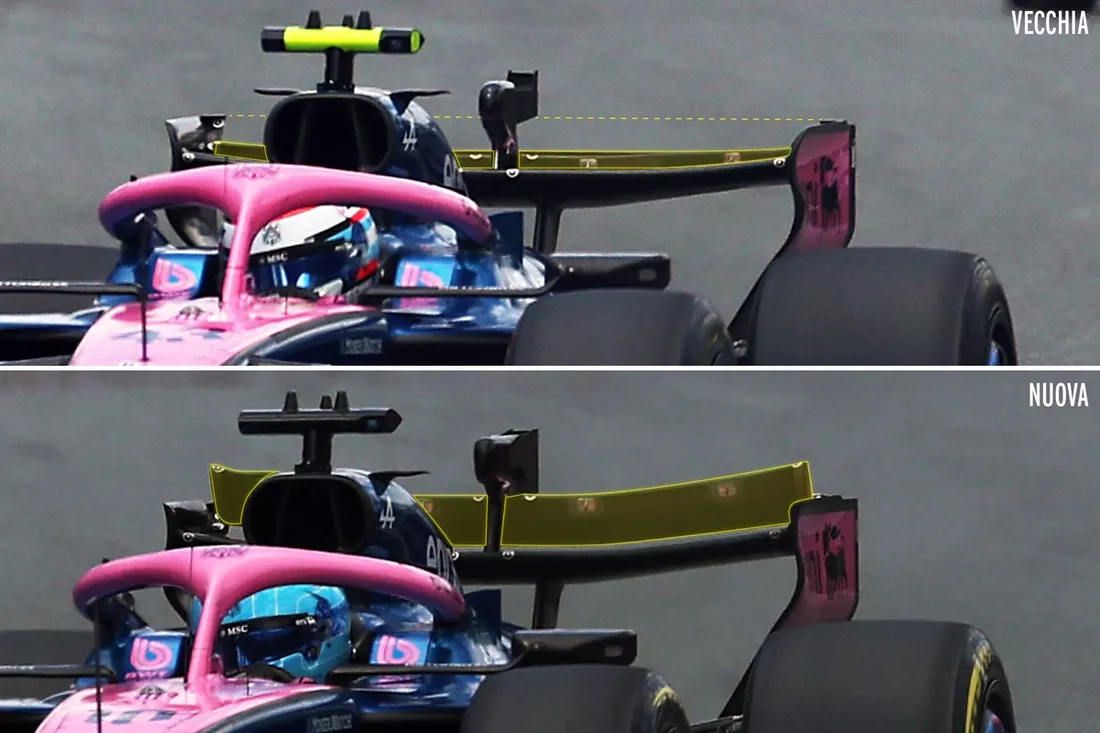
Macarena wing in action on the Ferrari of Charles Leclerc and the Red Bull of Max Verstappen.
Look at the size differences in the gap.

https://pbs.twimg.com/media/HHhn3xAXQAA ... ame=medium

Credit:
@XPBImages
This hyper fixation of that gap is contra productive.
Even if it is beneficial, its like 1% difference. And then add to it that the RB solution generates a lot srtonger end plate vortices because the wing ends in free air, creating a lot of drag.
So in the end its efficiency in regards to its gains shall be very similar to the Ferrari solution.

Add to all that the large actuator in the middle, which creates continuously drag and vortices, worsening the effectiveness of the entire wing. Regardless if closed or opened.
Exactly. At the end of the day what you're trying to promote is earlier separation on the mainplane and having the flap closer to it should achieve that better, not worse. It's not like you care about absolute local downwash per se. You use that to achieve something else.
Having the two profiles in such close longitudinal proximity could be a desired feature, the CFD video that has been released (see the RB22 thread) does not show the scale of the overall profile change (it is obviously ‘off’ as the flipped profile stays with the height of the endplate). So as with the analysis of the Ferrari original results should be taken with a pinch of salt and only used to determine a possible trend in the effect.
Overall I think that the effect of both is very similar, but the (fluid)mechanics of how each one creates that effect are fundamentally different.
Perspective - Understanding that sometimes the truths we cling to depend greatly on our own point of view.

User avatar
AR3-GP
608
Joined: 06 Jul 2021, 01:22

Re: Ferrari SF-26

Post

sucof wrote:
06 May 2026, 20:20
This hyper fixation of that gap is contra productive.
Even if it is beneficial, its like 1% difference. And then add to it that the RB solution generates a lot srtonger end plate vortices because the wing ends in free air, creating a lot of drag.
So in the end its efficiency in regards to its gains shall be very similar to the Ferrari solution.

Add to all that the large actuator in the middle, which creates continuously drag and vortices, worsening the effectiveness of the entire wing. Regardless if closed or opened.
I think you're still missing something. It's not as straightforward as you say. Actually, having open endplate tips reduces the power of the wing, which could lead to overall drag reduction.

I would be cautious of engineering interpretations being passed around by journalist who are not qualified to pass judgement.

Alpine have gone back to a similar trend of open wing tips after previously introducing the lay-back wing. So I think there is something advantageous about the open tip configuration, but it's a car-specific detail. What works for one car might not work for another.

Image

Alpines DRS position also shows why the Ferrari wing is so slow to restore downforce. Ferrari's wing stays in a "DRS" mode until it's near fully closed. It first passes through the wing angle that Mclaren and Alpine use as their DRS, which underlines how slow it is to recover.
Beware of T-Rex

User avatar
AR3-GP
608
Joined: 06 Jul 2021, 01:22

Re: Ferrari SF-26

Post

AmateurDriver wrote:
08 May 2026, 20:58
But unfortunately you don't know a thing about Ferrari wing and its downforce restoring speed. Stop saying bullshit you dont have a clue about.
We do. Qualitatively it's simple. The Ferrari wing spends more time in an aerodynamically incoherent position when it's closing.

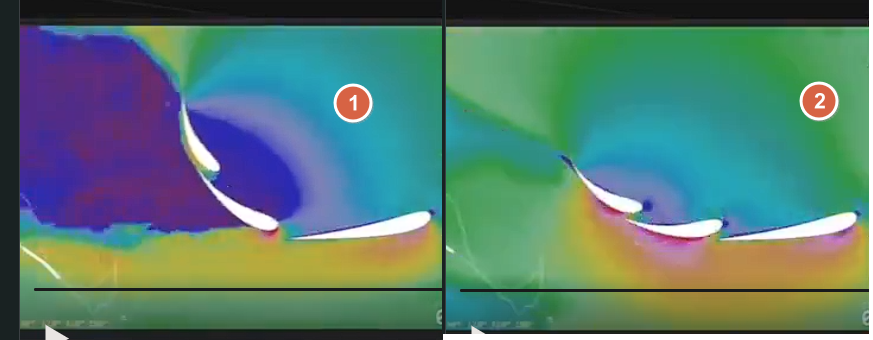
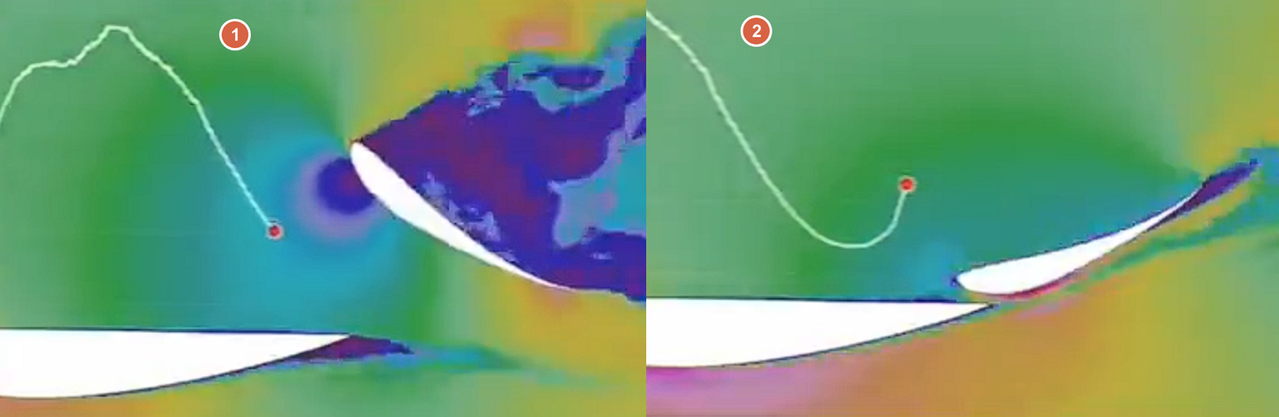
There have also been CFD studies that show the faster pressure recovery of Red Bull's design. We don't need to know the absolute numbers, the CFD is enough to show the effect. It's intuitive. Red Bull's wing should recover downforce faster because after about half of the back rotation, it just looks like a monaco rear wing. That's what the CFD model shows:


RB:
Image

The flow isn't fully attached, but you can see a suction peak forming at the leading edge of the 2nd element quite early on in the back rotation, much earlier than Ferrari's version. It makes sense. Due to the rotation direction, the wing passes through a high angle before it reduces to the closed position.

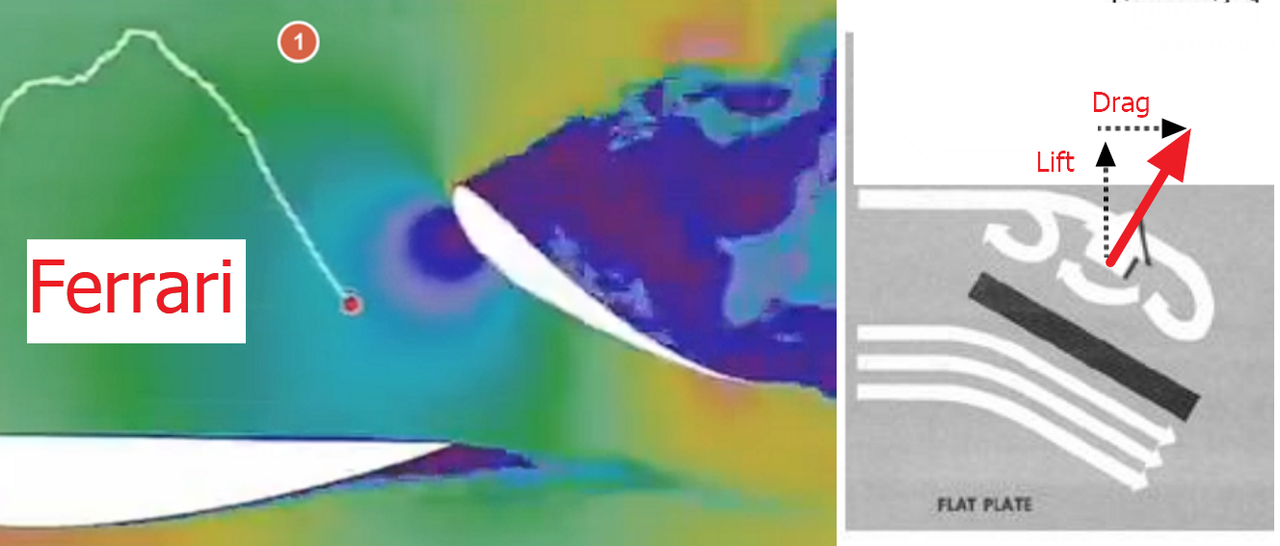
Ferrari:
Image


In Ferrari's case the wing passes through Mclaren and Alpine's DRS position before it closes. One wing is passing through a high downforce position near the end (Red Bull), and the other (Ferrari) is passing through a 2nd DRS position near the end. So RB recovers the downforce faster.

But we're only talking about one aspect of the wing. There are others. Everything has its purpose. I'm sure that both RB and Ferrari considered both versions and chose the one that is best for them.
Beware of T-Rex

Emag
Emag
137
Joined: 11 Feb 2019, 14:56

Re: Ferrari SF-26

Post

AR3-GP wrote:
08 May 2026, 23:32
AmateurDriver wrote:
08 May 2026, 20:58
But unfortunately you don't know a thing about Ferrari wing and its downforce restoring speed. Stop saying bullshit you dont have a clue about.
We do. Qualitatively it's simple. The Ferrari wing spends more time in an aerodynamically incoherent position when it's closing.

There have also been CFD studies that show the faster pressure recovery of Red Bull's design. We don't need to know the absolute numbers, the CFD is enough to show the effect. It's intuitive. Red Bull's wing should recover downforce faster because after about half of the back rotation, it just looks like a monaco rear wing. That's what the CFD model shows:


RB:
https://i.postimg.cc/cHLzBf0K/image.png

The flow isn't fully attached, but you can see a suction peak forming at the leading edge of the 2nd element quite early on in the back rotation, much earlier than Ferrari's version. It makes sense. Due to the rotation direction, the wing passes through a high angle before it reduces to the closed position.

Ferrari:
https://i.postimg.cc/bwzNfFTX/image.png


In Ferrari's case the wing passes through Mclaren and Alpine's DRS position before it closes. One wing is passing through a high downforce position near the end (Red Bull), and the other (Ferrari) is passing through a 2nd DRS position near the end. So RB recovers the downforce faster.

But we're only talking about one aspect of the wing. There are others. Everything has its purpose. I'm sure that both RB and Ferrari considered both versions and chose the one that is best for them.
These are also 2D simulations. It would be interesting to see what happens to the whole thing when you take the endplates into consideration as well.
Developer of F1InsightsHub

User avatar
nico5
25
Joined: 12 Mar 2017, 18:55

Re: Ferrari SF-26

Post

AR3-GP wrote:
08 May 2026, 23:32
Red Bull's wing should recover downforce faster because after about half of the back rotation, it just looks like a monaco rear wing. That's what the CFD model shows:
Yeah, a Monaco wing with a ginormous amount of separation at that transition angle lmao
The only thing that matters in this regard is closing time, but that can be easily obviated by closing the wing manually 0.2s earlier (lift just before braking?)

Farnborough
Farnborough
152
Joined: 18 Mar 2023, 14:15

Re: Ferrari SF-26

Post

nico5 wrote:
09 May 2026, 12:19
AR3-GP wrote:
08 May 2026, 23:32
Red Bull's wing should recover downforce faster because after about half of the back rotation, it just looks like a monaco rear wing. That's what the CFD model shows:
Yeah, a Monaco wing with a ginormous amount of separation at that transition angle lmao
The only thing that matters in this regard is closing time, but that can be easily obviated by closing the wing manually 0.2s earlier (lift just before braking?)
And that is just over 16.0 mtrs @ 180 mph, which nobody will voluntarily give up against a competitor when every fraction counts.

User avatar
nico5
25
Joined: 12 Mar 2017, 18:55

Re: Ferrari SF-26

Post

Farnborough wrote:
09 May 2026, 12:45
nico5 wrote:
09 May 2026, 12:19
AR3-GP wrote:
08 May 2026, 23:32
Red Bull's wing should recover downforce faster because after about half of the back rotation, it just looks like a monaco rear wing. That's what the CFD model shows:
Yeah, a Monaco wing with a ginormous amount of separation at that transition angle lmao
The only thing that matters in this regard is closing time, but that can be easily obviated by closing the wing manually 0.2s earlier (lift just before braking?)
And that is just over 16.0 mtrs @ 180 mph, which nobody will voluntarily give up against a competitor when every fraction counts.
Oh give me a break, Ferrari is currently losing 0.3s every straight bc their deployment cuts much earlier. Closing the SM mode 0.2s earlier is a comparable loss to Merc losing the end-of-lap deployment cut-off trick, like 2 hundredths of a second. If your system wins you even 0.05s bc of not having exposed flap tips, that's already a gain

User avatar
AR3-GP
608
Joined: 06 Jul 2021, 01:22

Re: Ferrari SF-26

Post

nico5 wrote:
09 May 2026, 12:19

Yeah, a Monaco wing with a ginormous amount of separation at that transition angle lmao
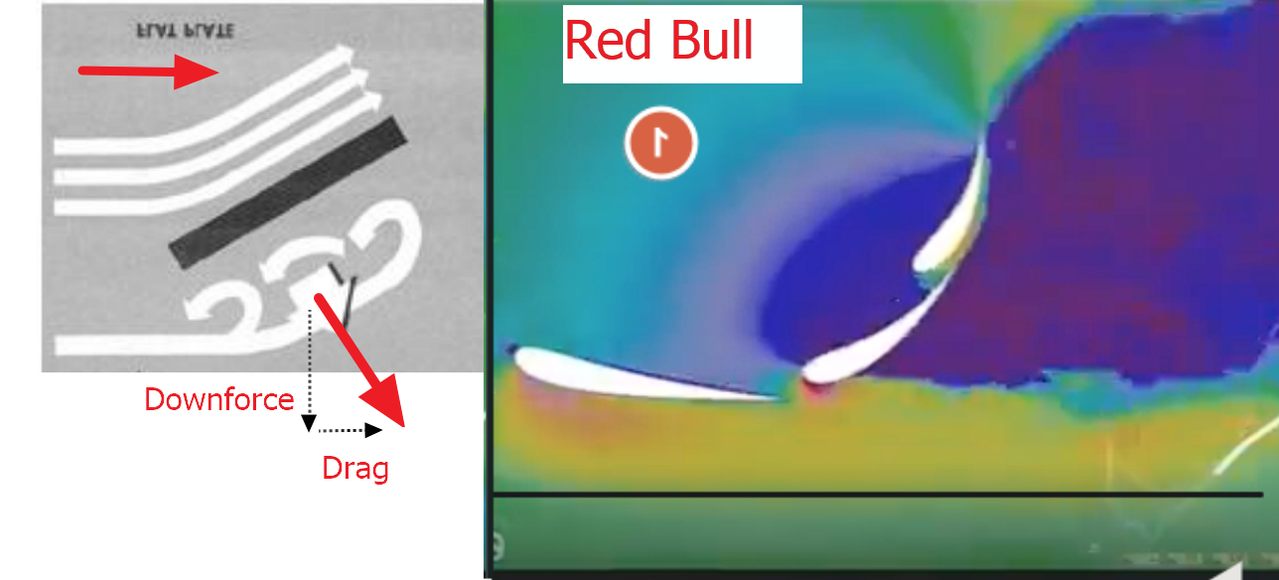
A separated wing still produces downforce as long as it has a positive angle of attack (like Red Bull). That is because it is still redirecting flow upwards on the top surface, even if the lower surface is separated. This figure for a generic wing shows that Red Bull's wing would start picking up downforce very early even before the flow becomes fully attached. The video in the tweet also shows that. Ferrari's wing is rotating through a negative angle of attack for most of the rotation. This means it cannot generate downforce until it's almost fully closed.

Image
Beware of T-Rex

User avatar
nico5
25
Joined: 12 Mar 2017, 18:55

Re: Ferrari SF-26

Post

AR3-GP wrote:
09 May 2026, 14:16
nico5 wrote:
09 May 2026, 12:19

Yeah, a Monaco wing with a ginormous amount of separation at that transition angle lmao
A separated wing still produces downforce as long as it has a positive angle of attack (like Red Bull). That is because it is still redirecting flow upwards on the top surface, even if the lower surface is separated. This figure for a generic wing shows that Red Bull's wing would start picking up downforce very early even before the flow becomes fully attached. The video in the tweet also shows that. Ferrari's wing is rotating through a negative angle of attack for most of the rotation. This means it cannot generate downforce until it's almost fully closed.

https://i.sstatic.net/epvLD.png
This graph is totally irrelevant bc that tests progressive separation, not reattachment. Having a flat flap with a massive high pressure area right behind and above the mainplane will hardly result in any upwash as you can see from your very CFD you brought up.

You only get SOME reattachment when the flap is 95+% closed.

Image
Image

User avatar
AR3-GP
608
Joined: 06 Jul 2021, 01:22

Re: Ferrari SF-26

Post

nico5 wrote:
09 May 2026, 16:06
AR3-GP wrote:
09 May 2026, 14:16
nico5 wrote:
09 May 2026, 12:19

Yeah, a Monaco wing with a ginormous amount of separation at that transition angle lmao
A separated wing still produces downforce as long as it has a positive angle of attack (like Red Bull). That is because it is still redirecting flow upwards on the top surface, even if the lower surface is separated. This figure for a generic wing shows that Red Bull's wing would start picking up downforce very early even before the flow becomes fully attached. The video in the tweet also shows that. Ferrari's wing is rotating through a negative angle of attack for most of the rotation. This means it cannot generate downforce until it's almost fully closed.

https://i.sstatic.net/epvLD.png
This graph is totally irrelevant bc that tests progressive separation, not reattachment. Having a flat flap with a massive high pressure area right behind and above the mainplane will hardly result in any upwash as you can see from your very CFD you brought up.

You only get SOME reattachment when the flap is 95+% closed.

https://i.imgur.com/xuel7ES.png
https://i.imgur.com/ppNWiUF.png
The flaps are generating the upwash. The colors are showing velocity, not pressure. Remeber Newton's third law. As long as the high pressure side should turn the airflow upwards, you will get an equal and opposite reaction force downwards in Red Bull's case. Ferrari's wing will do the opposite. It will generate lift at this point. That's why Red Bull's wing is faster restoring the load.

Image

Image

All of this happens before the airflow becomes attached. Stick your hand out of your car window at angles the next time you're out. Report back here what happens. :lol:
Beware of T-Rex

FDD
FDD
83
Joined: 29 Mar 2019, 01:08

Re: Ferrari SF-26

Post

How much of this is speculation I don't know

https://it.motorsport.com/f1/news/f1-to ... /10819885/

Vappy
Vappy
1
Joined: 14 Mar 2024, 20:09

Re: Ferrari SF-26

Post

AmateurDriver wrote:
11 May 2026, 14:51
AR3-GP wrote:
09 May 2026, 16:11
nico5 wrote:
09 May 2026, 16:06


This graph is totally irrelevant bc that tests progressive separation, not reattachment. Having a flat flap with a massive high pressure area right behind and above the mainplane will hardly result in any upwash as you can see from your very CFD you brought up.

You only get SOME reattachment when the flap is 95+% closed.

https://i.imgur.com/xuel7ES.png
https://i.imgur.com/ppNWiUF.png
The flaps are generating the upwash. The colors are showing velocity, not pressure. Remeber Newton's third law. As long as the high pressure side should turn the airflow upwards, you will get an equal and opposite reaction force downwards in Red Bull's case. Ferrari's wing will do the opposite. It will generate lift at this point. That's why Red Bull's wing is faster restoring the load.

https://i.postimg.cc/QtjJdd9t/image.png

https://i.postimg.cc/ZKm4KkVT/image.png

All of this happens before the airflow becomes attached. Stick your hand out of your car window at angles the next time you're out. Report back here what happens. :lol:
The Ferrari wing is purposely operated to generate aero braking when closing. World-class aerodynamicists of this forum need to buy a memory expansion to their low-end smartphones (or a bigger crayon box, with more colors available) to have this effect included in their simulations.
I'm with you on it generating braking, as it acts more like a spoiler than a wing during rotation back to the default position. Once it reaches its default position, flow re-attaches, and becomes more like a wing again.

User avatar
AR3-GP
608
Joined: 06 Jul 2021, 01:22

Re: Ferrari SF-26

Post

AmateurDriver wrote:
11 May 2026, 14:51
AR3-GP wrote:
09 May 2026, 16:11
nico5 wrote:
09 May 2026, 16:06


This graph is totally irrelevant bc that tests progressive separation, not reattachment. Having a flat flap with a massive high pressure area right behind and above the mainplane will hardly result in any upwash as you can see from your very CFD you brought up.

You only get SOME reattachment when the flap is 95+% closed.

https://i.imgur.com/xuel7ES.png
https://i.imgur.com/ppNWiUF.png
The flaps are generating the upwash. The colors are showing velocity, not pressure. Remeber Newton's third law. As long as the high pressure side should turn the airflow upwards, you will get an equal and opposite reaction force downwards in Red Bull's case. Ferrari's wing will do the opposite. It will generate lift at this point. That's why Red Bull's wing is faster restoring the load.

https://i.postimg.cc/QtjJdd9t/image.png

https://i.postimg.cc/ZKm4KkVT/image.png

All of this happens before the airflow becomes attached. Stick your hand out of your car window at angles the next time you're out. Report back here what happens. :lol:
The Ferrari wing is purposely operated to generate aero braking when closing. World-class aerodynamicists of this forum need to buy a memory expansion to their low-end smartphones (or a bigger crayon box, with more colors available) to have this effect included in their simulations.

Red Bull’s wing does the same thing, so that isn’t what distinguishes them.
Beware of T-Rex

User avatar
venkyhere
43
Joined: 10 Feb 2024, 06:17

Re: Ferrari SF-26

Post

FDD wrote:
11 May 2026, 14:27
How much of this is speculation I don't know

https://it.motorsport.com/f1/news/f1-to ... /10819885/
From the english translation, I infer :
- They purposely prioritized smaller heat exchangers for charge air, inorder to help packaging and thus provide more freedom to aero design.
- This results in high IATs and thus high engine temps, necessitating the steel head, and knowingly sacrificing power (not just peak power, but the entire power envelope at all rpms)
- The hope was that aero freedom + the blown exhaust, would give them more laptime advantage than brute power.

Unfortunately it hasn't worked out. If the FIA bans blown exhaust in 2027, the whole thing has to be scrapped and a completely new PU+chassis has to come.

Yup, sounds about right. Ferrari is Ferrari-ing.

AmateurDriver
AmateurDriver
-6
Joined: 22 Dec 2023, 11:28

Re: Ferrari SF-26

Post

AR3-GP wrote:
11 May 2026, 19:45
AmateurDriver wrote:
11 May 2026, 14:51
AR3-GP wrote:
09 May 2026, 16:11


The flaps are generating the upwash. The colors are showing velocity, not pressure. Remeber Newton's third law. As long as the high pressure side should turn the airflow upwards, you will get an equal and opposite reaction force downwards in Red Bull's case. Ferrari's wing will do the opposite. It will generate lift at this point. That's why Red Bull's wing is faster restoring the load.

https://i.postimg.cc/QtjJdd9t/image.png

https://i.postimg.cc/ZKm4KkVT/image.png

All of this happens before the airflow becomes attached. Stick your hand out of your car window at angles the next time you're out. Report back here what happens. :lol:
The Ferrari wing is purposely operated to generate aero braking when closing. World-class aerodynamicists of this forum need to buy a memory expansion to their low-end smartphones (or a bigger crayon box, with more colors available) to have this effect included in their simulations.

Red Bull’s wing does the same thing, so that isn’t what distinguishes them.
But it makes all your consideration on induced lift irrelevant. You are missing the point.