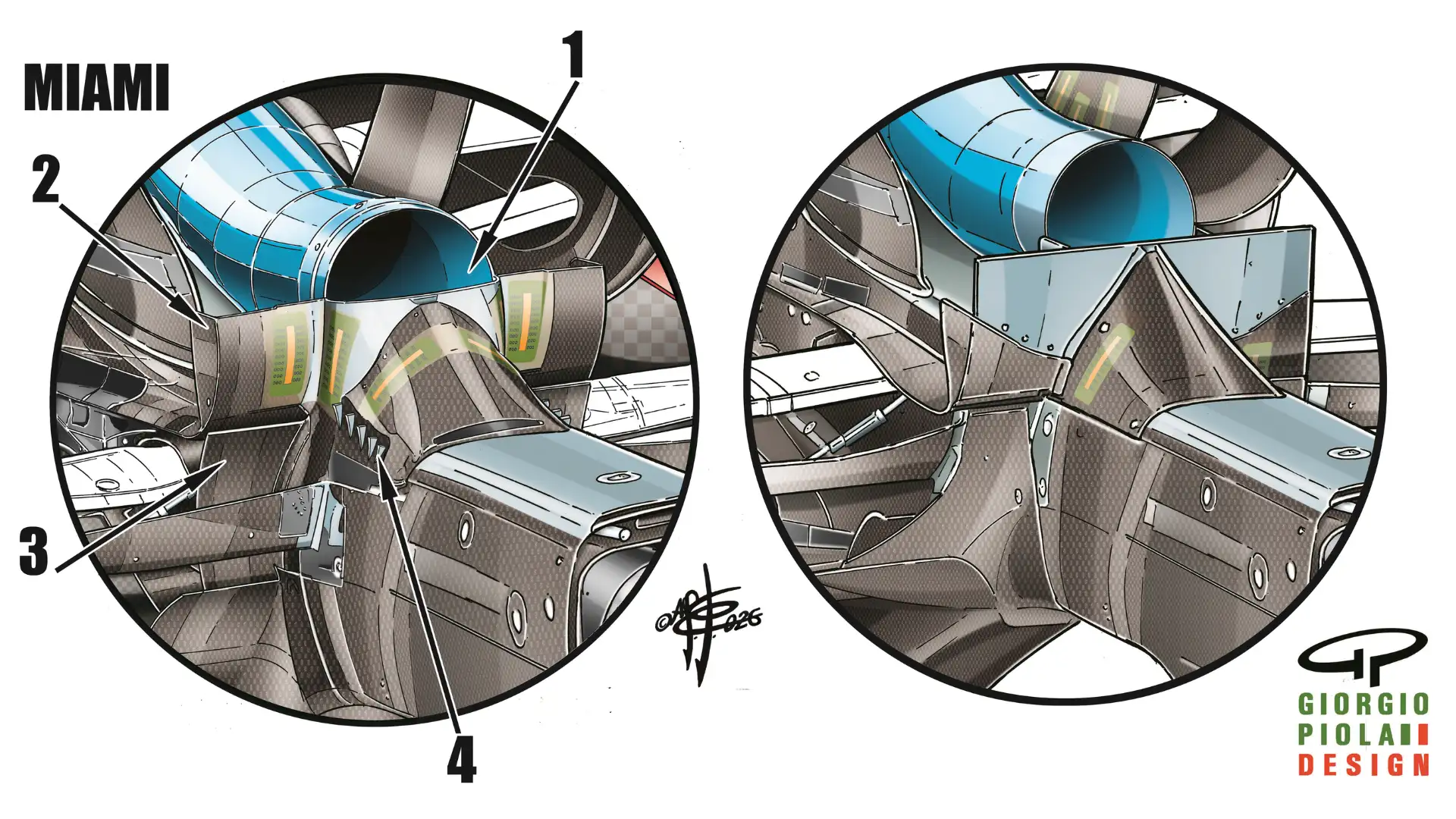
Speculation, but consistent with what I proposed some time ago:AR3-GP wrote: ↑03 May 2026, 15:37Yes but I think it's not for specifically for generating downforce on its own. Its connected to the operation of the wing. Potentially part of making it move faster or move more reliably.Brahmal wrote: ↑03 May 2026, 15:33That may be the case, but Ferrari clearly consider it to be an aerodynamic element as well. It even has it's own tiny little gurney flap!AR3-GP wrote: ↑02 May 2026, 05:28I've been thinking about the purpose of the "sticky-uppy bit" in the center of Ferrari's macarena wing. I think its purpose is to pretension the flap. It makes some drag which when applied in this position relative to the rotation point is creating a "restoring torque" that keeps the wing under a rotational tension when it's upside down. Either that or it's some kind of counterweight or mass damper to do the same thing.
https://www.formulatecnica.it/2026/05/f ... -macarena/
We are referring to the physical load that the pilot must apply to the yoke to overcome aerodynamic drag and move steering surfaces such as balancers, ailerons and directional rudder. This same principle has been translated by Ferrari to the "Macarena" 2.0 to reduce the workload of the actuators. The latter which, in all likelihood, could be of an electrical nature.
The flap of the Ferrari SF-26 of the Macarena 2.0 wing to speed up rotation
A hydraulic system would in fact have much larger dimensions, making their integration inside the side bulkheads more complicated. To be fair, it should be noted that no official confirmation or denial has yet arrived from Maranello on the matter. By placing the flap at a safe distance from the pivot of the main profile, aerodynamic drag is used to amplify the lever arm.
This scenario generates a higher torque as a result, capable of significantly speeding up the implementation of the component to which it is anchored. The obvious technical compromise pays off in terms of efficiency. If, on the one hand, during the 270-degree excursion, the device facilitates rotation in both directions, on the other hand, it turns into a penalizing element in a static position at 90 degrees.