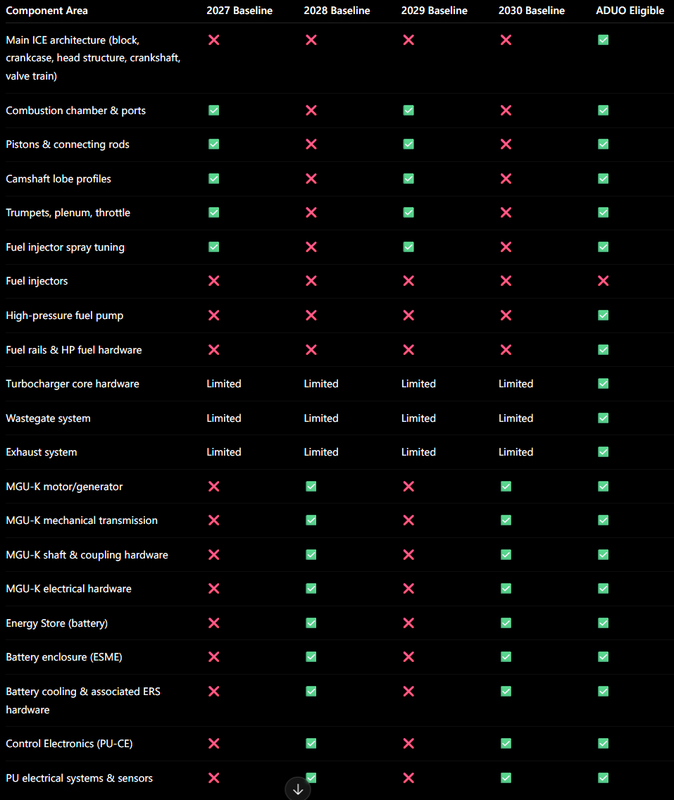
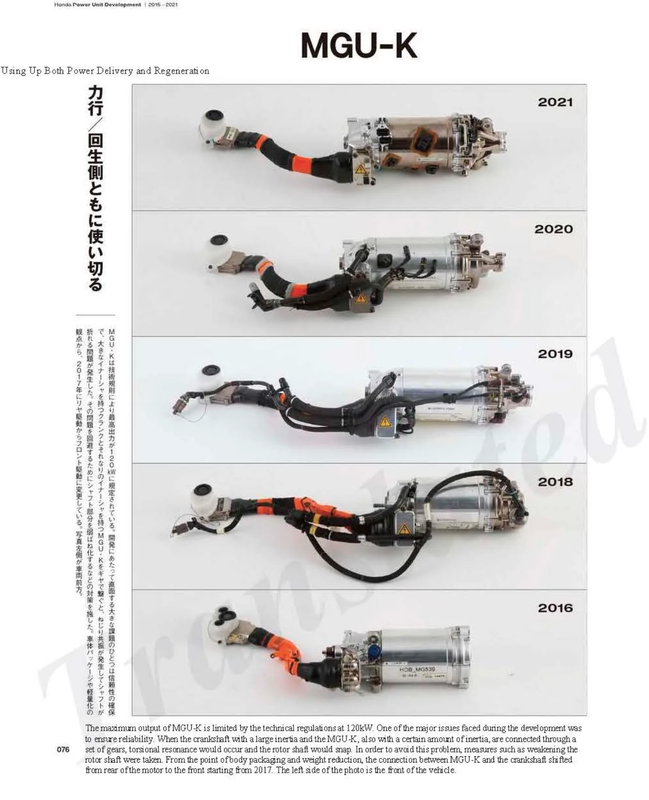
As a result of the ADUO decision, Red Bull's rookie hybrid system is frozen until 2028. The others will get 1 upgrade in 2026 and 1 upgrade in 2027. Hybrid system upgrades were a fundamental battleground in 2016-2022 where manufacturers made use of the in-season upgrades that was permitted in each season. Honda published white papers on their MGU-K, control electronics, and energy store development. The energy store, the control units, and the MGU-K are a significant development battleground that Red Bull will not have this year or next year.
Imo the failed ADUO outcome is enough for Red Bull to write off 2027.
Honda’s newest ESS, fully developed in-house, has remarkably lower loss, during times of high current flow in particular, compared to ESSs of the past due to its lower resistance. From a different perspective, this means it provides an increased level of usable energy. And with greater resistance to deterioration compared to older ESSs, with a minimal drop in output, the greater the distance traveled, the greater the difference in performance between the new and old ESSs.
Due to higher efficiency and lower loss in the new ESS, the MGU-K and MGU-H can be deployed for a longer period of time on the drive side compared to previous ESSs, even if energy recovery levels are the same. (Deployment refers to the assist focused on in mass production development, while harvesting is a term sometimes used by Honda and others, when developing F1 power units, for the recovery of energy.) The volumetric output density (W/kg) of the new ESS introduced in the 12th round of the 2021 season is 1.3 times greater than that of the ESS used in 2020 and 2021 seasons. Using the 2015 ESS as the base, the 2021 ESS is 26% smaller and 15% lighter, which contributes greatly from the perspectives of energy management and optimizing vehicle driving performance.
https://global.honda/en/tech/motorsport ... train_ESS/