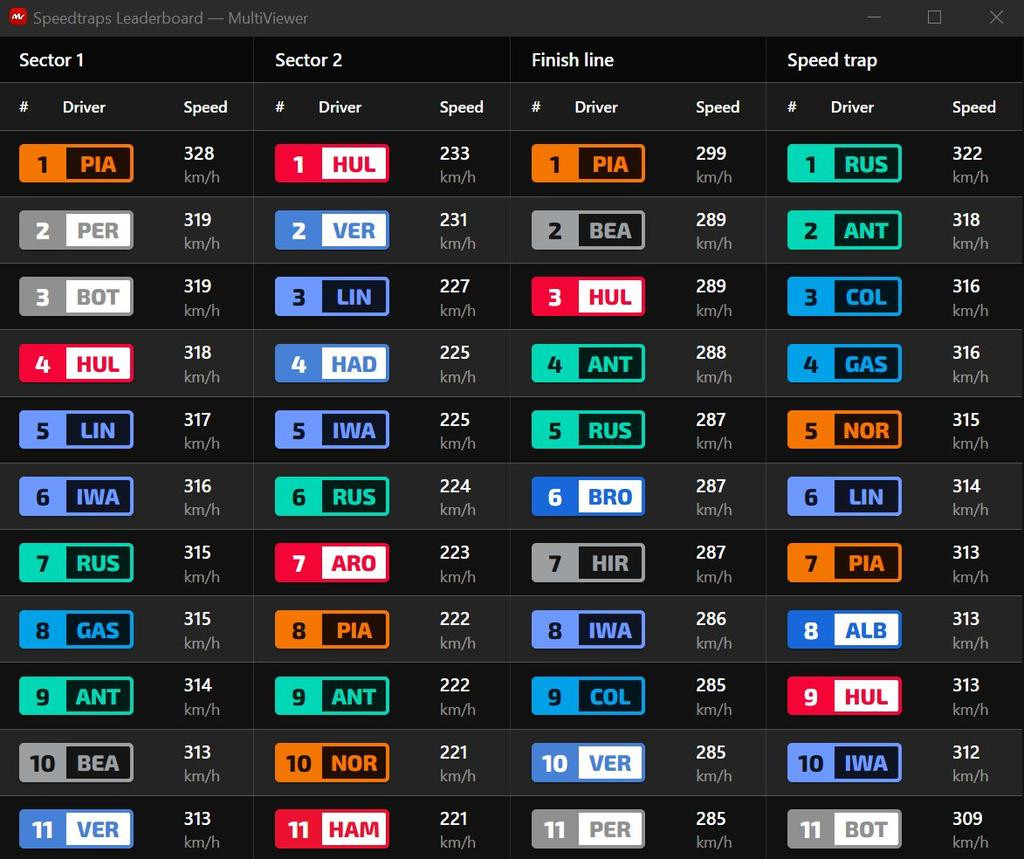
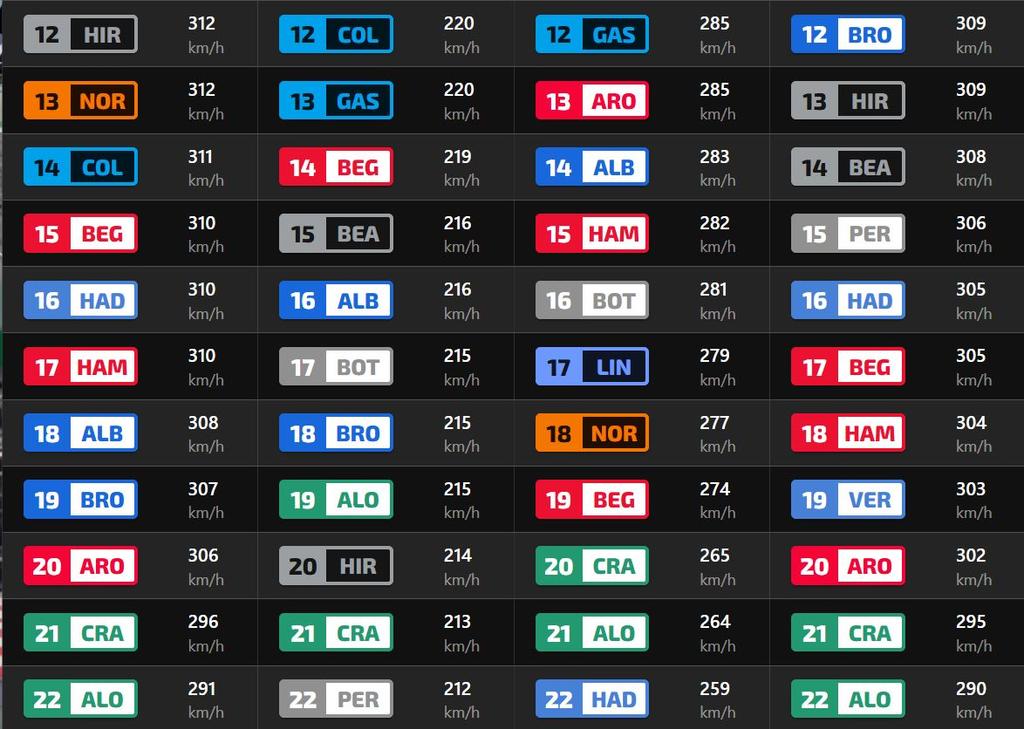
George Russell claimed his first Formula One sprint race win at the 2026 Chinese Grand Prix, maintaining his perfect start to the season after a closely fought contest that highlighted both Mercedes’ strengths and the evolving competitive order under the 2026 regulations.
This forum contains threads to discuss teams themselves. Anything not technical about the cars, including restructuring, performances etc belongs here.
I don't buy this, sorry. They are not this stupid. And it is also not logical, they did not take multiple times more upgrades than other teams...
What's "stupid" about it? They've brought more upgrades than anyone else at this stage. They've basically been through two upgrade cycles and everyone else is still on their first (RB bringing their second this round). After RB, Merc, and McLaren bring their second round of updates I'm sure they will be in a similar position.
I wrote in my original message: "They are NOT this stupid"......
The implication being that bringing your major upgrades early would be "stupid". It's not, if the upgrades work you take your advantage sooner, Spain was a perfect example. Ferrari is operating on the same budget as everyone else so naturally they will have exhausted more of their development budget on two upgrade cycles than teams who have brought just one. That's why you shouldn't expect another big update this side of the summer break, and who knows after.
I don't buy this, sorry. They are not this stupid. And it is also not logical, they did not take multiple times more upgrades than other teams...
What's "stupid" about it? They've brought more upgrades than anyone else at this stage. They've basically been through two upgrade cycles and everyone else is still on their first (RB bringing their second this round). After RB, Merc, and McLaren bring their second round of updates I'm sure they will be in a similar position.
I wrote in my original message: "They are NOT this stupid"......
I think the point went past you. Why would it be stupid, if true? They may have used up most of the budget intended for this year's car. Most of what remains is allocated to 2027's. It was only in the last race they were somewhat competitive, with Russel racing with a botched front wing setting and Antonelli retiring.
It remains to be seen what will the pecking order be after Mercedes and McLaren brings significant updates.
Yep the real world gains are never as simple as a single number.
The following video features a discussion with WEC engineer Riccardo Romanelli (Workracing Cars), who explains how the FIA, as well as the teams, evaluate the estimates for the ADUO (starting from the 20:10 mark):
In a nutshell, it's about:
How Teams Estimate Competitors' PU Power
Telemetry over Phonometry: Trackside acoustic/spectrographic analysis from the '90s/'00s is obsolete; today's methods are strictly mathematical.
GPS Modeling: Teams use GPS data to analyze linear acceleration. By subtracting known variables like tire rolling resistance (standardized Pirelli data) and estimating aerodynamic drag, engineers tune their simulations until their theoretical curve perfectly overlays the rival's telemetry.
Focus Area: Analysis targets mid-speed acceleration zones where traction limits and hybrid deployment strategies cause minimal distortion to the calculations.
...
Further subjects discussed were:
1. Power Unit Development & ADUO Concessions
Gualtieri (Ferrari) & Romanelli: PU development follows long R&D cycles. Major architectural changes mid-season are impossible due to technical complexity and strict reliability limits (restricted PU allocation).
ADUO Impact: Concessions help close the gap, but gains come from incremental steps (thermal management, mappings, aero) rather than overnight performance leaps.
2. Impact of Updates on the Ferrari Monopost
New engine/propulsion updates should not disrupt the car's baseline dynamics or established setups. The estimated power gain is minor and will simply complement the positive aero package seen in previous rounds.
3. Politics, FIA, and Media Rumors
Media Speculation: Press claims (e.g., "Mercedes has +30-40 HP") are groundless speculation.
Sandbagging/Reliability: Aligning with Mattia Binotto's past comments, teams may strategically run at 98-99% capacity to manage reliability and avoid triggering FIA/ADUO performance rebalancing.
FIA Opacity: Concealing exact ADUO rankings or BOP data (similar to Le Mans) is driven by commercial interests; top automotive brands refuse to be publicly labeled as having the weakest engine.
4. Barcelona Review & Austrian GP Outlook
Barcelona: Ferrari's solid pace stemmed from an efficient aero package and setup optimization (which suited Hamilton's style). Romanelli considers a 0.3–0.4s per lap gain from a major package plausible, but rules out a full 1-second leap.
Austria (Red Bull Ring): A starkly different track featuring long straights and corners demanding entry agility and exit traction, with low lateral load. Consequently, the softest compounds (C3, C4, C5) won't face high lateral degradation, meaning Ferrari should remain competitive.
Telemetry over Phonometry: Trackside acoustic/spectrographic analysis from the '90s/'00s is obsolete; today's methods are strictly mathematical.
GPS Modeling: Teams use GPS data to analyze linear acceleration. By subtracting known variables like tire rolling resistance (standardized Pirelli data) and estimating aerodynamic drag, engineers tune their simulations until their theoretical curve perfectly overlays the rival's telemetry.
Focus Area: Analysis targets mid-speed acceleration zones where traction limits and hybrid deployment strategies cause minimal distortion to the calculations.
Why 'estimated' ? are you sure that's what's said in the video ? what if they estimate one car to have higher/lower than actual value , wouldn't they grant it less/more ADUO in that case ?
Shouldn't Cd be deterministic, from CFD sims (I expect the formula-defining people of FIA to know how to take the CFD model of their cars that's submitted by the teams, and run a standard 'Cd estimator' sim on each model) ?
Telemetry over Phonometry: Trackside acoustic/spectrographic analysis from the '90s/'00s is obsolete; today's methods are strictly mathematical.
GPS Modeling: Teams use GPS data to analyze linear acceleration. By subtracting known variables like tire rolling resistance (standardized Pirelli data) and estimating aerodynamic drag, engineers tune their simulations until their theoretical curve perfectly overlays the rival's telemetry.
Focus Area: Analysis targets mid-speed acceleration zones where traction limits and hybrid deployment strategies cause minimal distortion to the calculations.
Why 'estimated' ? are you sure that's what's said in the video ? what if they estimate one car to have higher/lower than actual value , wouldn't they grant it less/more ADUO in that case ?
Shouldn't Cd be deterministic, from CFD sims (I expect the formula-defining people of FIA to know how to take the CFD model of their cars that's submitted by the teams, and run a standard 'Cd estimator' sim on each model) ?
Then just turn on the English translation to convince yourself—select English in the CC settings, in case you didn't know already.
Telemetry over Phonometry: Trackside acoustic/spectrographic analysis from the '90s/'00s is obsolete; today's methods are strictly mathematical.
GPS Modeling: Teams use GPS data to analyze linear acceleration. By subtracting known variables like tire rolling resistance (standardized Pirelli data) and estimating aerodynamic drag, engineers tune their simulations until their theoretical curve perfectly overlays the rival's telemetry.
Focus Area: Analysis targets mid-speed acceleration zones where traction limits and hybrid deployment strategies cause minimal distortion to the calculations.
Why 'estimated' ? are you sure that's what's said in the video ? what if they estimate one car to have higher/lower than actual value , wouldn't they grant it less/more ADUO in that case ?
Shouldn't Cd be deterministic, from CFD sims (I expect the formula-defining people of FIA to know how to take the CFD model of their cars that's submitted by the teams, and run a standard 'Cd estimator' sim on each model) ?
Then just turn on the English translation to convince yourself—select English in the CC settings, in case you didn't know already.
If you know Italian you can tell me in one word, or if you watched with 'english translation' the question still holds.
What's "stupid" about it? They've brought more upgrades than anyone else at this stage. They've basically been through two upgrade cycles and everyone else is still on their first (RB bringing their second this round). After RB, Merc, and McLaren bring their second round of updates I'm sure they will be in a similar position.
I wrote in my original message: "They are NOT this stupid"......
I think the point went past you. Why would it be stupid, if true? They may have used up most of the budget intended for this year's car. Most of what remains is allocated to 2027's. It was only in the last race they were somewhat competitive, with Russel racing with a botched front wing setting and Antonelli retiring.
It remains to be seen what will the pecking order be after Mercedes and McLaren brings significant updates.
It would be "stupid" because upgrade packages are not limited mainly by equipment or money, rather than Time.
Meaning, it is the time they need the most to develop the aero, so if you use your money quickly, you will have your engineers sitting still and looking out the window for the rest of the year instead of improving the car.
Hence a more balanced rythm of the updates makes your car faster overall.
Engineers also need to see the results, changes their latest ideas has caused to learn for the next update.
They also need the time to see the development of other cars, to stay up to date with their ideas.
You throw all those away if you spend your money in the beginning of the season.
But it is easy anyways, teams work like this if you look around. Some even decided to wait longer.
Why 'estimated' ? are you sure that's what's said in the video ? what if they estimate one car to have higher/lower than actual value , wouldn't they grant it less/more ADUO in that case ?
Shouldn't Cd be deterministic, from CFD sims (I expect the formula-defining people of FIA to know how to take the CFD model of their cars that's submitted by the teams, and run a standard 'Cd estimator' sim on each model) ?
Then just turn on the English translation to convince yourself—select English in the CC settings, in case you didn't know already.
If you know Italian you can tell me in one word, or if you watched with 'english translation' the question still holds.
You completely misunderstood. The Italian engineer was explaining how F1 teams (not the FIA) estimate competitor ICE power. That process relies, among other things, on estimating tire rolling resistance using the standard data provided by Pirelli to everyone. So, to be clear, it's a team-level estimation, not an official FIA calculation.
For context, here is the exact transcript translation of the portion of the video where the Italian engineer explains this specific topic:
How F1 Engine Secrets Are Uncovered
This is a very interesting aspect because we have moved away from a bygone era, let's say, of the 90s and 2000s, where engine manufacturers hired specialists who would stand trackside to take sound level measurements. By performing spectrum analysis—meaning frequency content analysis—they could determine not only the maximum RPM but also certain transients and situations that revealed specific insights.
Today, what can I tell you? Just like in the past, but even more so today, all teams have access to basic telemetry data from the car—the same data that we look at—which means the car's speed, from which you can obviously derive linear acceleration. This data is accurate because it comes from the cars' GPS. So, how can you determine engine power?
You can map out the car within a complex model. If you look at the top speed achieved—and in a car without an electric or hybrid component, where the power is purely thermal—it's clear that the top speed reached by the car, if you accurately knew the aerodynamic characteristics, specifically the overall drag, and by estimating the power lost to rolling resistance (since tires are the same for everyone), would allow you to determine at least the actual maximum power at the wheel.
Now, top speed is a bit more complex to use as a parameter because we know it is intimately linked to how the electric part is deployed—meaning how much energy you release and at what exact moment integrated over time, from the corner exit up to the top speed.
However, acceleration out of corners—especially medium-speed corners, where the impact of one car's traction efficiency compared to another can be considered less significant—means the velocity-over-time curve is somewhat a consequence of what? Of the residual force that allows the car to accelerate. And this instantaneous force, moment by moment, is what? It's the instantaneous power the Power Unit delivers to the wheel through the transmission system and the various efficiencies.
Thus, instantaneous power translates moment by moment into a tractive force that pushes the car forward, from which you must subtract the rolling resistance forces of the tires. These are well known because Pirelli obviously provides precise data, but teams know them anyway, and regardless, the tires are the same for everyone. The other aspect that slows the car down moment by moment, opposing its acceleration, is aerodynamics—meaning the drag that the car generates at any given instant.
So, when you build your complete model of the car and run lap time simulations—simulating the lap time and the car's performance over a lap—you are able to extract sectors for any given track which, as I mentioned, at least in the central phase of the car's acceleration, are minimally dependent on the purely electric component and minimally dependent on whether one car has slightly better or worse traction than another.
Therefore, by analyzing the central portions of the velocity-time diagram—or velocity-distance, which is obviously the same thing—you are able, by varying the parameters of your model, to try to make your competitor's telemetry curve converge with your own car model, in which you have tweaked these fundamental variables. From there, by matching the two results—meaning achieving an exact overlay between your car with modified coefficients and your competitor's telemetry—you try to estimate the power.
Obviously, the matter is highly complex because there is also the aspect of gear ratios; all teams have their own gearbox ratios, which stay the same for the whole season, but are still different from one another. But substantially, this is the method.
Then just turn on the English translation to convince yourself—select English in the CC settings, in case you didn't know already.
If you know Italian you can tell me in one word, or if you watched with 'english translation' the question still holds.
You completely misunderstood. The Italian engineer was explaining how F1 teams (not the FIA) estimate competitor ICE power. That process relies, among other things, on estimating tire rolling resistance using the standard data provided by Pirelli to everyone. So, to be clear, it's a team-level estimation, not an official FIA calculation.
For context, here is the exact transcript translation of the portion of the video where the Italian engineer explains this specific topic:
How F1 Engine Secrets Are Uncovered
This is a very interesting aspect because we have moved away from a bygone era, let's say, of the 90s and 2000s, where engine manufacturers hired specialists who would stand trackside to take sound level measurements. By performing spectrum analysis—meaning frequency content analysis—they could determine not only the maximum RPM but also certain transients and situations that revealed specific insights.
Today, what can I tell you? Just like in the past, but even more so today, all teams have access to basic telemetry data from the car—the same data that we look at—which means the car's speed, from which you can obviously derive linear acceleration. This data is accurate because it comes from the cars' GPS. So, how can you determine engine power?
You can map out the car within a complex model. If you look at the top speed achieved—and in a car without an electric or hybrid component, where the power is purely thermal—it's clear that the top speed reached by the car, if you accurately knew the aerodynamic characteristics, specifically the overall drag, and by estimating the power lost to rolling resistance (since tires are the same for everyone), would allow you to determine at least the actual maximum power at the wheel.
Now, top speed is a bit more complex to use as a parameter because we know it is intimately linked to how the electric part is deployed—meaning how much energy you release and at what exact moment integrated over time, from the corner exit up to the top speed.
However, acceleration out of corners—especially medium-speed corners, where the impact of one car's traction efficiency compared to another can be considered less significant—means the velocity-over-time curve is somewhat a consequence of what? Of the residual force that allows the car to accelerate. And this instantaneous force, moment by moment, is what? It's the instantaneous power the Power Unit delivers to the wheel through the transmission system and the various efficiencies.
Thus, instantaneous power translates moment by moment into a tractive force that pushes the car forward, from which you must subtract the rolling resistance forces of the tires. These are well known because Pirelli obviously provides precise data, but teams know them anyway, and regardless, the tires are the same for everyone. The other aspect that slows the car down moment by moment, opposing its acceleration, is aerodynamics—meaning the drag that the car generates at any given instant.
So, when you build your complete model of the car and run lap time simulations—simulating the lap time and the car's performance over a lap—you are able to extract sectors for any given track which, as I mentioned, at least in the central phase of the car's acceleration, are minimally dependent on the purely electric component and minimally dependent on whether one car has slightly better or worse traction than another.
Therefore, by analyzing the central portions of the velocity-time diagram—or velocity-distance, which is obviously the same thing—you are able, by varying the parameters of your model, to try to make your competitor's telemetry curve converge with your own car model, in which you have tweaked these fundamental variables. From there, by matching the two results—meaning achieving an exact overlay between your car with modified coefficients and your competitor's telemetry—you try to estimate the power.
Obviously, the matter is highly complex because there is also the aspect of gear ratios; all teams have their own gearbox ratios, which stay the same for the whole season, but are still different from one another. But substantially, this is the method.
Yes I did misunderstand. Thanks for correcting me.
not the FIA, it's the teams themselves.
However, even in this transcript translation, the word 'estimated' is used only in the context of rolling resistance, not in the context of Cd (for which the phrase 'accurate value' is used). The original post wasn't like this. That's all my point was.
The two cars on track during the first free practice session featured different aerodynamic solutions. At the Spielberg circuit, the focus was placed on data collection ahead of the low-downforce rounds at Silverstone and Spa. More specifically, the team led by Loïc Serra ran two SF-26s with different bargeboard configurations on the sidepods: on Hamilton's SF-26, the "forest" of vertically developed vanes was removed, replaced by a single, wider element with less outward curvature. A more "simple" design, closer to the solution used on the car prior to Miami, conceived for a more low-downforce aerodynamic setup. The Briton subsequently reverted to the profiles used in Barcelona. As for the other side of the garage, Beganovic was guided over the radio by Johannes Hatz, head of Vehicle Performance for Leclerc, who drove his car in a configuration identical to Barcelona's with regard to the floor boards.
During FP1, Dino Beganovic completed a few laps fitted with the classic fins in order to gather aerodynamic data on the rear of the SF-26. The young Ferrari Academy driver tested the SF-26 without the winglet positioned in front of the exhaust, as part of correlation work with tests conducted at Maranello, again with an eye toward the fast circuits coming up on the calendar. Maranello will most likely decide not to fit the FTM at Spa and Monza, while for the recent Silverstone round, the Scuderia will carefully analyse the data gathered during today's tests. The question remains primarily linked to aerodynamic drag considerations — which the system generates around the rear axle — in addition to the negligible effect related to the engine.
Also the new engine was apparently already fitted but they were running a significantly more conservative engine mapping compared to Mercedes
I found the top speeds of both Ferrari cars quite curious (somewhere around 15-20 kph below Mercedes), and although this can be explained by different PU and deployment mappings, something still didn't add up...
However, an Italian YouTuber with connections inside the F1 team suggests that they had already installed the new engine with Stage 1 ADUO as early as FP1, even though it was initially scheduled for FP3.
The reasoning behind this is:
1. Check the correlation with their simulations and to quickly react if something is going wrong,
2. They ran both PU and deployment mappings very conservatively, which explains the massive deficit in top speeds,
3. Development driver Beganovic tested the car without the RV component to compare the power gain against Hamilton's car, which had the part fitted.
Another observation is the shift in how they approach FP sessions since Barcelona: in FP1 they were 5 tenths behind Mercedes, in FP2 and FP3 only 2-3 tenths off, and by Q3 they were matching them on lap times ...
Last edited by atanatizante on 26 Jun 2026, 16:34, edited 1 time in total.
The two cars on track during the first free practice session featured different aerodynamic solutions. At the Spielberg circuit, the focus was placed on data collection ahead of the low-downforce rounds at Silverstone and Spa. More specifically, the team led by Loïc Serra ran two SF-26s with different bargeboard configurations on the sidepods: on Hamilton's SF-26, the "forest" of vertically developed vanes was removed, replaced by a single, wider element with less outward curvature. A more "simple" design, closer to the solution used on the car prior to Miami, conceived for a more low-downforce aerodynamic setup. The Briton subsequently reverted to the profiles used in Barcelona. As for the other side of the garage, Beganovic was guided over the radio by Johannes Hatz, head of Vehicle Performance for Leclerc, who drove his car in a configuration identical to Barcelona's with regard to the floor boards.
During FP1, Dino Beganovic completed a few laps fitted with the classic fins in order to gather aerodynamic data on the rear of the SF-26. The young Ferrari Academy driver tested the SF-26 without the winglet positioned in front of the exhaust, as part of correlation work with tests conducted at Maranello, again with an eye toward the fast circuits coming up on the calendar. Maranello will most likely decide not to fit the FTM at Spa and Monza, while for the recent Silverstone round, the Scuderia will carefully analyse the data gathered during today's tests. The question remains primarily linked to aerodynamic drag considerations — which the system generates around the rear axle — in addition to the negligible effect related to the engine.
Also the new engine was apparently already fitted but they were running a significantly more conservative engine mapping compared to Mercedes
I wrote in my original message: "They are NOT this stupid"......
I think the point went past you. Why would it be stupid, if true? They may have used up most of the budget intended for this year's car. Most of what remains is allocated to 2027's. It was only in the last race they were somewhat competitive, with Russel racing with a botched front wing setting and Antonelli retiring.
It remains to be seen what will the pecking order be after Mercedes and McLaren brings significant updates.
It would be "stupid" because upgrade packages are not limited mainly by equipment or money, rather than Time.
Meaning, it is the time they need the most to develop the aero, so if you use your money quickly, you will have your engineers sitting still and looking out the window for the rest of the year instead of improving the car.
Hence a more balanced rythm of the updates makes your car faster overall.
Engineers also need to see the results, changes their latest ideas has caused to learn for the next update.
They also need the time to see the development of other cars, to stay up to date with their ideas.
You throw all those away if you spend your money in the beginning of the season.
But it is easy anyways, teams work like this if you look around. Some even decided to wait longer.
This is just your idealization. If they decide it's not worth spending more time and money on this car they can work on the next car. Engineers certainly won't sitting around idle in any case...