
- Login or Register
No account yet? Sign up

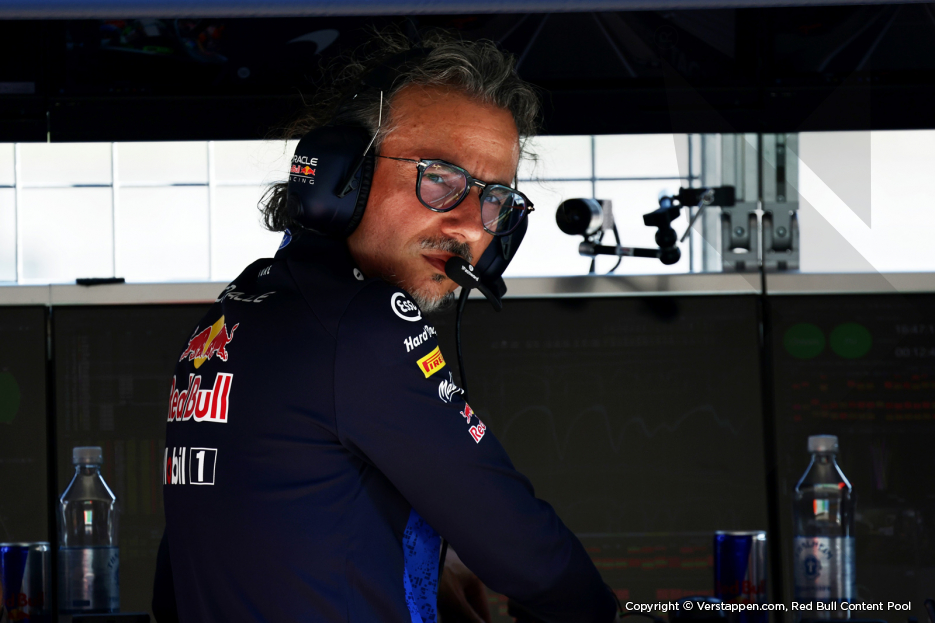
Mekies after Austrian GP qualifying: 'Apologise to Max'
Published on 27 June 2026 by Niels Hendrix
Laurent Mekies, team principal and CEO of Oracle Red Bull Racing, reflected on the Austrian Grand Prix qualifying and said: “The most important thing after this eventful qualifying session is that Max is okay. He delivered an excellent first run in Q3, and his final run was very fast until he lost the car in turn 9. The dynamic of the incident was quite unusual, and we lost aero performance on the rear of the car and it gave Max no chance to survive. As a team we take full responsibility for it and apologise to him.”
Mekies continued: “Not sending Max out for a second run in Q2 was certainly a close call, but we knew we had to take some risks after deciding to approach qualifying with only three new sets of softs to give ourselves more strategic options for the race.”
At Spielberg the RB22 received an upgrade. Mekies explained: “With any significant upgrade, it is never simply a case of plug-and-play. The real challenge is to understand the package, identify its optimum operating window and maximise its potential over the course of the weekend. We are still learning but today was an encouraging first step. The improved pace we had demonstrated the progress we have made with the package we have brought to Austria.”
“A huge thank you to everyone back at the factory. This large upgrade package, covering many aspects of the car and PU, is the result of the hard work across the entire team. Seeing that effort reflected in our competitiveness today is a well-deserved reward for everyone involved. Our full focus now turns to tomorrow. Another extremely hot race awaits us, and it will be interesting to see how we perform in these conditions.”

Anti-dive kept the floor in the optimal window without the change in the AOA of the floor.venkyhere wrote: ↑27 Jun 2026, 19:38I am unable to understand this correlation between anti-dive (which was a necessity in the tunnel era where the floor was sensitive even to tiny orientation changes) and high speed corners. In the pre-tunnel era, where chassis rules were similar to current era, I don't remember seeing much of anti-dive geometries and cars had no issues flying through high speed corners. So it would be helpful if you elaborate a bit what you are trying to convey.

Thank you.FW17 wrote: ↑28 Jun 2026, 04:34Anti-dive kept the floor in the optimal window without the change in the AOA of the floor.venkyhere wrote: ↑27 Jun 2026, 19:38I am unable to understand this correlation between anti-dive (which was a necessity in the tunnel era where the floor was sensitive even to tiny orientation changes) and high speed corners. In the pre-tunnel era, where chassis rules were similar to current era, I don't remember seeing much of anti-dive geometries and cars had no issues flying through high speed corners. So it would be helpful if you elaborate a bit what you are trying to convey.
While in pre 2022 era teams went for large rake and shifting aero balance as concept, the ground effect era brought out the benefit of keeping the floor in its most optimum window. Anti-dive with its lack of load shifting is not great for the feeling the front at corner entry and low speed performance, something a lot of drivers were very vocal about.
While some teams went back to the shifting of loads concept like red bull others top 3 Merc, Ferrari and Mclaren have carried their learnings from GE era to the current era to maximise the highspeed performance. They must also have developed systems with their suspension, steering and geometry for the low speed not be lacking.
It is all incremental, but the extreme anti dive geometry was not exploited till RBR came out with the 2022 concept. Initially 2022 leading car like Ferrari did not have anti-dive, yet was very fast. Mclaren in 2025 had the most extreme version of it, yet performed quiet well in low speed relative to competition.
As seen this year, 8 of the 11 teams have gone with the anti-dive, 2 RB teams and Caddi has gone the conventional route. Considering the clutter of concepts thrown at the car in the last 4 months, being conventional is not helping.
The current floors offer a wider window of ride height than the last GE cars. While some 8 teams have chose not to use the wide window 2 have gone for the wide window. I guess it is easier to design a floor with a narrow window rather than for a wider window.venkyhere wrote: ↑28 Jun 2026, 08:41Thank you.FW17 wrote: ↑28 Jun 2026, 04:34Anti-dive kept the floor in the optimal window without the change in the AOA of the floor.venkyhere wrote: ↑27 Jun 2026, 19:38
I am unable to understand this correlation between anti-dive (which was a necessity in the tunnel era where the floor was sensitive even to tiny orientation changes) and high speed corners. In the pre-tunnel era, where chassis rules were similar to current era, I don't remember seeing much of anti-dive geometries and cars had no issues flying through high speed corners. So it would be helpful if you elaborate a bit what you are trying to convey.
While in pre 2022 era teams went for large rake and shifting aero balance as concept, the ground effect era brought out the benefit of keeping the floor in its most optimum window. Anti-dive with its lack of load shifting is not great for the feeling the front at corner entry and low speed performance, something a lot of drivers were very vocal about.
While some teams went back to the shifting of loads concept like red bull others top 3 Merc, Ferrari and Mclaren have carried their learnings from GE era to the current era to maximise the highspeed performance. They must also have developed systems with their suspension, steering and geometry for the low speed not be lacking.
It is all incremental, but the extreme anti dive geometry was not exploited till RBR came out with the 2022 concept. Initially 2022 leading car like Ferrari did not have anti-dive, yet was very fast. Mclaren in 2025 had the most extreme version of it, yet performed quiet well in low speed relative to competition.
As seen this year, 8 of the 11 teams have gone with the anti-dive, 2 RB teams and Caddi has gone the conventional route. Considering the clutter of concepts thrown at the car in the last 4 months, being conventional is not helping.
But how narrow is 'floor optimal window' in this era ?
The 'floor-downforce' is now coming from high suction force spread over a large rectangular area, rather than super-high-extreme suction force coming from a pair of venturi tunnels of the GE era (relative proportion of the two factors in the force x area equation). So the 'window of operation' surely has to be much wider compared to GE era. Which in turn means the need for tremendous anti-dive / anti-squat suspension geometry is much lesser, I reckon ; and in exchange providing a much better cornering feel to the driver & much better kerb riding ability, by having a conventional suspension geometry and softer suspension stiffness w.r.t the GE cars.
But that is 'vanilla/conventional' thinking from me. Obviously 3 out of the 4 teams have seen something more nuanced and have stuck to the aggressive anti-dive/anti-squat.
I should have framed my question better - what makes 'almost-nil' longitudinal movement of the floor in high speed corners so critical in 2026, when it was fine to have movement in 2021 ? Am I even asking the right question ? Does anti-dive geometry still being present, have anything to do with high speed cornering ?
That still doesn't asnwer my Q : what role does anti-dive geometry play in high speed corners (long and short) ?FW17 wrote: ↑28 Jun 2026, 13:23The current floors offer a wider window of ride height than the last GE cars. While some 8 teams have chose not to use the wide window 2 have gone for the wide window. I guess it is easier to design a floor with a narrow window rather than for a wider window.venkyhere wrote: ↑28 Jun 2026, 08:41Thank you.FW17 wrote: ↑28 Jun 2026, 04:34
Anti-dive kept the floor in the optimal window without the change in the AOA of the floor.
While in pre 2022 era teams went for large rake and shifting aero balance as concept, the ground effect era brought out the benefit of keeping the floor in its most optimum window. Anti-dive with its lack of load shifting is not great for the feeling the front at corner entry and low speed performance, something a lot of drivers were very vocal about.
While some teams went back to the shifting of loads concept like red bull others top 3 Merc, Ferrari and Mclaren have carried their learnings from GE era to the current era to maximise the highspeed performance. They must also have developed systems with their suspension, steering and geometry for the low speed not be lacking.
It is all incremental, but the extreme anti dive geometry was not exploited till RBR came out with the 2022 concept. Initially 2022 leading car like Ferrari did not have anti-dive, yet was very fast. Mclaren in 2025 had the most extreme version of it, yet performed quiet well in low speed relative to competition.
As seen this year, 8 of the 11 teams have gone with the anti-dive, 2 RB teams and Caddi has gone the conventional route. Considering the clutter of concepts thrown at the car in the last 4 months, being conventional is not helping.
But how narrow is 'floor optimal window' in this era ?
The 'floor-downforce' is now coming from high suction force spread over a large rectangular area, rather than super-high-extreme suction force coming from a pair of venturi tunnels of the GE era (relative proportion of the two factors in the force x area equation). So the 'window of operation' surely has to be much wider compared to GE era. Which in turn means the need for tremendous anti-dive / anti-squat suspension geometry is much lesser, I reckon ; and in exchange providing a much better cornering feel to the driver & much better kerb riding ability, by having a conventional suspension geometry and softer suspension stiffness w.r.t the GE cars.
But that is 'vanilla/conventional' thinking from me. Obviously 3 out of the 4 teams have seen something more nuanced and have stuck to the aggressive anti-dive/anti-squat.
I should have framed my question better - what makes 'almost-nil' longitudinal movement of the floor in high speed corners so critical in 2026, when it was fine to have movement in 2021 ? Am I even asking the right question ? Does anti-dive geometry still being present, have anything to do with high speed cornering ?
It is early days, the front wing getting closer to the road at low speeds during braking has not been exploited yet by RB.
Quite a few new parts on Max Verstappen's car after his crash yesterday - but, as they're all of the same specification, he's fine to take his place on the grid.
Here's the list, if you're curious:
LHS rear view mirror assembly
Front wing / nosebox assembly
Floor assembly (excluding plank and skids)
Rear wing assembly
Steering column assembly
LHS front suspension assembly
Power steering assembly
Steering wheel
Gearbox assembly including control hydraulics
LHS and RHS rear suspension assemblies
LHS sidepod
ICE water radiator assembly
TAG700 ECU


 and he has another Medium!