Seems like a tighter coke bottle area.SilviuAgo wrote: ↑02 Jul 2026, 18:03
New brake ducts for Ferrari at the BritishGP.
https://pbs.twimg.com/media/HMO_PI3XcAA ... name=large

- Login or Register
No account yet? Sign up
Seems like a tighter coke bottle area.SilviuAgo wrote: ↑02 Jul 2026, 18:03
New brake ducts for Ferrari at the BritishGP.
https://pbs.twimg.com/media/HMO_PI3XcAA ... name=large
Also different wingletsLM10 wrote: ↑02 Jul 2026, 19:24Seems like a tighter coke bottle area.SilviuAgo wrote: ↑02 Jul 2026, 18:03
New brake ducts for Ferrari at the BritishGP.
https://pbs.twimg.com/media/HMO_PI3XcAA ... name=large
Was this the same spec that was tested in Fp1 in Austria?




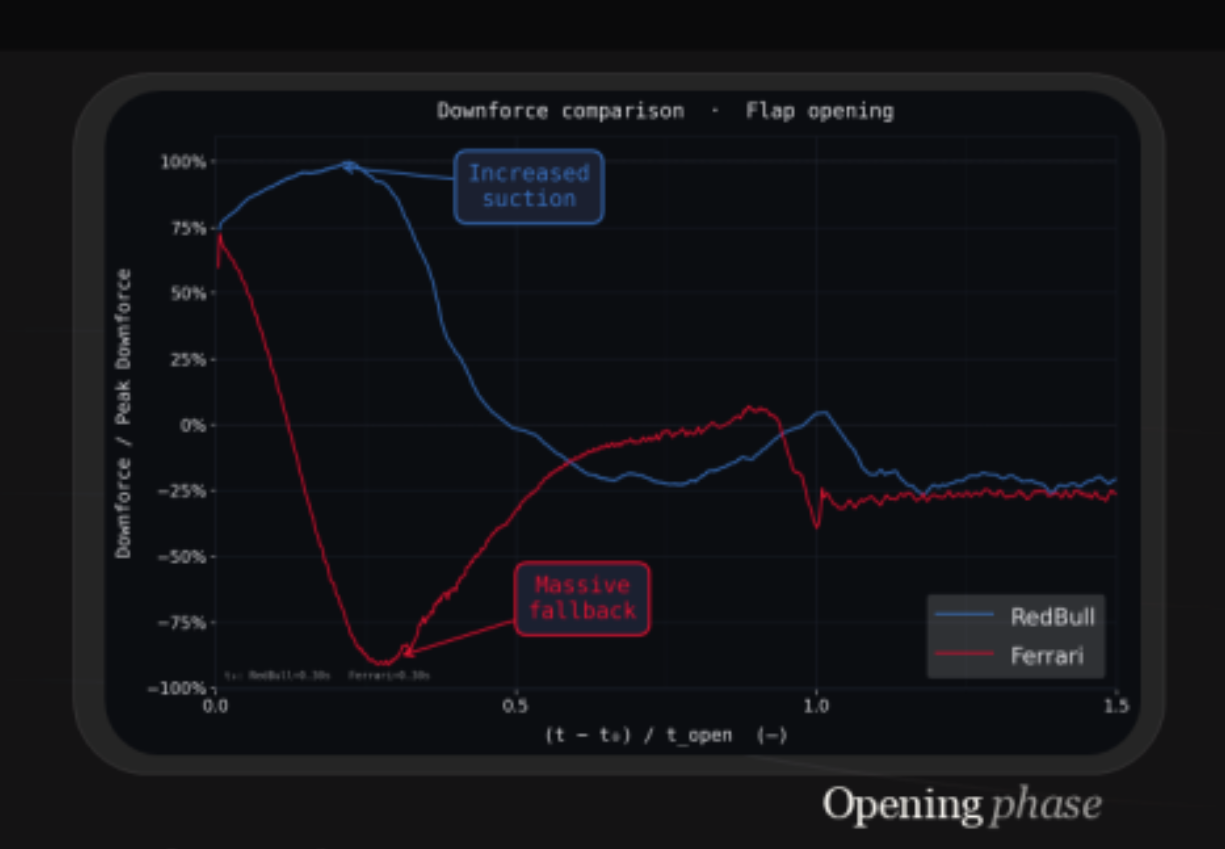
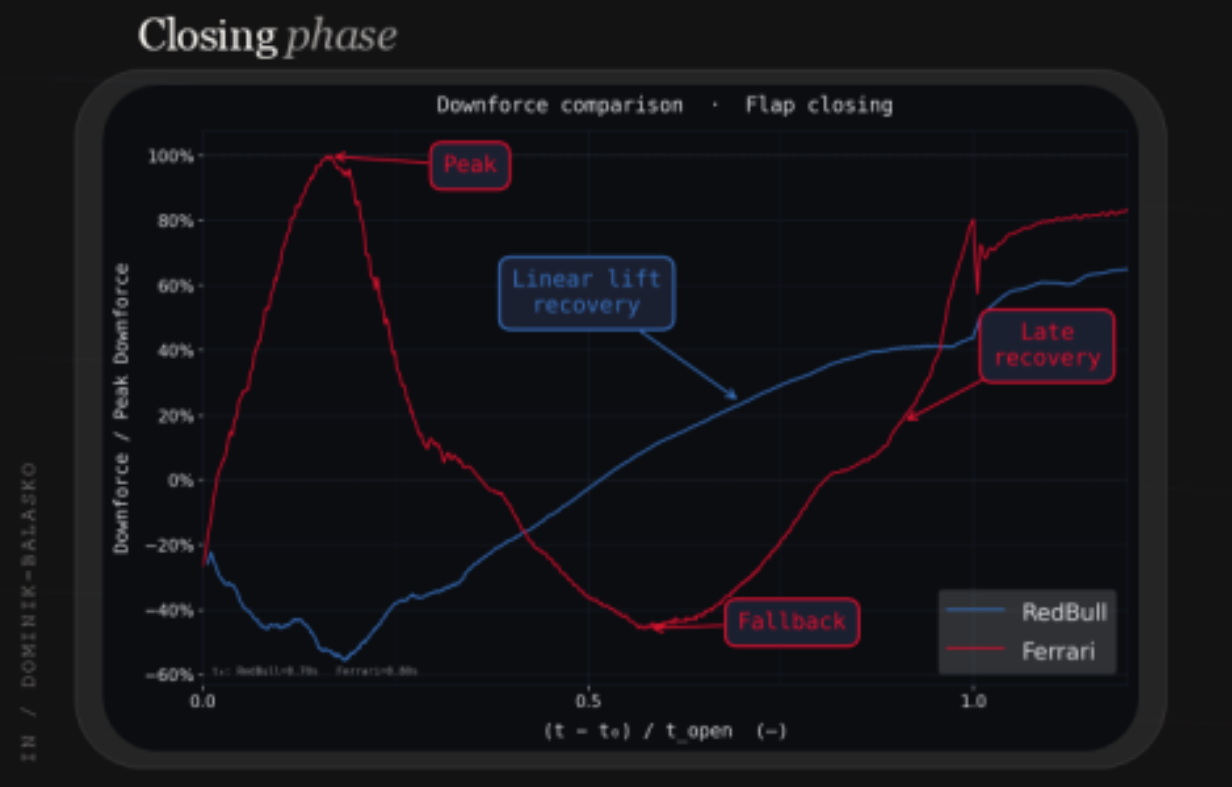
Just to close the loop on this discussion. Balaskó Dominik, a CFD specialist, conducted simulations comparing the pressure recovery of the Red Bull and Ferrari style wings. The tldr was Red Bull faster downforce recovery (in theory...AR3-GP wrote: ↑09 May 2026, 16:11The flaps are generating the upwash. The colors are showing velocity, not pressure. Remeber Newton's third law. As long as the high pressure side should turn the airflow upwards, you will get an equal and opposite reaction force downwards in Red Bull's case. Ferrari's wing will do the opposite. It will generate lift at this point. That's why Red Bull's wing is faster restoring the load.nico5 wrote: ↑09 May 2026, 16:06This graph is totally irrelevant bc that tests progressive separation, not reattachment. Having a flat flap with a massive high pressure area right behind and above the mainplane will hardly result in any upwash as you can see from your very CFD you brought up.AR3-GP wrote: ↑09 May 2026, 14:16
A separated wing still produces downforce as long as it has a positive angle of attack (like Red Bull). That is because it is still redirecting flow upwards on the top surface, even if the lower surface is separated. This figure for a generic wing shows that Red Bull's wing would start picking up downforce very early even before the flow becomes fully attached. The video in the tweet also shows that. Ferrari's wing is rotating through a negative angle of attack for most of the rotation. This means it cannot generate downforce until it's almost fully closed.
https://i.sstatic.net/epvLD.png
You only get SOME reattachment when the flap is 95+% closed.
https://i.imgur.com/xuel7ES.png
https://i.imgur.com/ppNWiUF.png
https://i.postimg.cc/QtjJdd9t/image.png
https://i.postimg.cc/ZKm4KkVT/image.png
All of this happens before the airflow becomes attached. Stick your hand out of your car window at angles the next time you're out. Report back here what happens.
 ), but Ferrari with potential for greater drag reduction due to the greater interaction of the wing with the diffuser upwash.
 https://www.linkedin.com/posts/dominik- ... 23456-dX8wRed Bull debuted their Macarena-style flipping rear wing in Miami — and the architecture tells a different story to Ferrari’s.
What they share:
Both deploy trailing-edge-first. The goal: exploit the deployed position aerodynamically, not just reduce drag.
Where Ferrari extracts more:
Ferrari’s endplate actuation places the flap rearward into the diffuser upwash at full deployment. The flap curves that upwash into a forward-inclined lift vector — an active aero gain, not just camber-change drag relief. Red Bull’s centred actuation keeps the flap forward of that corridor. The gain is drag reduction, not lift generation.
Where Red Bull has the advantage:
Ferrari actuates from one endplate only. That’s a massive torsional load across the full flap span — asymmetric, structurally demanding, and a real weight penalty. Red Bull’s central mount is symmetric, lighter, and allows significantly faster opening and closing.
The aero behaviour on closing reflects that too. Ferrari’s flap only re-enters the slot gap suction region late in the closing stroke — delayed reattachment, wide hysteresis loop, slow downforce recovery. Red Bull’s closing sequence tells a different story:
• Slot gap suction re-established from the start of the stroke
• Partial attachment present early → lift builds linearly through the return
• Smooth, predictable downforce recovery with no step-change in loading
In practice: more consistent aero loading on corner entry, directly influencing trail-braking margin and rear stability under rotation.
My take?
Red Bull likely won’t match Ferrari’s peak straight-line delta. But a lighter, faster actuation system combined with linear lift build-up through the closing stroke means more consistent performance lap-to-lap — and in a race environment, that’s often the more valuable commodity.
Not a compromise. A deliberate trade-off — peak gain for aerodynamic consistency.


Max would beg to disagree?AR3-GP wrote: ↑07 Jul 2026, 16:46Just to close the loop on this discussion. Balaskó Dominik, a CFD specialist, conducted simulations comparing the pressure recovery of the Red Bull and Ferrari style wings. The tldr was Red Bull faster downforce recovery (in theory...AR3-GP wrote: ↑09 May 2026, 16:11The flaps are generating the upwash. The colors are showing velocity, not pressure. Remeber Newton's third law. As long as the high pressure side should turn the airflow upwards, you will get an equal and opposite reaction force downwards in Red Bull's case. Ferrari's wing will do the opposite. It will generate lift at this point. That's why Red Bull's wing is faster restoring the load.nico5 wrote: ↑09 May 2026, 16:06
This graph is totally irrelevant bc that tests progressive separation, not reattachment. Having a flat flap with a massive high pressure area right behind and above the mainplane will hardly result in any upwash as you can see from your very CFD you brought up.
You only get SOME reattachment when the flap is 95+% closed.
https://i.imgur.com/xuel7ES.png
https://i.imgur.com/ppNWiUF.png
https://i.postimg.cc/QtjJdd9t/image.png
https://i.postimg.cc/ZKm4KkVT/image.png
All of this happens before the airflow becomes attached. Stick your hand out of your car window at angles the next time you're out. Report back here what happens.
https://www.linkedin.com/posts/dominik- ... 23456-dX8wRed Bull debuted their Macarena-style flipping rear wing in Miami — and the architecture tells a different story to Ferrari’s.
What they share:
Both deploy trailing-edge-first. The goal: exploit the deployed position aerodynamically, not just reduce drag.
Where Ferrari extracts more:
Ferrari’s endplate actuation places the flap rearward into the diffuser upwash at full deployment. The flap curves that upwash into a forward-inclined lift vector — an active aero gain, not just camber-change drag relief. Red Bull’s centred actuation keeps the flap forward of that corridor. The gain is drag reduction, not lift generation.
Where Red Bull has the advantage:
Ferrari actuates from one endplate only. That’s a massive torsional load across the full flap span — asymmetric, structurally demanding, and a real weight penalty. Red Bull’s central mount is symmetric, lighter, and allows significantly faster opening and closing.
The aero behaviour on closing reflects that too. Ferrari’s flap only re-enters the slot gap suction region late in the closing stroke — delayed reattachment, wide hysteresis loop, slow downforce recovery. Red Bull’s closing sequence tells a different story:
• Slot gap suction re-established from the start of the stroke
• Partial attachment present early → lift builds linearly through the return
• Smooth, predictable downforce recovery with no step-change in loading
In practice: more consistent aero loading on corner entry, directly influencing trail-braking margin and rear stability under rotation.
My take?
Red Bull likely won’t match Ferrari’s peak straight-line delta. But a lighter, faster actuation system combined with linear lift build-up through the closing stroke means more consistent performance lap-to-lap — and in a race environment, that’s often the more valuable commodity.
Not a compromise. A deliberate trade-off — peak gain for aerodynamic consistency.
https://media.licdn.com/dms/image/v2/D4 ... S5vhIY_RdQ
But the conclusions from the study depend on the real world designs replicating the motions from simulation. Red Bull for the moment have an unreliable actuation mechanism, so the theory of having faster pressure recovery is ironically voided if the mechanics fail to close the wing fully: viewtopic.php?p=1349167#p1349167
AR3-GP wrote: ↑07 Jul 2026, 16:46But the conclusions from the study depend on the real world designs replicating the motions from simulation. Red Bull for the moment have an unreliable actuation mechanism, so the theory of having faster pressure recovery is ironically voided if the mechanics fail to close the wing fully: viewtopic.php?p=1349167#p1349167
