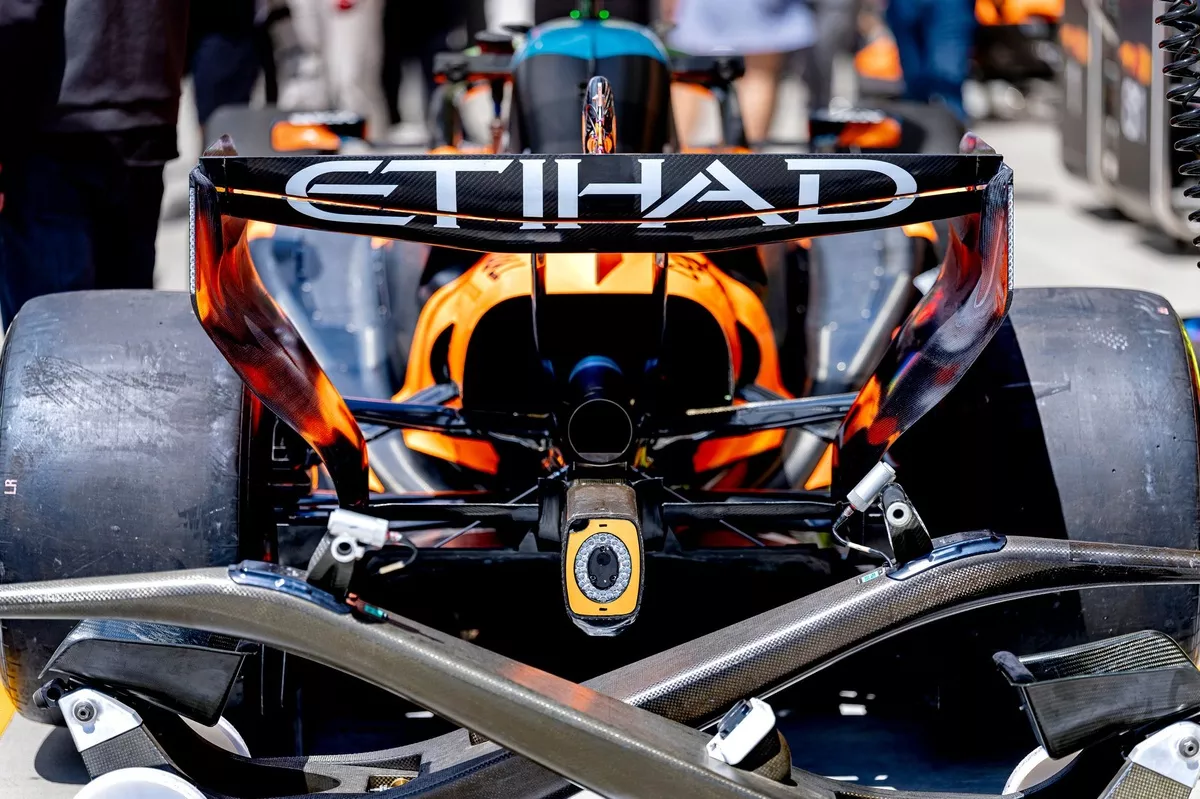
A very nice article on McLaren new RW rotating wing:
https://it.motorsport.com/f1/news/f1-mc ... /10841610/
McLaren debuted its own experimental version of the folding wing, retaining a central actuator but featuring a three-lever system with kinematics as complex in operation as it is ingenious. However, as with Ferrari, when the wing is deployed, the tips remain connected to the endplate to reduce turbulence.
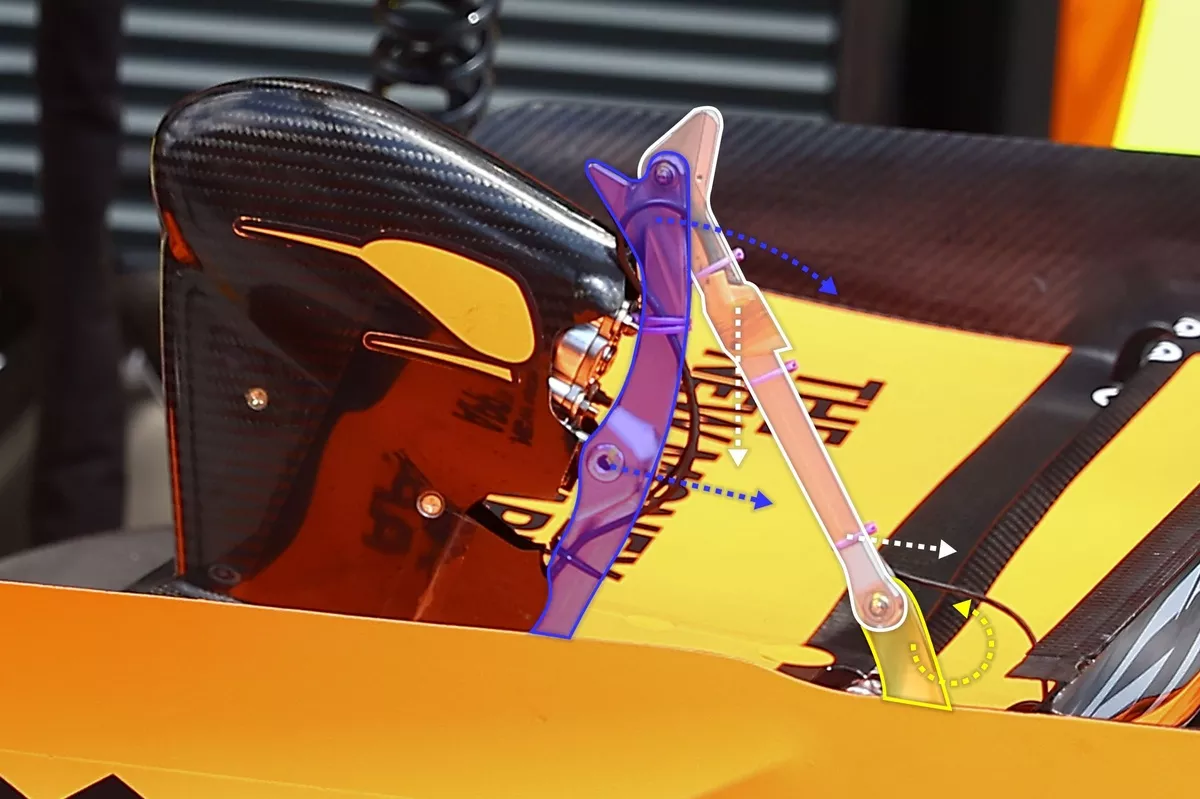
The curious aspect is that, while the Ferrari and Red Bull folding wings have nothing in common, neither the direction of rotation nor the methods by which the movement occurs, the solution developed by the Woking team seems to recall some principles of both, only to differentiate itself through its own choices, very refined and sophisticated in their application.
The Woking-based team's engineers chose not to integrate the actuator into the endplate, as is done on Ferrari's "Macarena." Instead, they opted to maintain a central control that, through a complex and ingenious lever system, allows the two flaps to rotate into the folded position.
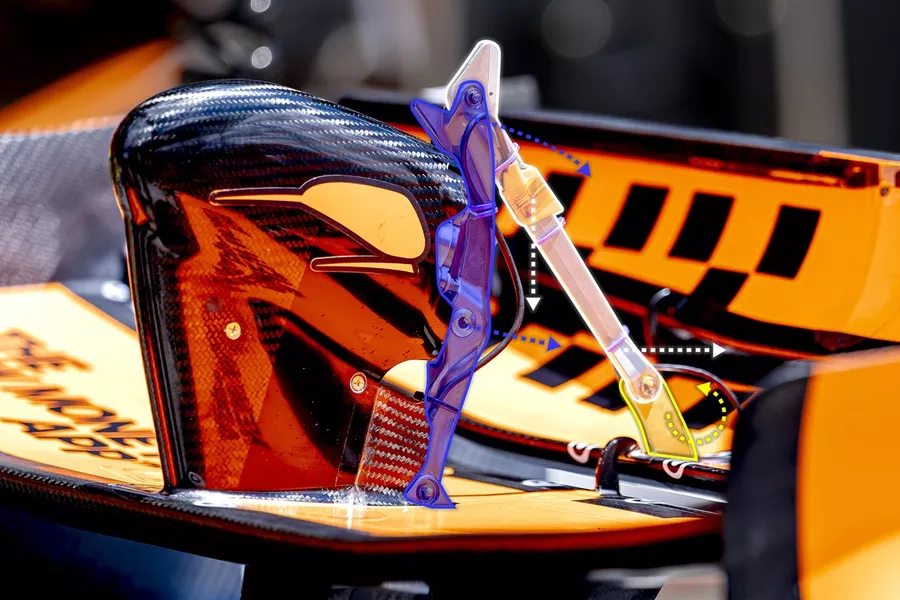
In short, rotation occurs when the wing flips backwards, like on the RB22, but interestingly, the Woking engineers chose not to also lift the outer edge when the wing opens. This reduces the turbulence that occurs when the outer corners are exposed, unlike the Red Bull, which uses a complex system of lateral pivots that also flip.
On the McLaren, however, the lateral pivots on which rotation occurs are more traditional: two free elements located at the ends of the upper flap, on which the mobile wings can rotate, accompanied by the movement of the hydraulic actuator. This choice allows the tips to be kept very close to the endplates, limiting the formation of turbulence that normally increases when the outer areas of the wing are exposed.
Even more interesting, however, is the operation of the central actuator chosen by McLaren. While Red Bull uses a sturdy metal structure that houses the control and connects directly to the pivot that, as it rotates, raises the wing, the engineers in Woking have adopted a completely different approach: three levers connected by pivots that allow them to tilt and rotate freely. A sophisticated solution, it allows for the desired movement with more complex kinematics.
When the movable wing is activated, the first lever ( in blue) is pushed by a small piston that extends from the actuator until it reaches an inclination of approximately 45°. The second lever, the white one, moves accordingly and extends to a nearly horizontal position . Finally, the third lever, in yellow, connected to the first movable flap from the bottom, rotates upward , forming almost a right angle with the second lever.
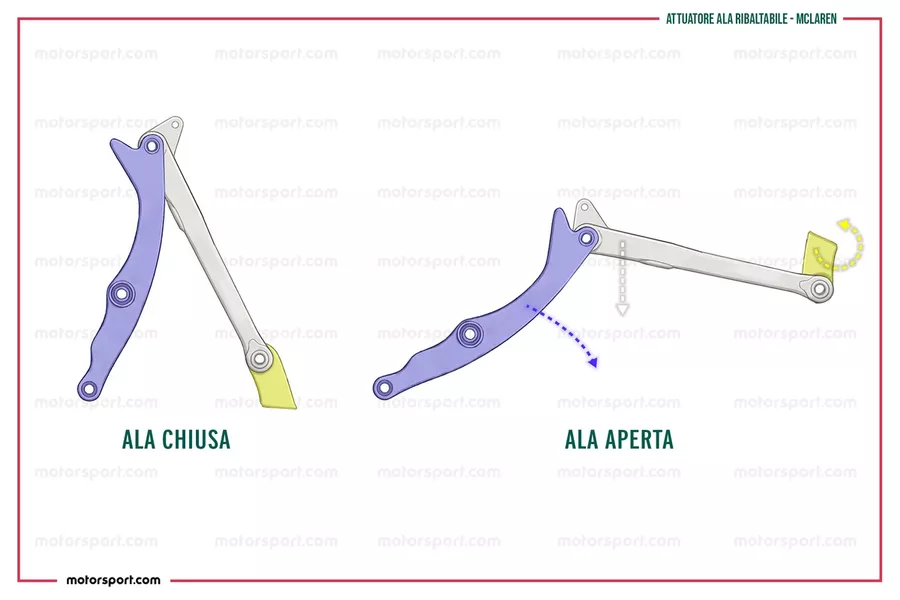
In short, the last lever in yellow is the one that physically "lifts" the flaps and supports them , assuming a vertical position . With this solution, the pivot points are not attached to a fixed structure as in the case of Red Bull, which in fact had to build a "cage" to house the system, but the levers themselves act as load-bearing elements, likely saving some weight as well. A very complex, but also extremely ingenious system.