DEVELOPMENT CORNER: Who is still continuing to upgrade its car?


Although the 2025 F1 season is nearing its conclusion, there are a limited number of teams that are still developing their cars. F1Technical's senior writer Balazs Szabo reveals who has brought upgrades to last weekend's Austin F1 race.
With the current season approaching its final leg and the major technical overhaul set to arrive in just a few months' time, it is not surprising that the majority of the field has long shifted its focus to the development of the all-new 2026 cars.
The past weeks saw Red Bull introduce a floor upgrade (Monza) and a front wing upgrade (Singapore), while Mercedes also brought some tweaks to the W16's front wing at the Marina Bay Circuit.
The Brackley-based outfit, which finds itself in a fierce battle with Red Bull and Ferrari for the second place in the constructors' championship, brought further upgrades to last weekend's United States Grand Prix, while Haas also introduced new parts on its car on home soil.
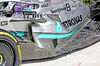
As for Mercedes, one small update to the W16 arrived in Austin. The Brackley-based outfit introduced a a small revision to the rear corners. The camber of the upper lip of the top wishbone on the suspension has reduced to improve local flow quality. The winglet span has been reduced to increase tyre clearance.
"Upper lip camber reduced to improve local flow quality around top wishbone, and winglet span reduced to increase tyre clearance," noted Mercedes.
Elsewhere, F1's sole American outfit, Haas brought a whole new floor to Austin. The American team revealed that it changed the expansion rate on the main floor, made tweaks to the fences and reduced the floor edge wing in size.
"The upgrade builds on the R12 [Silverstone] upgrade by refining the floor fences and outboard edge to increase aerodynamic load, with a focus on high-speed corner performance”.
The new floor also prompted Haas to optimalize the rear corner winglet. In addition to that, the Amerincan team introduced a revision to the mirror stay "to improve flow alignment."