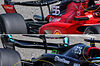
F1TECH: How has Ferrari upgraded its SF26 at Barcelona?

Ferrari arrived at the Barcelona‑Catalunya Grand Prix with one of its most substantial development packages of the season, unveiling a heavily revised SF‑26 that features changes across the front wing, nose, floor, diffuser and sidepods.
Lewis Hamilton delivered a commanding and emotionally charged first victory for Ferrari last time out at the Barcelona-Catalunya Grand Prix, converting bold strategy, relentless pace and flawless execution into a landmark triumph for the Scuderia.
While Hamilton celebrated a breakthrough that instantly entered Ferrari folklore, his team-mate Charles Leclerc endured a painful afternoon. The Monegasque made an excellent start from P10, climbing to seventh and overtaking Oscar Piastri as he began to carve his way forward.
He then spent much of the race locked in combat with Max Verstappen, showing competitive pace and the potential to fight for a strong points finish. But late in the race, his hopes evaporated when a power‑steering issue forced him to retire — his second consecutive race without seeing the chequered flag.
Despite his disappointing race at Barcelona, Leclerc was left to praise Ferrari for the upgrade package the Scuderia introduced in Montmelo.: "Our team should be proud of the upgrades we brought to the car, which ramped up our performance to this level."
But what did Ferrari bring to the second European race of the season which enabled Hamilton to dominate the last third of the 66-lap Barcelona round?
New front wing, floor, sidepods and diffusorThe Italian marque introduced an all‑new front wing and nose assembly, a redesign aimed at improving aerodynamic balance and enhancing the car’s Straight Mode (SM) functionality.
According to the team’s technical documentation, the front wing features a revised footplate, new vane arrangements, an added endplate diveplane and a re‑optimised spanwise loading distribution across the elements.
The SM mechanism has been re‑engineered with new links integrated into a reshaped nose, whose raised lower surface is intended to clean up the centreline airflow. Ferrari expects this to deliver improved front‑wheel wake control, greater aero‑balance range and more stable tip‑flow behaviour, all of which should help the SF‑26 generate a more predictable platform in both low‑ and high‑speed corners.
"Evolution of the front wing platform raced so far, with enhanced tip flow features coming with front wheel wake control benefits as well as increased aero balance capacity. More integrated SM mechanism links returns tidier centre line flow features. It also comes with flap lips modulation."
Updates to the floor and diffusorThe floor has also undergone a comprehensive overhaul. The team has reduced keel volume, redesigned the front floor leading‑edge profiles and claws, optimised both horizontal and vertical floorboard elements, and reprofiled the diffuser sidewall cut‑out.
The diffuser itself features a revised winglet angle of attack and a reworked expansion profile. Ferrari’s engineers describe the update as a global load‑generating package, designed to improve onset‑flow quality, increase downforce across the car’s operating window and enhance flow robustness, particularly towards the rear corners.
"Benefiting from an improved onset flow quality, this entire floor update is targeting overall aerodynamic load increase across the main car operating window as well as flow features robustness improvements together with improved flow topology and energy towards the rear corners."
Upgraded sidepodsTo complement the new floor geometry, Ferrari has also introduced reworked sidepods with an inflated shoulder and adapted cokeline.
This reshaping manipulates the front‑wheel wake in conjunction with the floorboard update and helps rebalance the front‑floor pressurisation, ensuring the new underbody operates as intended.
"This geometry has been developed in conjunction with the floor update and manipulates front wheel wake together with the floor board update, as well as the rebalancing the front floor pressurisation," Ferrari explain