F1TECH: The secret test items Ferrari tried out on the opening day in Austria

Ferrari has arrived at the Austrian Grand Prix with an unusual development programme, continuing the refinement process that began with the team’s major aerodynamic overhaul in Barcelona.
While the Scuderia has brought four updated components to Spielberg, only one of them—the revised front wing—will be raced throughout the weekend.
The remaining items, consisting of a modified floor board, new mirror stays and changes to the RV tail, are strictly correlation tools intended for data gathering during free practice.
The four items for Spielberg
The headline change is the updated front wing endplate, which represents an evolution of the geometry introduced at the previous round.
Ferrari has refined the diveplane and footplate vane arrangement, consolidating the aerodynamic intent of the Barcelona specification.
The team describes this as a further step in stabilising the flow structures generated at the front of the car, improving local load and ensuring that the wing continues to feed the floor and sidepod undercut with consistent, well‑managed airflow. This is the only component that will remain on the car for qualifying and the race.
The other three updates are part of a broader correlation programme designed to improve the team’s understanding of how its aerodynamic surfaces behave on track.
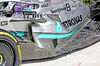
The modified floor board features optimised front elements and a simplified single vertical member, allowing Ferrari’s engineers to compare real‑world behaviour with wind‑tunnel and CFD predictions.
Similarly, the revised mirror stay—shorter and connected differently to the sidepod—was run to map the influence of small structural changes on the airflow around the upper sidepod and cockpit region. Both items are strictly data‑gathering tools and will not be used beyond free practice.
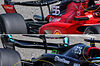
The most notable test item, however, is the modified RV tail and tailpipe assembly. Ferrari experimented with the removal of the central RV tail element, a configuration that Dino Beganovic evaluated during FP1 while driving Charles Leclerc’s car.
This test is particularly relevant because the additional winglet above the tailpipe—an innovative Ferrari solution that generates extra local load and improves rear‑wing feeding—will be banned from 2027.
Running without it allows the team to understand the aerodynamic and engine‑related consequences of its removal. While the vane provides a measurable aerodynamic benefit, it is believed to reduce back‑pressure, potentially costing engine performance.
The revised overlap between the tailpipe exit and its supporting bracket, as described in the team’s documentation, is intended to extract more local load within the limits of the regulations while enabling Ferrari to gather data for future layouts.