F1TECH: What did we learn from the debut of Aston Martin's B-spec F1 car?

Aston Martin introduced the most comprehensive upgrade package seen so far during the 2026 Formula 1 season at the Hungarian Grand Prix, unveiling what is effectively a B-spec version of its AMR26 challenger.
Although the new package suffered an early reliability setback during its track debut, technical chief and team principal Adrian Newey believes the initial signs are encouraging.
The upgraded car made its first appearance during Friday's opening free practice session at the Hungaroring. Fernando Alonso completed the majority of Aston Martin's running and finished 13th fastest, while Lance Stroll's session ended prematurely after just 11 laps following a suspected rear suspension failure.
Despite the interruption, Newey was positive about the first data gathered from the new package: "Very early days in terms of understanding the new package. Provisional results are promising," Newey said after the session.
The Briton emphasized that the Hungarian upgrade is only the first phase of Aston Martin's development programme.
"It's only part of the package. We will have some more steps in Zandvoort, Monza and Baku, so it is the first part of our planned upgrade. Very short on parts so being careful with it and trying to learn all about it."
A fundamentally revised AMR26Although Aston Martin has retained the existing chassis, suspension layout and overall architecture, the aerodynamic package has undergone a major redesign.
The FIA's official submission lists no fewer than 16 updated components, making it one of the largest single-step development packages introduced under the 2026 regulations.
Newey described the philosophy behind the project:"It's an evolution in as much as the chassis is the same, the layout's the same, front suspension's the same. So, it's very much an aerodynamic evolution."
He explained that the team deliberately took a step back after the opening races to better understand the car before committing to such a significant redesign.
"We were very short on research time prior to the launch of the car back in Barcelona in February. So, it's really been a matter of taking a step back, trying to understand, and go forward with this package."
The team in the garage worked incredibly hard to get both cars ready for FP1.
— Aston Martin Aramco F1 Team (@AstonMartinF1) July 24, 2026
All planned upgrades were delivered on schedule and fitted to the cars. Work will continue throughout the weekend to refine the package and optimise the performance of both cars.#HungarianGP pic.twitter.com/akKkY0ahLh
The upgrade package touches virtually every aerodynamic area of the AMR26.
At the front of the car, Aston Martin has introduced a completely revised front wing featuring a new front-view geometry and planform with redistributed chord to improve front-end load.
The front wing endplates have also been redesigned with updated bodywork, diveplanes and foot geometry, while the nose has become longer and slimmer to better integrate with the new wing concept.
The front brake duct assembly has also been revised through modifications to the external elements, including a redesigned lip and longer rear deflector. These changes work together with the new front wing package to better manage airflow around the front wheels.
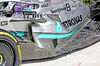
The floor has received perhaps the most extensive development. Engineers have revised all permitted floor surfaces, introduced new leading-edge fences, modified the floor edge around the footplate and the area ahead of the rear tyres, and redesigned the diffuser, including its main body, fences and winglets.
Collectively, these changes are intended to increase the amount of downforce generated by the floor while improving overall aerodynamic efficiency.
The bodywork has also evolved significantly. Aston Martin has reshaped the sidepod inlets to improve airflow feeding the rear of the car, accompanied by subtle revisions to the engine cover. Updated cooling louvres provide additional flexibility for managing cooling requirements under different circuit conditions.
At the rear, the package includes revised rear suspension leg positions and external fairings, together with updated rear brake duct geometry. Aston Martin has also modified the rear corner aerodynamics through changes to the inlet, outlet and vane arrangement.
The rear wing itself has been redesigned with a redistribution of chord across its three elements and the addition of winglets on the flap trailing edge.
According to Aston Martin, the new configuration is intended to generate higher cornering-mode downforce while simultaneously reducing drag in straight-line mode. Complementing these changes are a revised beam wing twist distribution and completely redesigned rear wing endplates.
The only major issue during the debut came when Stroll's car stopped with what Aston Martin believes was a rear suspension failure.
Newey stressed that the incident appears unrelated to the newly introduced components: "Everybody is feverishly trying to understand what went wrong and it is only once we have an understanding that we can comment on what we do next. The area involved is not what has been changed, so in that sense it was very unexpected."
Managing expectationsAlthough the scale of the upgrade naturally raises expectations, Newey was careful not to predict immediate results. Instead, he reiterated his long-standing philosophy of focusing on solving engineering problems rather than chasing performance targets.
"I've never been a fan of setting goals. Much more a fan of working logically through problems, getting everybody working together, getting a culture together, and then at that point, you end up where you end up."
He concluded with a reflection drawn from decades in Formula 1: "What I have found over the years is when you're not winning, it seems an impossible mountain to climb.
"When you are winning, sometimes you're not sure how you got there, because you're not actually doing anything different, or you don't feel as if you're doing anything different."
With additional upgrade packages already planned for Zandvoort, Monza and Baku, Aston Martin views the Hungaroring package as the first major step in a longer-term development programme.