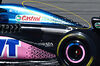
Things to know about the the hexagonal pattern that will sport Aston Martin's livery in Monaco

Aston Martin has arrived in Monaco with a one-off colour‑shifting livery that will make sure that the AMR26 will appear to change colour corner by corner.
In partnership with Principal Partner Maaden, one of the world’s fastest‑growing mining and metals companies, the team has unveiled a Monaco‑only design that attempts nothing less than to visualise the entire journey of civilisation: from the raw, unyielding rock beneath our feet to the pinnacle of engineered performance on the world’s most glamorous street circuit.
From Rock to RacetrackThe campaign title, From Rock to Racetrack, is almost modest compared to the ambition of the design itself. The livery uses a specialist colour‑shifting wrap material — a satin‑finish vinyl that refracts light like a mineral pulled fresh from the earth.
As the AMR26 threads through Monaco’s tight corners, the car will appear to change colour corner by corner, moment by moment, as if the machine is undergoing metamorphosis in real time.
Maaden’s identity is built on transformation — on turning raw materials into infrastructure, innovation, and progress.
Aston Martin’s Monaco livery takes that idea and amplifies it into spectacle: gold, copper, aluminium, and iron tones woven into a shifting skin that refuses to stay still, even when the car is stationary.
A Livery designed to defy stillnessThe wrap material is inspired by Andromeda Red, the exclusive colour‑shifting paint used on Aston Martin’s Valour and Valhalla hypercars. But on a Formula One car — a machine that slices through air at 300 km/h — the effect becomes something else entirely.
The AMR26 will appear one colour on corner entry and another on exit, as though the car is shedding layers of itself with every metre travelled.
The team describes it as an “immersive and interactive visual experience,” but that undersells the drama. This is a livery that refuses to be captured, refuses to be defined, refuses to be anything less than a moving sculpture.
Behind the spectacle lies a staggering amount of technical and creative labour. Applying a specialist wrap to a Formula One car is not like wrapping a road car. Every gram matters. Every raised edge risks aerodynamic disturbance. Every additional layer threatens performance.
The team could not simply cover the car in iridescent material. They had to choose their moments — selecting areas where the wrap would not compromise airflow, weight distribution, or heat management. Even the usual protective lamination had to be abandoned, because it would dull the colour‑shifting effect.
A lattern that creates illusionsOne of the defining features of the livery is the hexagonal pattern inspired by the Maaden icon. It creates a seamless transition between Aston Martin Racing Green, exposed carbon, and the iridescent wrap — but it also solves a practical impossibility.
More than 100 pattern variations were tested. Around 30 full visual concepts were explored.
Custom software was developed to generate hexagonal transitions that would behave correctly across the AMR26’s complex surfaces. Virtual Monaco simulations were run to study how the colours would shift under real‑world lighting.