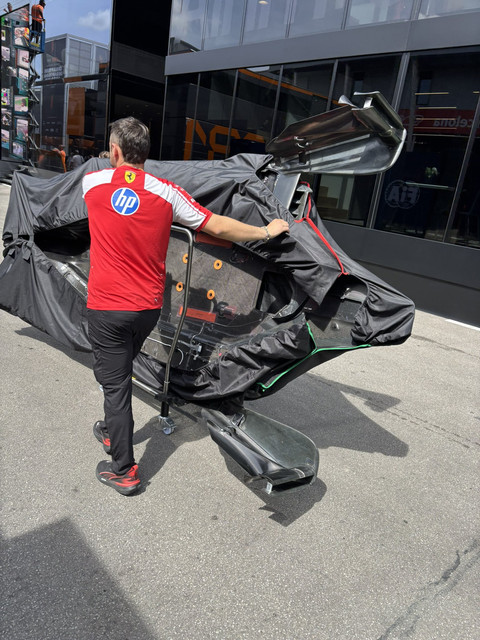
Carbone Industrie brakes fitted to Charles' car

- Login or Register
No account yet? Sign up

George Russell claimed his first Formula One sprint race win at the 2026 Chinese Grand Prix, maintaining his perfect start to the season after a closely fought contest that highlighted both Mercedes’ strengths and the evolving competitive order under the 2026 regulations.


I think I have to correct you with this notion that people have the the electrical "mystery box" is accounting for power differences. This is not so and is far from the truth... But it may be lost on persons just joining the sport.CRazyLemon wrote: ↑10 Jun 2026, 09:37What you see on track isn't just ICE alone, otherwise if the tests are to believed you'd see RBPT outperforming the Mercedes on the straights as well.gearboxtrouble wrote: ↑10 Jun 2026, 01:29That just not possible. We're talking ~50hp assuming 575-600 for the RBPT. I don't think it is realistic that Ferrari would be that far behind. Based on the (limited) wheel to wheel action we've seen between a RBPT engined car and a Ferrari engined car the RBPT car does seem faster down the straights but its not that level of gap. Either the FIA has messed up the test in a way thats overrating the RBPT engine or RBPT are running it below its potential for reliability reasons.
If you are delivering more ICE power it means you can harvest more if you so choose, that would make any pure ICE grunt advantage look like less of a difference.
Anyway Mercedes getting ADUO means RBPT must be extremely inefficient on the electrical side that they're getting trounced engine wise by Mercedes.
Charles is playing with fire here... Not sure he's the experimenting type of driver to do this..

They have information far far in excess of most in this respect. Add to that the deployment profile it seems already established in LH chassis and live use (if report is correct on this topic) then certainly not a shot in the dark.gearboxtrouble wrote: ↑11 Jun 2026, 03:44Changing brakes on a race car is a massive risk even for amateurs racing weekend track days. So much depends on pedal feel and just knowing where the ABS (not in f1) and traction limits are without locking that even an on paper upgrade can make you slower. Hopefully he tries it in FP1 and FP2 has a plan B to go back to the devil he knows (Brembo) for FP3 and quali if its not working the way the thought.
Ferrari insists on a 'hot' engine. The photo taken by AG Foto in the Barcelona garages is as eloquent as ever: the heat exchanger on the SF-26 is less than half the size of Red Bull's. On both cars, the designers have placed the intercoolers above the turbocharged 6-cylinder engine, but the large difference in the volume of each component is striking
The Scuderia, as we had the opportunity to anticipate, has homologated the 067/6 engine, which is able to operate with an intake air temperature of around 100 degrees, while all other units run at values between 60 and 80 degrees.
At Maranello, they developed this innovative concept thanks to the steel alloy cylinder head which, compared to aluminium, is capable of operating with a combustion chamber pressure significantly higher than the competition. The project carried out by Enrico Gualtieri's team is very bold, as well as revolutionary. It is a development path that will not be abandoned with the upgrades that will be brought to the track through the ADUO (Additional Development and Upgrade Opportunities).
According to rumours, the engine that should make its debut at the Austrian GP with the first upgrade permitted by the FIA will significantly increase the temperature of the air entering the intercooler: figures of between 110 and 115 degrees are being mentioned. The goal, in fact, is to improve combustion chamber efficiency by halving the power gap compared to the reference unit: for Maranello, that is the Mercedes W17 E Performance engine, while according to FIA data the most powerful internal combustion engine would be the Red Bull Powertrains Ford DM01.
Either way, on both fronts the gap is around 25 horsepower, and the hope is to reduce the difference to no more than 10 horsepower — to be potentially closed with the second ADUO upgrade — provided the governing body doesn't change its mind following Red Bull's repeated protests, as they do not consider themselves the benchmark at all, given they are running an engine in its debut season in F1.
Ferrari, being able to exploit the characteristics of the 'hot' engine, has made significant concessions to the chassis and aerodynamics teams: the cooling system, requiring less heat exchange to stay within safe reliability ranges, has been designed with smaller radiating masses, which help enable more aggressive aerodynamic shapes. The SF-26 is the only car to feature a triangular airbox without the ears on the sides of the roll hoop."
The FTM system with the flap that allows the hot exhaust gases to be blown also benefits from the advantages provided by the steel alloy head: with the 'plug' active, around 7 horsepower are lost, but the drop in power must be adequately compensated by the increased aerodynamic downforce generated through improved rear wing efficiency and extraction of air from the diffuser.
Here you go! Some quote from both drivers. Charles is definitely learning from lewis, you can't be quiet when change is needed. He needs to speak up. Lewis has brought the steering wheel and now brakes to Ferrari. I am sure it wasn't easy knowing how Ferrari operatesPlatinumZealot wrote: ↑11 Jun 2026, 03:11Charles is playing with fire here... Not sure he's the experimenting type of driver to do this..
I am still not convinced that Brembo isn't the sole supplier to Ferrari. These photos don't prove anything because the disks are quite similar nowadays.
In the 2010's they had telling hole patterns... But i don't think this is the case today.