F1TECH: How has Ferrari upgraded its SF26 at Barcelona?

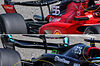
Ferrari arrived at the Barcelona‑Catalunya Grand Prix with one of its most substantial development packages of the season, unveiling a heavily revised SF‑26 that features changes across the front wing, nose, floor, diffuser and sidepods.
The Italian marque introduced an all‑new front wing and nose assembly, a redesign aimed at improving aerodynamic balance and enhancing the car’s Straight Mode (SM) functionality.
New front wing, floor, sidepods and diffusorAccording to the team’s technical documentation, the front wing features a revised footplate, new vane arrangements, an added endplate diveplane and a re‑optimised spanwise loading distribution across the elements.
The SM mechanism has been re‑engineered with new links integrated into a reshaped nose, whose raised lower surface is intended to clean up the centreline airflow. Ferrari expects this to deliver improved front‑wheel wake control, greater aero‑balance range and more stable tip‑flow behaviour, all of which should help the SF‑26 generate a more predictable platform in both low‑ and high‑speed corners.
The floor has also undergone a comprehensive overhaul. The team has reduced keel volume, redesigned the front floor leading‑edge profiles and claws, optimised both horizontal and vertical floorboard elements, and reprofiled the diffuser sidewall cut‑out.
The diffuser itself features a revised winglet angle of attack and a reworked expansion profile. Ferrari’s engineers describe the update as a global load‑generating package, designed to improve onset‑flow quality, increase downforce across the car’s operating window and enhance flow robustness, particularly towards the rear corners.
To complement the new floor geometry, Ferrari has also introduced reworked sidepods with an inflated shoulder and adapted cokeline. This reshaping manipulates the front‑wheel wake in conjunction with the floorboard update and helps rebalance the front‑floor pressurisation, ensuring the new underbody operates as intended.
Back-to-back testsTeam principal Frédéric Vasseur acknowledged the scale of the upgrade and the challenge of evaluating it under Barcelona’s demanding conditions. “We know Barcelona, it’s very difficult to put a lap together in these conditions, but it’s the same for everybody,” he said.
“We had a lot of new elements on the car, new package, different components, which meant we had a lot of back‑to‑back to do. I think it will be difficult in terms of tyre degradation.
"We saw today with all the components that the deg is there, and it’s important. We’ll put more rubber on the track and it will probably reduce a little bit, but it will be difficult, for sure.”
The team also monitored Charles Leclerc closely after recent brake‑system changes introduced post‑Monaco. Vasseur confirmed that the Monegasque adapted well: “It went well. For sure, he needed a couple of laps to accommodate, but he did well. At the end it was okay, no issue.”
Leclerc’s feedback from the cockpit aligned with the team’s expectations, and his pace across both sessions suggested that the revised SF‑26 offers a more stable and predictable platform than in recent rounds.
Taken together, Ferrari’s Barcelona upgrade package represents a holistic aerodynamic rethink rather than a collection of isolated parts. The new front wing and nose aim to stabilise the car’s forward platform and improve SM behaviour; the redesigned floor and diffuser target increased load and flow robustness; and the reshaped sidepods ensure the updated underbody receives the correct airflow structures.
While Friday’s sessions showed that Ferrari still faces a performance gap to McLaren and Mercedes, the early signs indicate that the SF‑26 has taken a meaningful step forward. With more data to analyse overnight and tyre degradation expected to play a decisive role, Ferrari will now focus on extracting the full potential of its new package ahead of qualifying.